
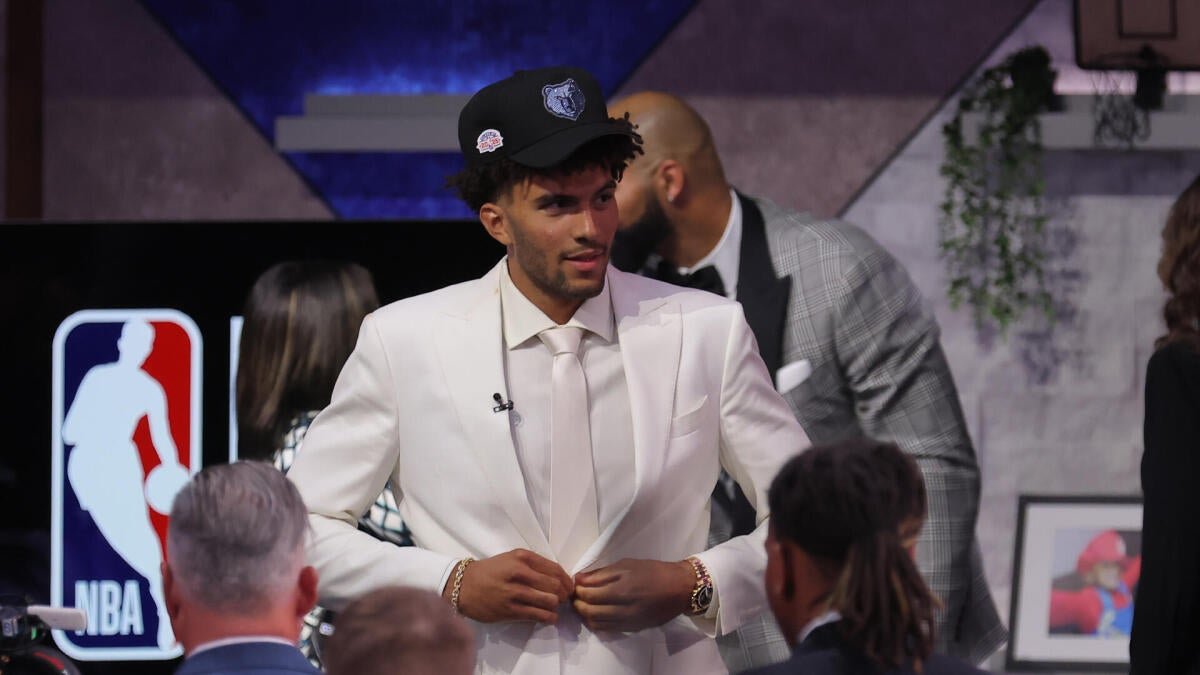
The first round of the 2026 NBA Draft is in the books, and the class that scouts and executives have been circling for years finally has NBA homes.
For all the anticipation around this draft — and there has been plenty — Tuesday night was relatively light on true chaos. There were a few wonky, small-potatoes trades, some movement around the margins and one notable faller in Koa Peat, who slid further than expected before barely saving face as a first-round pick. But the headliner remained the pool itself: a loaded group of prospects headlined by a Big 3 whose potential stardom has been obvious since high school. AJ Dybantsa, Darryn Peterson and Cameron Boozer have long been viewed as franchise-altering talents, and now the real work begins for the Wizards, Jazz and Grizzlies, in that order.
The strength of this draft did not stop there. Caleb Wilson and Keaton Wagler helped give the top five even more star power than expected, while the one-and-done point guard crop — Wagler, Mikel Brown, Darius Acuff and Kingston Flemings among them — gave lottery teams plenty to debate. Brooklyn picking Brown over Acuff will be one of the draft’s defining long-term questions.
2026 NBA Draft team grades: Report cards for all 30 teams after Round 1
Cameron Salerno
As always, these grades are not just a referendum on the player. They are an attempt to evaluate each pick in the proper context: the prospect’s long-term upside, the team fit, the range of outcomes and, in some cases, the resources it took to get into position to make the selection.
With that in mind, here are CBS Sports’ grades for every pick in the first round of the 2026 NBA Draft.
2026 NBA Draft Grades
Round 1

1. Washington Wizards: AJ Dybantsa | BYU | SF
Dybantsa is a prototypical big wing with positional size, length, athleticism, and an elastic build who can score from all three levels and create his own offense almost on demand. He pressures the rim, understands how to get fouled, and is as polished of a scorer as we’ve seen in several draft cycles. He will be a Day 1 scorer in the NBA and yet still has plenty of room to keep taking his game to new levels with the progression of his 3-point shooting, handle, and defense. Dybantsa legitimately has the potential to lead the NBA in scoring one day, but also has to prove that he can consistently impact, and ultimately, drive winning. Grade: A
2. Utah Jazz: Darryn Peterson | Kansas | PG
Peterson is the best fit here and has the higher long-term upside. At Kansas this season we saw a level of shot-making that we did not know existed. Peterson can get to the rim, score at all levels, and is a dynamic shotmaker. He has a chance to be the very best player to come out of this draft. With the frontcourt rebuilt this year, you can slot Peterson very cleanly next to Keyonte George to create Utah’s backcourt of the future. With this move, the Jazz have essentially rebuilt its roster. The hope is that the durability issues from last season are now behind him and he can merge the shot-making we saw at Kansas with the creation we saw in high school. Grade: A
3. Memphis Grizzlies: Cameron Boozer | Duke | PF
Boozer has the highest floor in the draft and an underrated ceiling. Not only can no other player in the field match Boozer’s history of winning or production, but Boozer also has an unmatched overlap of size, skill, physicality, and feel for the game. He’s also very much in line with the type of player that Memphis has prioritized in the draft process in recent years. Memphis can plug Boozer in next to Zach Edey and Cedric Coward and Memphis’ rebuilding project already has their frontcourt of the future figured out. Grade: A+
4. Chicago Bulls: Caleb Wilson | N. Carolina | PF
Wilson was the fairly obvious choice here. He has legit star-type outcome and potential. He’s the most explosive athlete in the draft with a big-time motor and unusual elasticity (or bend) for a player his size. At North Carolina, Wilson was farther along offensively than expected and yet has immense room for progress, not just with his perimeter skill-set, but even his defensive polish. Those tools should check a lot of boxes for new Executive Vice President of Basketball Operations Bryson Graham. Grade: A
5. Los Angeles Clippers: Keaton Wagler | Illinois | PG
Of the four one-and-done freshman point guards, Wagler is the easiest to pair with Clippers’ guard Darius Garland. The positional size and shooting give him on/off ball versatility that would be critical in this context, but it’s his feel for the game and natural instincts that may be his true superpower. Wagler is a natural shooter with versatility to make shots off the catch, dribble, or on the move. He has terrific basketball instincts, high basketball IQ, and a very deliberate pace that prevents opposing defenders from speeding him up. Grade: B+
2026 NBA Draft: Wizards take AJ Dybantsa over Darryn Peterson at No. 1 as top four unfolds without a surprise
Cameron Salerno
6. Brooklyn Nets: Mikel Brown Jr. | Louisville | PG
Brown gives Brooklyn a naturally skilled, high-upside, late-blooming lead guard, whose athleticism is catching up. He’s incredibly skilled, naturally ambidextrous, has complete control of the ball, is a pinpoint passer, and a much better shooter than his numbers showed at Louisville. Brown Makes deep shots in bunches when he gets hot. Excellent left hand too. Very good floor-vision, passing, and ability to make reads coming off of ball-screens. Ranked in the 89th percentile as a pick-and-roll ball-handler. Grown into having positional size at 6-3.5 without shoes, long arms, and newfound athleticism. The concerns are Brown’s lack of strength and physicality. He can hunt high-level plays instead of making the easy one, and he has a history of injuries, which could impact his durability. Brown impressed teams when he met with them face-to-face. Grade: B
7. Sacramento Kings: Darius Acuff Jr. | Arkansas | PG
This is exactly what Sacramento wanted and it didn’t have to trade up to get him. Acuff gives the Kings the type of offensive alpha creator they don’t yet have and he provides a more immediate impact than other players on the board, especially on the offensive end of the floor. Acuff is a shot-creator and multi-level scoring threat. He has the strength, balance, and poise to dictate his own pace and supplements that with extreme confidence to deliver in big games and moments. There are some concerns with his defensive commitment and approach. Size, length, and athleticism are adequate for NBA standards, but not ideal. Grade: A-
8. Atlanta Hawks: Kingston Flemings | Houston | PG
Flemings gives Atlanta a high-level athlete and two-way lead guard with a high floor. Flemings would fit with a defensively oriented young perimeter core in Atlanta, and give them plenty of upside if his shooting proves to be sustainable. What is undeniable is that Flemings is an elite athlete who can get a piece of the paint on demand and rise up explosively at the rim.
Flemings is a dynamic athlete with end-to-end speed, burst in his first step, physical strength, and leaping ability. He puts constant pressure on the paint, attacks both sides off the dribble, and rises up for big finishes. He’s also capable of getting to his pull-up at virtually any time and arguably the most dedicated defender of this freshman quartet. Flemings has solid positional size, but lacks great length. His 3-point shot is still very streaky with questionable mechanics. Grade: B+
‘Nerd’ Kingston Flemings knows he could be an analyst or a scout; instead, he’ll be a first-round draft pick
James Herbert
9. Dallas Mavericks: Morez Johnson Jr. | Michigan | PF
New Mavs coach Dusty May brings in a Michigan player to Dallas. Morez Johnson was one of the biggest winners of the combine, measuring bigger than expected with massive length, well-rounded athleticism, and simultaneously reaffirming the shooting gains we saw this year. Johnson is long and powerful with an NBA-ready body and rugged physicality to match. He is a two-way rebounder and a versatile defender who can not only guard ball-screens in multiple ways but also be switchable inside-and-out.
Johnson is not a creator and doesn’t project as being more than a complementary piece offensively. Shooting is also still largely unproven with a total of 12 3-pointers in two college basketball seasons. He can provide some secondary rim protection, but doesn’t project as a primary shot-blocker at the NBA level. Grade: C+
10. Milwaukee Bucks: Brayden Burries | Arizona | SG
The Bucks benefit from Dallas taking a swing on Morez Johnson and are able to get Burries at No. 10. Burries is a strong and aggressive two-way guard who can get downhill with force, provide a formidable 3-point shooter, and defend his position, all with an NBA-ready frame. He has versatility in his shot-making profile and utilizes his strength as an engaged defender and high-volume perimeter rebounder. Burries played point guard when he was younger, but hasn’t shown the ball-handling or passing growth as much since. Best as a secondary handler. Grade: B+
11. Golden State Warriors: Yaxel Lendeborg | Michigan | PF
Lendeborg is one of the more versatile two-way players, and specifically defenders, in the draft. At 6-9 with a 7-3+ wingspan, he often guarded opposing point guards this year, is an excellent passer, and improved shooter who made 37% of his 3-pointers. Very good passer who can be a connector offensively, start the break himself, and has improved each year as a shooter.
The questions about Lendeborg are tied to his upside since he will turn 24-years-old before playing in his first NBA game. Very solid ball-handler for his size but more of a straight-line driver than dynamic creator or change of direction play. Aday Mara would have been a better roster fit here for the Warriors. Grade B-
12. Oklahoma City Thunder: Aday Mara | Michigan | C
The Thunder picking Mara here is easily seen as a direct answer to attempting to defend San Antonio Spurs superstar Victor Wembanyama for the foreseeable future. At 7-3 (without shoes), Mara is a giant, even by NBA standards, and a tremendous rim protector. He’s also got sneaky mobility, good hands, real passing ability, and provides vertical spacing. Mara is a defensive anchor who alters or discourages as many shots as he blocks thanks to his timing and massive size.
Playmaking big who has good touch, can pass the ball from various spots on the floor, and even show some creativity with the way he can manipulate passing angles. Vertical spacer and lob threat who ranked in the 97th percentile at the rim with his extreme reach, underrated hands, and coordination for his size. Mara’s body mechanics aren’t ideal with less visible muscle mass and high/wide hips that can impact his flexibility. Not always a graceful mover on the perimeter, but more adept at keeping people in front than he sometimes gets credit for. He is an inconsistent free-throw shooter who has shown a reluctance to develop his face-up touch. Grade: A-
13. Milwaukee Bucks: Nate Ament | Tennessee | PF
(via trade with Miami)
The Bucks begin their rebuild after trading away Giannis Antetokounmpo by selecting Ament, a late-blooming 6-10 combo-forward who is fluid and has touch and skill. Ament remains inconsistent and needs to get stronger, but has a great overlap of positional size, along with dexterity (great left hand) and fluidity as a mover. He has soft natural hands and touch and a high release point on his shot.
Ament has a lack of strength and sheer force in his game, which can impact his physicality. He can play upright, without ideal bend or upper body elasticity, on both ends of the floor, and is somewhat in between positions defensively. Ament’s shooting and finishing numbers haven’t been nearly as encouraging in college as they were in high school. While his freshman year was up and down, Ament’s overall arc has been linear, and there’s still glaring potential. That upside makes him a logical choice here. Grade B+
14. Charlotte Hornets: Hannes Steinbach | Washington | PF
Steinbach is a skilled and smart big man who has elite hands and is a high-volume rebounder. He’s a bit between a 4 and a 5, but with the NBA trending back towards more size in the frontcourt, he should be capable of playing both positions on most nights. Efficient offensive player (58% field-goal shooting) with footwork, passing instincts, and versatility as a roller (can slip, short-roll, or even play-make some). Soft touch around the rim and floor-spacing potential (35% on catch-and-shoot 3-pointers). There are some athletic limitations both in terms of vertical explosiveness in traffic and lateral mobility when pulled to the perimeter defensively. Grade: B
15. Chicago Bulls: Dailyn Swain | Texas | SF
Swain is a high-upside big wing who puts pressure on the rim, has all the tools to blossom into an elite defender, and significant upside if he proves to be more of a primary creator. The questions are the shooting and the high turnover rate. Swain checks a lot of boxes as a defensive-oriented big wing who can play off the bounce, pressure the rim, and provide some secondary creation.
He has the two-way versatility and the potential to play multiple positions with his perimeter size, 6-10 wingspan, and on-ball creation. If he proves to be a jumbo initiator, rather than a slashing wing, it changes his upside. Grade: C+
16. Oklahoma City Thunder: Bennett Stirtz | Iowa | PG
(via trade with Memphis)
Stirtz is a highly skilled true point guard with an elite feel for the game. He’s not an overwhelming athlete or defender, but he’s a big-time shooter, ultra-reliable, and always in the right spots. Stirtz one of the smartest players in the draft, a floor-spacer and another ball-handler who can run the offense. Stirtz combines true shot-making (49% on catch-and-shoot 3-pointers) with the ability to run.
Stirtz has solid positional size, but otherwise lacks overwhelming or ideal physical tools for NBA standards. Perceived lack of rim pressure and separation at the next level given his lack of elite burst. There are questions about how Stirtz will match up with elite playmaking guards at the point of attack defensively in the NBA. Good move by OKC to takes advantage of loads of future draft assets to make sure Memphis doesn’t take the guy it wants. Grade: B+
17. Detroit Pistons: Ebuka Okorie | Stanford | PG
(via trade with Memphis)
Detroit did a ton of due diligence here on Okorie. He lacks overwhelming size, but he has terrific speed, can get a piece of the paint on demand, and his shooting continued to tick up as the season went on last year. Okorie puts constant pressure on the rim, beginning in the open floor by utilizing his speed, but continuing in the halfcourt where he’s effective with his angles and footwork.
Okorie gives Detroit speed and rim pressure but is not an elite shooter, and so he doesn’t really help their floor spacing quite as much as hoped around Cade Cunningham, but he does give them another creator when Cunninghm is off the floor
Undersized for the NBA with a still relatively undeveloped, 186-pound frame that needs to keep bulking up without compromising his burst. Grade: B
18. Charlotte Hornets: Christian Anderson | Texas Tech | PG
The Hornets get who may be the best shooter in the draft. While Anderson is similar to what they already have (skilled shooters who are questionable defenders), Anderson would fill the void left by Coby White’s anticipated departure in free agency. Anderson also has a complementary feel for the game and advanced understanding of how to play off ball-screens. There are questions about how he’ll adapt physically and defensively, but his offense is worth betting on.
I think this may be a little bit a case of giving them what they already have. Charlotte’s got great shooting, but it needed more defense. Having said that I’m a big Anderson fan. Grade: B+
19. Toronto Raptors: Allen Graves | Santa Clara | PF
Graves left at least five million dollars on the table in NIL money to stay in the draft, so it was expected he would be selected around this range. Graves is an analytic darling who has elite BPM metrics and a rare overlap of defensive playmaking, passing, ball-security, and offensive rebounding. In addition to his combination of physicality and feel, Graves also has great hands and touch to stretch the floor.
Graves gives Toronto needed frontcourt floor spacing but his defensive footspeed and athleticism are concerns. Grade: B-
20. San Antonio Spurs: Jayden Quaintance | Kentucky | C
Quaintance is the best defensive player in the draft. We’re talking about a lottery talent, one of the best athletes in the draft, and a potential defensive savant who fell in the raft due to a knee injury. A healthy Quaintance gives the Spurs a real long-term option up front — his defensive playmaking numbers were off the chart as a freshman at Arizona State. If the Spurs can figure out how to keep Wemby healthy, they can get Quaintance right.
After playing only four games this year at Kentucky, Quaintance helped himself at the combine by looking explosive in his pro day. He’s long, powerful, violently athletic at the rim, and a real game-changer on the defensive end of the floor. Grade A-
21. Memphis Grizzlies: Karim Lopez | Mexico | PF
(via trade with Detroit)
This is a long-term stock move by the Grizzlies, and the fit is a little clunky alongside Cameron Boozer as I expected Memphis to take a guard here. It is good business to add five second round picks.
Lopez is a Mexican native who played with the New Zealand Breakers in the NBL Next Stars program this year and made really nice strides. He’s a hard-playing, physical presence who pressures the rim and competes on both ends. He is a lottery-level talent and could have been off board much higher than this. He has the physical strength, projectable frame, and potential positional versatility to be very appealing. Grade: B
22. Philadelphia 76ers: Labaron Philon | Alabama | PG
Philon replaces Jared McCain, who the previous GM, Darryl Morey, moved to OKC at the deadline. Philon gives Philadelphia a dynamic scorer who attacks with pace, has worked his way into a shot-maker, and showed more defensive chops as a freshman. A gifted shot creator, Philon stuffed the stat sheet as the focal point of one of college basketball’s fastest offenses, and did it with 50/40/80 shooting splits. If he can tap back into some of the defensive tools he showed as a freshman, there could be real value here. Grade: B+
23. Atlanta Hawks: Zuby Ejiofor | St. John’s | C
Ejiofor is undersized for a center but is powerful, strong and physical with an NBA-ready body, very long arms (7-2 wingspan), high motor, and infectious energy levels. He is mobile and coordinated athletically for his size and a competitive defender who can body up with bigger guys in the post, be switchable on the perimeter, and very active as a playmaker with 3.3 stocks per game (2.1 blocks and 1.2 steals). He is an emphatic dunker when he has the space to get above the rim, but can otherwise be bothered by size and length in the paint. Grade: C+
24. Los Angeles Lakers: Cameron Carr | Baylor | SG
(via reported trade with New York)
Carr definitely slipped a bit, but his physical traits and shotmaking is hard to find at this point in the draft. Carr followed up on his breakout season at Baylor with a terrific showing at the combine. Has a rare overlap of bouncy athleticism, extreme length (7-foot-plus wingspan), and shot-making, which is the basis for high long-term upside projections. Carr is a true three-level threat who can be a tough shot-maker from the perimeter, a constant threat to rise and fire in the mid-range area, and a straight-line slashing threat.
Carr is one of the few perimeter prospects in this draft who can combine length, athleticism, and shot-making. He still has some maturing to do, but Carr gives the Lakers physical tools and shooting range to match. He lacks physical strength and may not have an NBA-ready frame, which could be initially problematic on both ends of the floor. Grade: B+
25. Dallas Mavericks: Sergio de Larrea | Spain | SG
(via reported trade with New York)
A big guard and advanced passer with excellent perimeter size, de Larrea has the potential to play multiple positions. He has a good feel for the game and ability to navigate and make reads off ball-screens. Dictates his own pace and rarely gets sped up. Made notable strides as a shooter and became a reliable floor-spacer, albeit with a fairly elongated release that is powered primarily through his upper body.
De Larrea has some athletic limitations that are exacerbated by playing upright with limited bend or flexibility in his body mechanics. He struggles to get all the way to the rim, especially in the half-court. Also a limited finisher in traffic. Relies on his size and IQ defensively, but has had similar struggles to hold his own on that end of the floor in EuroLeague play. Grade: B
26. San Antonio Spurs: Tarris Reed Jr. | UConn | C
(via reported trade with Denver)
Reed has NBA-caliber positional size, length, power, athleticism, maybe more face-up skill than he gets credit for, and some defensive versatility and sneaky switchability to match. Reed was as good as any big man in the NCAA Tournament and followed that up with a strong combine performance, which makes him the best available five-man at this point. Inconsistent free-throw shooter (61.7%) and not yet a floor-spacer (didn’t make a 3-pointer in two seasons at UConn), albeit with some face-up touch to potentially develop. Grade: B
27. Boston Celtics: Chris Cenac Jr. | Houston | PF
Cenac has size, length, measurables, athleticism, mobility to slide laterally, and some developing face-up skill and shooting potential. Very fluid multi-directional mover who is equally smooth as a leaper. He was a high-volume rebounder this year and answered questions about his motor in the process, but still has times where the potential exceeds the production. Switchable defender who slides laterally very well for his size. Simultaneously showed spurts of being a high-volume rebounder.
Cenac’s overall production has never lived up to the totality of his diverse tools, even when playing with a consistently higher motor this year at Houston. Inefficient offensive style. Drifts to the perimeter too often for someone who remains an inconsistent 3-point shooter. Also has a habit of settling for tough twos around the mid-post area instead of pressuring the rim like he should be capable of. Grade: B
28. Brooklyn Nets: Joshua Jefferson | Iowa St. | PF
(via trade with Minnesota)
Brooklyn showed a clear affinity for high-feel passers in last year’s draft cycle, and Jefferson checks those boxes. Jefferson is a strong-bodied four-man who was one of the best frontcourt passers in college basketball this year. He has terrific vision, dexterity, and uncommon feel for the game from the forward position. He has an NBA-ready frame and good defensive playmaking metrics. Jefferson should be, at minimum, a valuable connector at the next level. Grade: B
29. Sacramento Kings: Alex Karaban | UConn | PF
(via reported trade with Cleveland)
A two-time national champion at UConn, Karaban is a shooter with extreme gravity. He shot 53% on unguarded catch-and-shoot 3-pointers. He is a high feel processor of the game. Excellent passer within the flow of the offense who makes quick reads with the ball and is equally good as a cutter.
Karaban will be a rotation player who spaces the floor and passes. He is an ideal role player. Deceptive length with a 6-11 wingspan and soft natural hands.Karaban is not a naturally explosive athlete in terms of vertical explosiveness or lateral quickness, so he relies on acumen, angles, and physicality defensively. He is a bit in between positions, particularly on the defensive end, at 6–6.75. Much more of a connector, floor-spacer, and decision maker than he is a dynamic creator. Built to be a role player, not an offensive hub. Grade B
30. Phoenix Suns: Koa Peat | Arizona | PF
(via reported trade with New York)
Peat will play in the NBA for 10+ years. He is strong, has an NBA-ready body and the physicality, willingness, and ability to play through contact, and a wealth of competitive intangibles.
Peat’s stock has slid a bit because of questions surrounding his shooting and mixed reviews from some workouts, but his impact on winning is well-documented. He puts pressure on the rim as a straight-line driver and off short-rolls. Excellent finisher who converted 67% at the rim and is now quick off his feet athletically.Peat is much higher than this on the CBS Big Board, but his glaring lack of shooting is going to require a specific fit. Peat is a non-shooter whose mechanics seemed to get worse during the pre-draft process, despite making just seven 3-pointers (and 62% of his free-throws) on the season. Grade: A-
Round 2
31. New York Knicks
32. Memphis Grizzlies
33. Minnesota Timberwolves (via reported trade with Brooklyn)
34. Sacramento Kings
35. San Antonio Spurs
36. Los Angeles Clippers
37. Oklahoma City Thunder
38. Chicago Bulls
39. Houston Rockets
40. Boston Celtics
41. Miami Heat
42. San Antonio Spurs
43. Brooklyn Nets
44. San Antonio Spurs
45. Sacramento Kings
46. Orlando Magic
47. Phoenix Suns
48. Dallas Mavericks
49. Denver Nuggets
50. Toronto Raptors
51. Washington Wizards
52. Los Angeles Clippers
53. Houston Rockets
54. Golden State Warriors
55. New York Knicks
56. Chicago Bulls
57. Atlanta Hawks
58. New Orleans Pelicans
59. Minnesota Timberwolves
60. Washington Wizards



