
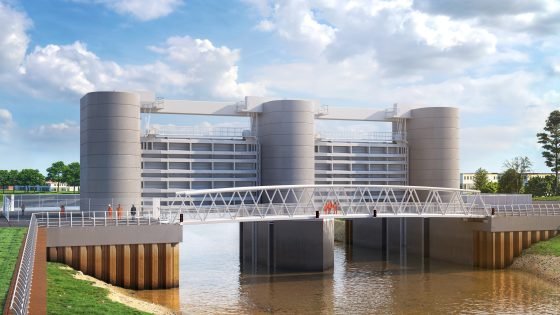
The Environment Agency has announced changes to the design of the Bridgwater Tidal Barrier after completing a “design efficiency review” aimed at keeping the project affordable while maintaining its promised level of flood protection.
The review, led by scheme designer AtkinsRéalis, found the barrier can deliver the same standard of protection –defence against a 1-in-200-year tidal event – with a simplified superstructure and other technical adjustments that reduce construction complexity, operating costs and embodied carbon. The substructure and downstream defence works already being delivered by principal contractor Kier will continue as planned, the Environment Agency said.
Key revisions to the concept design include:
- A reduction of about 10m in overall height so the three towers will be roughly 15m high
- More uniform, streamlined tower shapes and simplified mechanical systems
- Relocation of the drive equipment that moves the gates to the base of the towers to ease maintenance and lower long-term costs
- Lighter, high-level operational walkways replacing a previously proposed overbridge
Officials say these changes are intended to make the barrier easier and cheaper to build and maintain while retaining safety and performance standards. The revised design will be further refined through an outline design review in early 2026, with a final detailed design due mid-2026.
Context and funding
The review was launched in response to inflation and global market pressures affecting materials, energy and labour. Somerset Council, which is co-funding the project, framed it as necessary to ensure “responsible use of public funds” and to explore newer technologies that could achieve equivalent outcomes with fewer resources.
The scheme – intended to protect Bridgwater and surrounding areas from tidal flooding – has already secured government backing. Full approval of the business case in September 2024 made it eligible for Flood Defence Grant-in-Aid funding, and the Environment Agency says significant capital allocations have been confirmed. The project has so far been allocated £249M in funding, it confirmed.
Funding is coming from a combination of national and local sources, including the Department for Environment, Food and Rural Affairs (Defra), the Environment Agency, Somerset Council, local enterprise and regional flood committees, and other partners such as the Somerset Rivers Authority and the Wildfowl and Wetlands Trust.
Construction progress and timetable
Kier has been carrying out enabling and substructure work since 2023, a jack-up barge arrived on site in March 2025 to aid in-river works and the Environment Agency reports “significant progress” on site through the rest of last year. It expects work to continue for another five to six years, including final landscaping, but could not confirm a specific completion date. It says the priority remains to make the barrier operational as soon as possible to protect the town.
The project team intends to integrate the revised superstructure design into the live construction programme to avoid unnecessary delays. An updated overall programme and timeline is expected later in 2026 once remaining design refinements – including to the operational building and landscape elements – are finalised.
Savings, scrutiny and remaining uncertainties
The review has identified potential cost savings through design simplification, material efficiencies and optimised construction methods, and officials say further savings are being sought. The final overall project cost will be confirmed only after the ongoing review is complete and reported through normal government processes.
Local stakeholders have previously stressed the importance of the scheme for flood resilience and the regional economy; supporters say it will also deliver environmental and community benefits such as improved habitats, restored historic kilns for public display and better cycle and footpath links.
The jack-up barge working on the substructure of the Bridgwater Tidal Barrier across the River Parrett and the completed bypass channel
What happens next
The Environment Agency will continue to refine the design through early- and mid-2026 milestones and has committed to publishing updates showing how community and technical feedback has been incorporated. Until the outline and detailed design stages are complete, several elements – including the exact cost and final finishes of the superstructure, the operational building and landscaping – remain subject to change.
Ross Barton, project director for the Bridgwater Tidal Barrier scheme, said: “The review outcomes have strengthened the delivery of the scheme. It confirms we can deliver the same high level of flood protection in a more efficient and affordable way, while keeping construction moving and creating a lasting benefit for local communities.”
Bill Revans, leader of Somerset Council, said: “The Bridgwater Tidal Barrier Scheme is vital to the future of our communities and local economy. We welcome this responsible approach, which maintains flood protection while ensuring the Scheme remains affordable and on track.”
Like what you’ve read? To receive New Civil Engineer’s daily and weekly newsletters click here.
Source: www.newcivilengineer.com



