
The basics:
- $3B Meadowlands convention center proposal includes convention center, hotel, arena
- Economic impact projected at $30.4 billion over 30 years
- Designed to drive year-round tourism and events
- State review and next steps expected soon
For decades, the idea of a large-scale convention center in the Meadowlands has hovered just out of reach — long discussed, often revisited, but never fully realized. Now, with detailed designs complete and a state review approaching, that vision is beginning to take on sharper definition as a project with a plausible path forward.
On April 14, leaders unveiled significant progress on the proposed facility during a news conference hosted by the Meadowlands Chamber in Lyndhurst. They outlined a roughly $3 billion proposal that aims to transform the former arena site into a year-round destination for events, tourism and sustained economic activity.
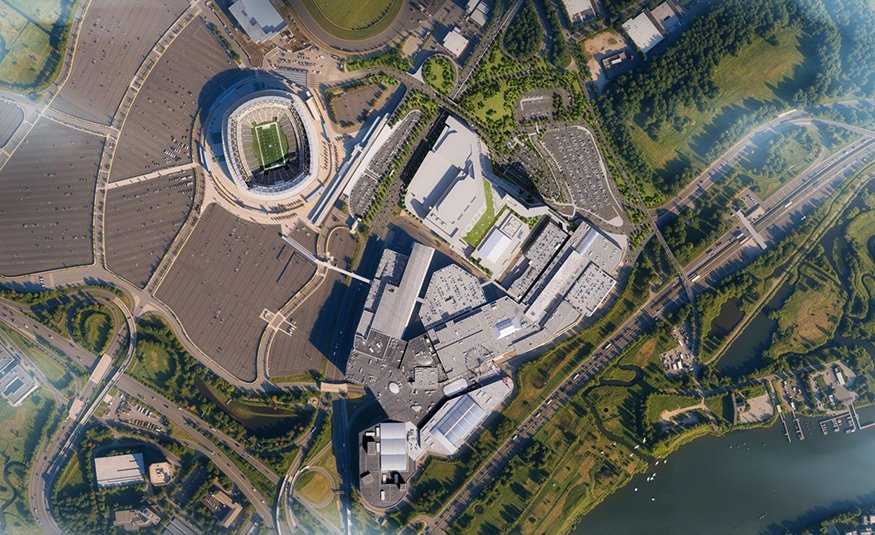
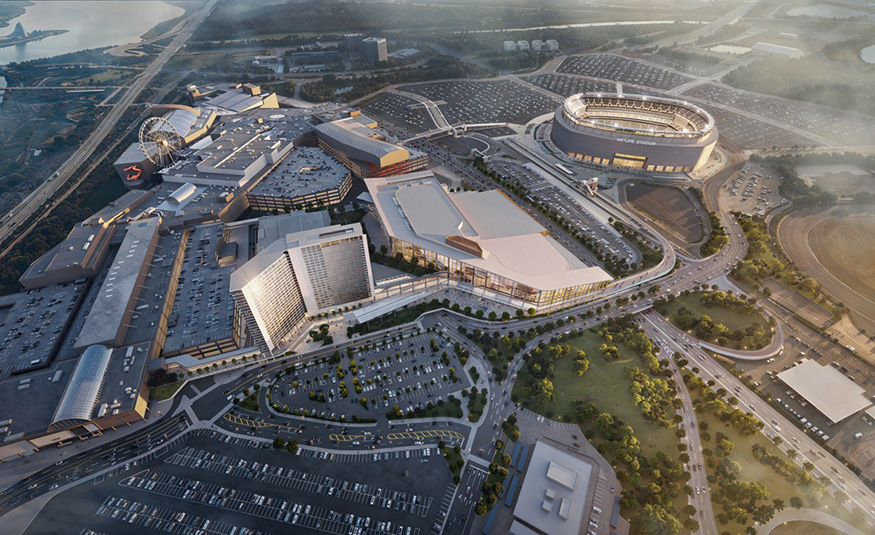
The plan reflects a multiyear effort involving national experts in market analysis, design and engineering. It calls for a 300,000-square-foot convention center anchored by a 1,000-room headquarters hotel and supported by a flexible 5,000–6,000-seat arena, structured parking, and new pedestrian and transit connections. Together, those elements are designed to create a fully integrated, multi-use campus within the Meadowlands Sports Complex, leveraging proximity to MetLife Stadium, American Dream and existing transportation infrastructure.
Moving into execution strategy
Backed by studies from firms including Hunden Partners, TVS Design and WSP, the proposal reflects what stakeholders describe as a “decision-ready” development framework — one that moves beyond planning into detailed execution strategy.
“This is no longer a conceptual conversation. The design is complete, the market demand is clear, and the remaining analysis will be finalized this spring. We’ve put a serious, credible development option on the table, positioning the state to determine next steps early in the incoming Administration,” said Meadowlands Chamber President and CEO Jim Kirkos.
This is no longer a conceptual conversation.
– Jim Kirkos, Meadowlands Chamber president and CEO
At the center of the proposal is the idea of repositioning the Meadowlands from an area defined largely by episodic, high-profile events into a destination capable of supporting consistent, year-round visitation. The facility is expected to host more than 300 event days annually, with planners emphasizing a diverse mix of conventions, trade shows, corporate meetings, sports tournaments and entertainment programming.
Significantly, project leaders said the convention center would not host events on NFL game days, a practical measure designed to avoid conflicts with existing stadium operations while maintaining overall traffic flow within the complex.
Billions in economic activity
The broader economic case for the project is a key driver behind its momentum. According to the market and financial analysis conducted as part of the scoping program, the development could generate approximately $30.4 billion in net new economic activity over 30 years, along with $3.03 billion in tax revenue, more than 3,700 permanent jobs and nearly 5,000 construction jobs.
Stakeholders repeatedly point to those projections as evidence that the effort represents more than a standalone development — framing it instead as a generational investment with the potential to reshape the regional economy.

“That $30 billion economic impact that was reported is not something we can walk away from,” said Kirkos. “This organization cannot stick a $30 billion economic impact in a drawer and make like it doesn’t exist – without taking it the whole distance.”

Senate Budget Chairman Paul Sarlo, D-36th District, has championed the initiative in the Legislature and helped secure early seed funding through the State and Local Fiscal Recovery Program. He echoed that long-term perspective while underscoring the practical implications for local businesses.
“I represent this district, and I know what it means to all the small-town businesses, the restaurants, some of the small industrial folks, the folks who are members of the Chamber of Commerce. They’re here day in and day out, whether the Giants and Jets are playing, whether FIFA is coming, whether it’s a great concert coming; they are the backbone of the economy of the Meadowlands. This will bring people to the region on an annual basis – not just when there’s a big game or a big concert. But weekly, there’ll be people from around the country and perhaps around the world that will be coming here. So, let’s keep our eye on the prize today.”
Ensuring a steady flow of visitors
The “prize,” as Sarlo framed it, is the shift from sporadic surges in activity to a steady, predictable flow of visitors — one that could drive sustained spending across hospitality, retail and service sectors throughout northern New Jersey.
At the same time, planners emphasize that the proposal is grounded in both market realities and operational feasibility. Hunden Partners‘ analysis found that the New York metropolitan region remains underserved for large-scale convention space, creating an opportunity for the Meadowlands to position itself as a cost-effective alternative capable of attracting new events while complementing – rather than competing directly with – existing venues, such as the Jacob K. Javits Convention Center in New York City.
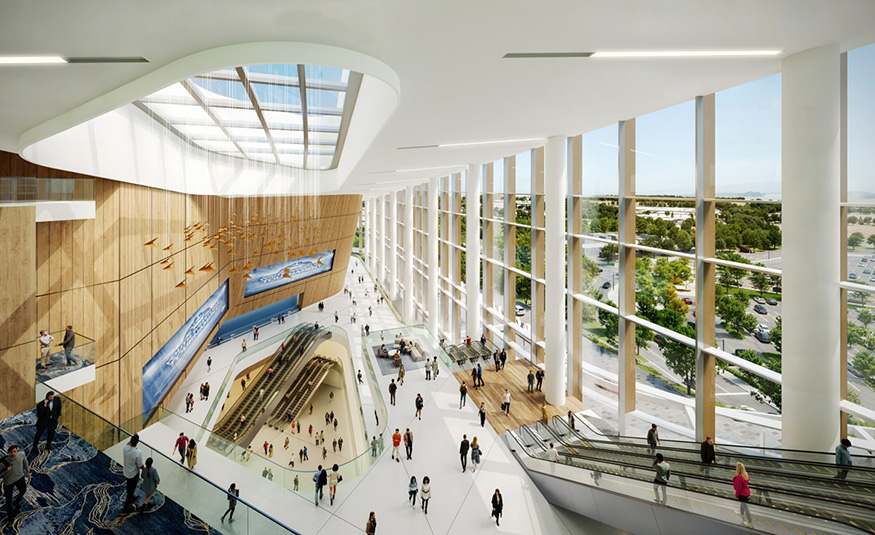
Design work led by TVS translates that market opportunity into a functional layout that includes divisible exhibit halls, a large ballroom, extensive meeting space and integrated logistics infrastructure. The vertical stacking of program elements – from loading and parking at lower levels to exhibit space, meeting rooms and hospitality components above – is intended to maximize efficiency while enabling multiple events to occur simultaneously.


Getting there
Equally significant is the transportation and circulation strategy developed by WSP, which addresses long-standing congestion challenges within the Meadowlands Sports Complex. Through targeted roadway improvements, redesigned ingress and egress patterns, enhanced ride hailing operations and better internal circulation, the plan aims not only to accommodate additional traffic generated by the convention center but also to improve overall mobility for existing tenants and visitors.
“We hired WSP to do that. WSP — certainly top three engineering firms in the world, largest active firm in the region, probably. And what they did was they researched this for us, and they created a seven-step improvement plan that includes wayfinding, expansion of lanes, a relocation of the rideshare, pedestrian crossover that connects to the train station; maintenance and administrative improvements on the site and new circulation for Turnpike and other access,” said Ron Simoncini, president of Axiom Communications and lead consultant on the project.
“Even though we’re building a Convention Center and even though we’re introducing 2.4 million visitors a year at the state, the fan experience will prove ingress and egress,” Simoncini continued. “And you’re knocking off up to 10 minutes per person.”
“The project is not necessarily pedestrian-friendly right now,” Kirkos said. “We want to make it pedestrian-friendly. We want to transform it — the next-generation of the Meadowlands Sports Complex.”
Integrating into the Meadowlands ecosystem
The integration of the convention center into the existing Meadowlands ecosystem is another defining feature of the proposal. Positioned within walking distance – and connected via pedestrian pathways and bridges – to American Dream, MetLife Stadium and Meadowlands Racing & Entertainment, the site is designed as part of a larger, multivenue district capable of supporting extended stays and varied visitor experiences.
“This plan shows what’s possible when we invest in smart planning and create a clear path forward that the next Administration can evaluate and build upon,” said Sarlo.
That connectivity is expected to play a key role in driving demand, particularly given the project’s proximity to major transportation corridors, including Interstate 95, Route 3, NJ Transit rail lines and Newark Liberty International Airport.
This plan shows what’s possible when we invest in smart planning and create a clear path forward that the next Administration can evaluate and build upon.
– Senate Budget Chairman Paul Sarlo, D-36th District
During the press briefing, Sarlo noted Kirkos and Simoncini’s persistence about the project – and that he has sat with them numerous times, seeing different iterations and concepts of the plan. “It made me a believer – made me to go Gov. [Phil] Murphy and the Legislature to ask for, let’s call it seed money, for some of the due diligence, some of the site planning, some of the traffic impact, market analysis,” said Sarlo. “Bringing in an amazing team of experts from around the country, some international as well – with experience in the planning, design, development and operation maintenance.
“So, I’m excited. There’s a long way to go, of course. There’s a whole funding mechanism. And there’s going to be those who are going to want invest in this, whether it’s a public-private partnership or not.”
Working with what’s here
At full buildout, the broader district is projected to support more than 2,000 hotel rooms within walking distance, further enhancing its ability to host large-scale conventions and multiday events.

Despite the scale and ambition of the proposal, project leaders have been careful to frame it as a pragmatic and achievable development — one that builds on existing assets rather than attempting to create an entirely new ecosystem from scratch.
“And I think one of the reasons is because we always made it about common sense. We didn’t over dream this, right? We didn’t overbuild it. We didn’t try to build something that we couldn’t afford. We fit it on what was there, right? And we made it make sense to American Dream, to the stadium, to the track, to New Jersey,” Kirkos said.
What’s next?
That emphasis on practicality extends to the project’s timeline and next steps. Since the announcement, the team has been finalizing the remaining elements of the scoping assessment, including legal frameworks, financing strategies and operational models. The goal is to assemble a comprehensive roadmap that outlines how the project could move from concept to construction.
Fly around
Watch an animated flyover of the proposed Meadowlands Convention Center here.
“So, what’s next between now and May 8? We’re going to sew this thing together, including a bunch of essentially what amount to legal opinions on how you go from here to a place where the state can authorize the construction of the convention center,” said Simoncini. “We’re calling it the interim stage. Very important stage, demonstration project, negotiation on the actual construction programming, and then an authorization for the state.”
That work is expected to culminate in a formal presentation to Gov. Mikie Sherrill and state leaders marking a key moment in the process before any legislative authorization or funding decisions. Stakeholders suggested that a determination on whether to advance the project could come later this year or in early 2027, following the completion of the review process and broader state priorities such as the FIFA World Cup.
After the matches
Sherrill has yet to publicly weigh in on the project proposal.
“We have a new governor. We haven’t had a chance to brief the new governor yet on this,” said Sarlo. “A lot of focus right now, in all fairness, for the governor and others is FIFA and the World Cup, and getting that successfully done over the course of the next couple of weeks and months.
“But how great it would be to come off of the World Cup, then to pivot and start to think about the next single largest capital project in the State of New Jersey?”
Linking the proposed convention center to the state’s broader economic and global positioning reflects the stakes involved in the decision ahead. For supporters, the project represents an opportunity to capitalize on New Jersey’s strategic location, existing infrastructure and proximity to New York City while addressing a clear gap in the regional convention market.
The post $3B Meadowlands convention center plan gains momentum appeared first on NJBIZ.



