
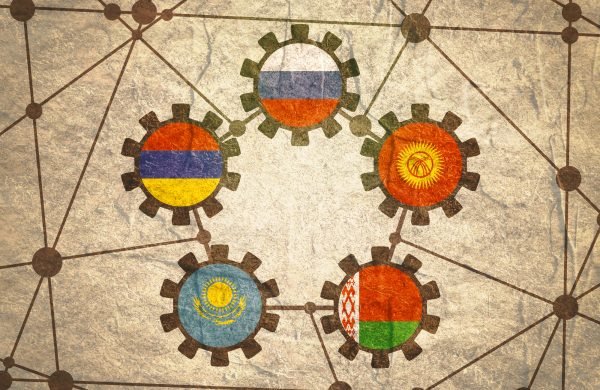
On January 1, 2026 Kazakhstan took on the rotating chairmanship of the Eurasian Economic Union (EAEU). In an address on December 31, Kazakh President Kassym-Jomart Tokayev proposed that the EAEU focus on artificial intelligence, logistics, digitalization, free trade, and global dialogue.
“Economic integration is an important tool designed to ensure tangible results from cooperation within the EAEU,” Tokayev concluded, highlighting the “creation of new industries and modern jobs, the introduction of advanced technologies, and the formation of a free trade environment.”
The EAEU is entering its second decade, having been officially established on January 1, 2015, with Russia, Kazakhstan, and Belarus as initial members. Armenia technically acceded on January 2, 2015 and Kyrgyzstan in August that year.
Since then the union has not expanded, despite occasional serious flirtation with the idea in Uzbekistan and Tajikistan over the years. Uzbekistan essentially put to rest consideration of full membership in 2024, when First Deputy Speaker Akmal Saidov of Uzbekistan’s parliament, the Oliy Majlis, said Uzbekistan would maintain the observer status it achieved in 2020. He pointed to Kazakhstan as an example, saying Astana had “received very few benefits from joining the EAEU.”
The EAEU is ostensibly a vehicle for economic integration, but Russia’s full-scale invasion of Ukraine in 2022 and the ongoing war have opened members to deeper scrutiny on the back of that integration. It’s of little surprise that regional countries – even countries in the customs union – have put greater effort into expanding trade and transit routes that bypass Russia in recent years, turning to new endeavors and reinvesting in existing routes.
At the same time, the EAEU has not been abandoned by its members (even Armenia, whose relations with Russia have deteriorated markedly). The EAEU has continued to establish new free trade agreements with external partners – including a temporary FTA with Mongolia in April 2025, and economic partnership agreements with the UAE in June and Indonesia in December. It muddled through with Belarus’ leadership in 2025.
With Kazakhstan returning to the EAEU chairmanship in 2026, it’s clear Tokayev hasn’t set the union aside. Instead, the areas he proposed for it to focus on on serve Kazakhstan’s wider economic initiatives and pair well with its other efforts, including those with the United States.
Tokayev characterized AI “as a new tool for the development of economic integration,” arguing that the world has entered a new era “that offers unprecedented opportunities but also gives rise to new challenges, including growing technological inequality.” His goal is to direct “new technologies to the benefit of our peoples and turn them into a key factor in Eurasian economic integration,” pointing to Kazakhstan’s strategic goal of becoming “a fully-fledged digital country.”
Next, Tokayev urged the union to double down on its “common goal” of becoming the Eurasian continent’s “leading logistics hub.” Tokayev referred to the EAEU as “a geopolitical bridge between East and West, North and South.”
“Cargo should move across the EAEU member states as quickly as possible, without unnecessary delays or bureaucratic red tape,” he said, highlighting a long-recurring problem. He also, later in his address, commented that customs regulations “should not be used as a tool to exert pressure on the governments of the EAEU member states.” This pressure is exerted by members on other members with routine frequency; Tokayev suggested AI here too as a solution to monitor legislative initiatives in member states.
Finally, Tokayev proposed continuing to expand the EAEU’s relations with external partners.
“In the long term, it would be advisable to expand the EAEU’s relations with countries in the Global South, the Arab world, Southeast Asia and Africa, as well as with authoritative regional associations,” he said.
Kazakhstan’s hyper-focus on technology may seem forward-looking, but it presents a rosy future that may not be attainable without serious work on the practical problems. Kazakhstan faces an energy deficit. To cover for an expected deficit in the fall and winter of 2025, Kazakhstan arranged to import electricity from Russia and Uzbekistan. AI runs on electricity; it is of little use to restructure the economy around such technologies if the grid and the supply isn’t there to support it.



