
There’s little doubt that the standoff between the United States and Iran imposes economic costs on Americans. The price at the pump is up by more than a third since the start of the war and economists project inflation rising and growth slowing. According to a recent poll by Ipsos, six out of 10 Americans disapprove of the conflict, and a majority believe U.S. military action in Iran will have a negative impact on their personal financial situations. (Only 1 percent believe the war will have a positive impact on personal finances, and less than a quarter of Americans surveyed think the conflict has been worth it.) Why, then, aren’t Americans expressing more anger about the war in the form of protests?
There are several potential answers. The same Ipsos poll finds that 44 percent of Americans have heard only “a little” about the conflict and 7 percent have heard “nothing at all,” suggesting either a lack of interest in global affairs or limited personal and financial impact. Another recent poll, by Gallup, found that Americans are more worried about health care than the economy. The United States also entered the war with historic advantages: It has become the planet’s largest producer of both oil and natural gas, its stock market is enjoying an AI-driven boom, and its imports are benefiting from a strong dollar.
There’s little doubt that the standoff between the United States and Iran imposes economic costs on Americans. The price at the pump is up by more than a third since the start of the war and economists project inflation rising and growth slowing. According to a recent poll by Ipsos, six out of 10 Americans disapprove of the conflict, and a majority believe U.S. military action in Iran will have a negative impact on their personal financial situations. (Only 1 percent believe the war will have a positive impact on personal finances, and less than a quarter of Americans surveyed think the conflict has been worth it.) Why, then, aren’t Americans expressing more anger about the war in the form of protests?
There are several potential answers. The same Ipsos poll finds that 44 percent of Americans have heard only “a little” about the conflict and 7 percent have heard “nothing at all,” suggesting either a lack of interest in global affairs or limited personal and financial impact. Another recent poll, by Gallup, found that Americans are more worried about health care than the economy. The United States also entered the war with historic advantages: It has become the planet’s largest producer of both oil and natural gas, its stock market is enjoying an AI-driven boom, and its imports are benefiting from a strong dollar.
For most other countries, though, each of Washington’s advantages becomes a point of weakness. A poll conducted across six countries in the global south shows a 100 percent awareness of the conflict, with seven out of 10 respondents “very concerned” about the cost of living. The heightened sensitivity to events in the Gulf can be explained in part by the fact that, unlike the United States, a majority of the world’s nearly 200 countries are net importers of energy. Asia, in particular, accounts for 40 percent of the world’s energy demand, making its countries particularly sensitive to price shocks. Developing economies often lack the fiscal room to subsidize energy for their citizens—who in any case earn far less than Americans do and disproportionately suffer when energy prices spike. Additionally, just as a strong dollar helps American importers, it hurts countries that have to spend more rupees or pesos to buy commodities traded in U.S. dollars. Finally, the tailwinds from AI are mostly enjoyed by U.S. companies and their shareholders; the so-called Magnificent Seven, which includes Alphabet, Amazon, Apple, Meta, Microsoft, Nvidia, and Tesla, are all American.
The oil-rich Gulf economies are usually well-positioned to navigate a global economic shock, but they are, of course, particularly mired in the current conflict. In contrast, the United States is geographically blessed with no adversaries nearby. Put together, Washington’s unique advantages mean that its citizens have so far suffered less than most other people around the world.
Pakistan has garnered headlines for mediating peace talks between the United States and Iran, but what has received less attention is how much Islamabad needs the war to end. Pakistan imports 80 percent of its energy from the Gulf. The conflict in the Middle East sent petrol and diesel prices in Pakistan to record highs. As a result, Islamabad instituted a four-day workweek for government offices, ordered half its federal staff to work from home, shuttered schools for two weeks, and asked cabinet ministers to forgo two months of salary. Meanwhile, Pakistan was forced to turn to Saudi Arabia for a $3 billion bailout as it struggles to service debt payments and liquidity commitments made to the International Monetary Fund (IMF).
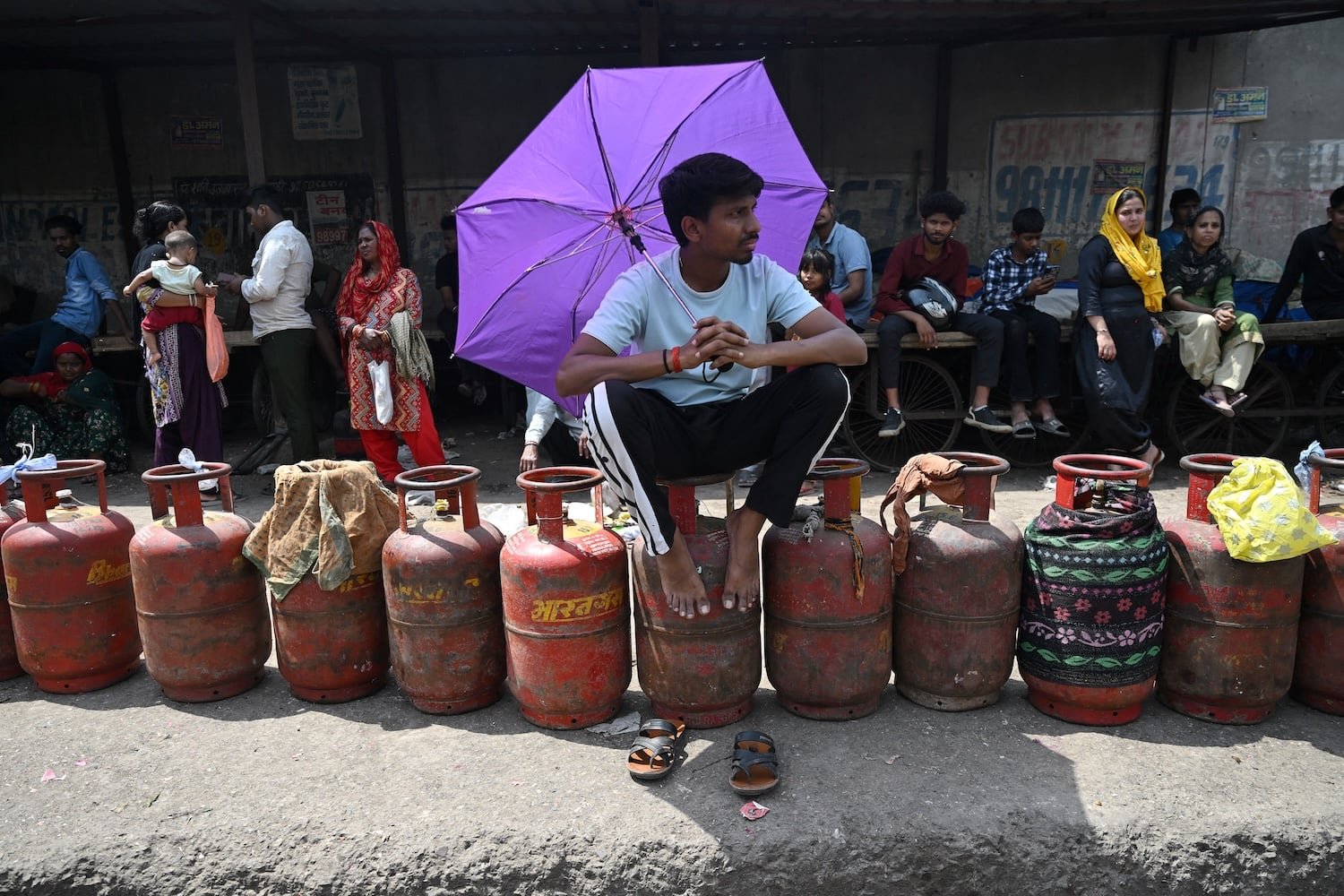
Pakistan’s woes are reflected across South Asia. Bangladesh, which imports 95 percent of its energy needs and holds less than a month’s worth of reserves, has imposed daily limits on fuel sales amid panic buying. Dhaka shut universities and ordered shopping centers to close by 8 in the evening. Local prices for liquefied petroleum gas (LPG), which is used widely from cooking to powering rickshaws, are up by nearly half since the start of the conflict. For a garment worker earning the equivalent of $4 a day, a 50 percent rise in the price of cooking gas translates to painful daily sacrifices.
Sri Lanka, too, has moved to a four-day workweek. In Nepal, transport strikes have driven up the price of rice and vegetables in a country where rural households already spend more than half of their income on food. Even Bhutan, the self-proclaimed happiest nation in the world, has long queues at its gas stations.
India, the world’s third-largest oil importer and sixth-biggest economy, has more room to maneuver than its neighbors. Ahead of state elections this month, New Delhi cut taxes on petrol and diesel to protect consumers from price increases, absorbing a hit to its national balance sheet. Even so, the country’s 1.4 billion people have been deeply affected by the conflict. India imports 90 percent of its LPG from the Gulf, and shortages have forced restaurants across the country to ration usage and slow business. The country’s benchmark stock market has plunged by 8 percent since the start of the year, and its economic output is expected to decline by around a percentage point because of the conflict. India also imports a quarter of its fertilizer from the Middle East, raising the prospect of a food crisis in what remains a largely agrarian economy.
It’s a similar story across Asia, which purchases four-fifths of the crude oil and natural gas that transits the Strait of Hormuz. The Philippines declared a state of national energy emergency on March 24. Thailand has ordered civil servants to work from home and urged the public to carpool and conserve electricity. Vietnam, one of Asia’s fastest-growing economies, has directed its airlines to cut routes in the face of soaring jet fuel prices. And an increase in fertilizer prices couldn’t come at a worse time for a region about to begin planting season, and facing a historic heat wave to boot.
Richer economies aren’t immune to pain from the conflict. Announcing a $1.9 billion package of fuel subsidies last week, German Chancellor Friedrich Merz said his country would feel the impact “for a long time to come.” Berlin is reportedly slashing its growth forecast for 2026 by half. Ireland, one of the European Union’s most expensive countries to live in, called in the army earlier this month to clear up mass protests over rising fuel prices. The European Central Bank—which had been preparing to cut rates in March—instead raised its inflation forecast and cut its projections for the eurozone’s growth.
Europe may have a greater capacity to sustain economic trouble than many countries in the global south, but the continent is still transitioning from the profound energy shock of 2022, when Russia launched its full-scale invasion of Ukraine. The European Union, which relies on natural gas for a fifth of its energy, saw benchmark prices rise by more than 70 percent after the Iran war began. The region’s gas storage facilities are now at their lowest level since 2022. Europe will have to pay a lofty market price to fill up ahead of winter.
Nations bear the costs of war in different ways. Citizens in countries with lower income levels, thin reserves, and weak currencies fare badly. Wealthier nations invariably suffer less. But even if American consumers imagine they are relatively insulated, they would be wrong about that—eventually.
A sobering data point came last week from the IMF, which now estimates, in its most pessimistic scenario, that global growth could fall to 2 percent this year and next. That has only happened four times since 1980, the fund says. A global recession would inevitably come back to hurt American businesses. Already, as the New York Times has reported, the price of thread has doubled in Bangladesh because polyester and nylon come from petroleum. That means companies like Zara and Uniqlo will soon have to pass on costs from their hubs in Asia to stores in the United States. It hasn’t happened yet, but supply chains always catch up. And from helium to sulfur to tungsten, crucial ingredients that go into the manufacturing of semiconductors, fertilizer, and munitions are caught up in the blockade of the Strait of Hormuz.
Second, there are the more direct costs of war. Harvard University economist Linda Bilmes estimates the conflict could eventually cost the U.S. taxpayer $1 trillion. The White House has declined to offer an estimate but has asked Congress to approve $1.5 trillion for defense next year, a 40 percent increase.
Read More
A worker loads sulfur at a storage yard on a wharf in Nanjing, China. A worker loads sulfur at a storage yard on a wharf in Nanjing, China. The Iran War Comes for the ‘King of Chemicals’
The conflict is wreaking havoc on an obscure sector that is more important than you’d think.

U.S. President Donald Trump, seen in a long-exposure image, speaks during a prime-time address to update the nation on the war in Iran, from the White House in Washington. U.S. President Donald Trump, seen in a long-exposure image, speaks during a prime-time address to update the nation on the war in Iran, from the White House in Washington. Why Trump Mishandled Iran
The U.S. president has a history of following other world leaders—or his gut—instead of his own intelligence officers and experts.
A man stands between two tractors, one green and one red, with tires as tall as his shoulders. A spray painted sign at the front of the red tractor says “No fuel, no food.” The sky overhead is gray, and midrise buildings are visible across the street. A man stands between two tractors, one green and one red, with tires as tall as his shoulders. A spray painted sign at the front of the red tractor says “No fuel, no food.” The sky overhead is gray, and midrise buildings are visible across the street. The Energy Crisis Won’t End Right Away (Even if the Iran War Does)
Even if the cease-fire holds, it will take months to undo the damage.


The United States’ energy advantage is a recent phenomenon. Since 2003, when Washington invaded Iraq, the United States has expanded its production of crude oil by 130 percent, in large part because it discovered how to extract oil from shale. That innovation has also turbo-charged the production of natural gas, which now powers a third of the country’s energy needs. America’s dominance in natural gas gives it an unprecedented leg up on other economies. This has surely shaped how the White House thinks about the costs of starting wars.
And yet, that energy advantage does not render the United States immune from the reality of how interconnected the world has become. It would be a mistake for the White House to focus only on its energy dominance and forget that it lags behind China on critical minerals and depends on an intricate global marketplace for hundreds of other elements that are essential to daily life in the United States.
The White House is also deeply impacted by political sentiment. It is clear that Trump worries about the global price of oil; Americans love driving, after all. The president also sees the stock market as a barometer of the economy’s health (it’s not, exactly). Perhaps that’s why Trump has taken to repeatedly assuring investors that oil prices will come down or that the war will end soon. But even Trump knows Tehran still has a say. The longer Iran blocks the Strait of Hormuz, the more likely prices will catch up with reality, and more pain reaches the American consumer. How much will the rest of the world have to endure before then?



