
Welcome back to World Brief, where we’re looking at potential peace talks between the United States and Iran, Russia’s big win in Bulgaria’s general election, and the continued political fallout from ex-British diplomat Peter Mandelson.
Peace Talks 2.0
U.S. and Iranian officials are expected to kick off a second round of Pakistan-mediated talks in Islamabad on Tuesday. The aim is to secure a lasting peace deal before Washington’s two-week cease-fire with Tehran expires on Wednesday. However, growing uncertainty over the Strait of Hormuz has threatened to upend negotiations before they can even begin.
Dialogue could look the same as its first iteration. U.S. Vice President J.D. Vance plans to lead the White House delegation alongside special envoy Steve Witkoff and President Donald Trump’s son-in-law Jared Kushner. Iranian authorities have confirmed that if Vance attends, Iranian parliamentary speaker Mohammad Bagher Ghalibaf will also return to the negotiating table. Vance has yet to depart for Islamabad, though, casting doubt on both of their attendance.
According to Trump, if Tuesday’s negotiations occur, they will focus on securing a nuclear deal that prohibits Iran from enriching uranium. If “Iran’s new leaders (Regime Change!) are smart, Iran can have a great and prosperous future!” Trump wrote on Truth Social on Monday. He added in a separate post that “If a Deal happens under ‘TRUMP,’ it will guarantee Peace, Security, and Safety, not only for Israel and the Middle East, but for Europe, America, and everywhere else.”
Yet Trump appears unconcerned with the cease-fire’s looming Wednesday deadline. In an interview with Bloomberg on Monday, the U.S. president said it is “highly unlikely” that he will extend the truce. “I’m not going to be rushed into making a bad deal,” Trump said. “We’ve got all the time in the world.”
An acceptable deal may be difficult to achieve, though, as Tehran seems wary of any U.S. peace offers. Iranian President Masoud Pezeshkian warned of the country’s “deep historical distrust” in the United States on Monday, alluding to the U.S. military’s decision to launch strikes on Iran during previous peace talks as well as U.S. forces’ seizure of an Iranian-flagged cargo ship in the Gulf of Oman on Sunday.
The “non-constructive and contradictory approach of U.S. officials in recent days carries a bitter message: they seek Iran’s surrender,” Pezeshkian wrote on X on Monday. “The people of Iran will not bow to coercion.”
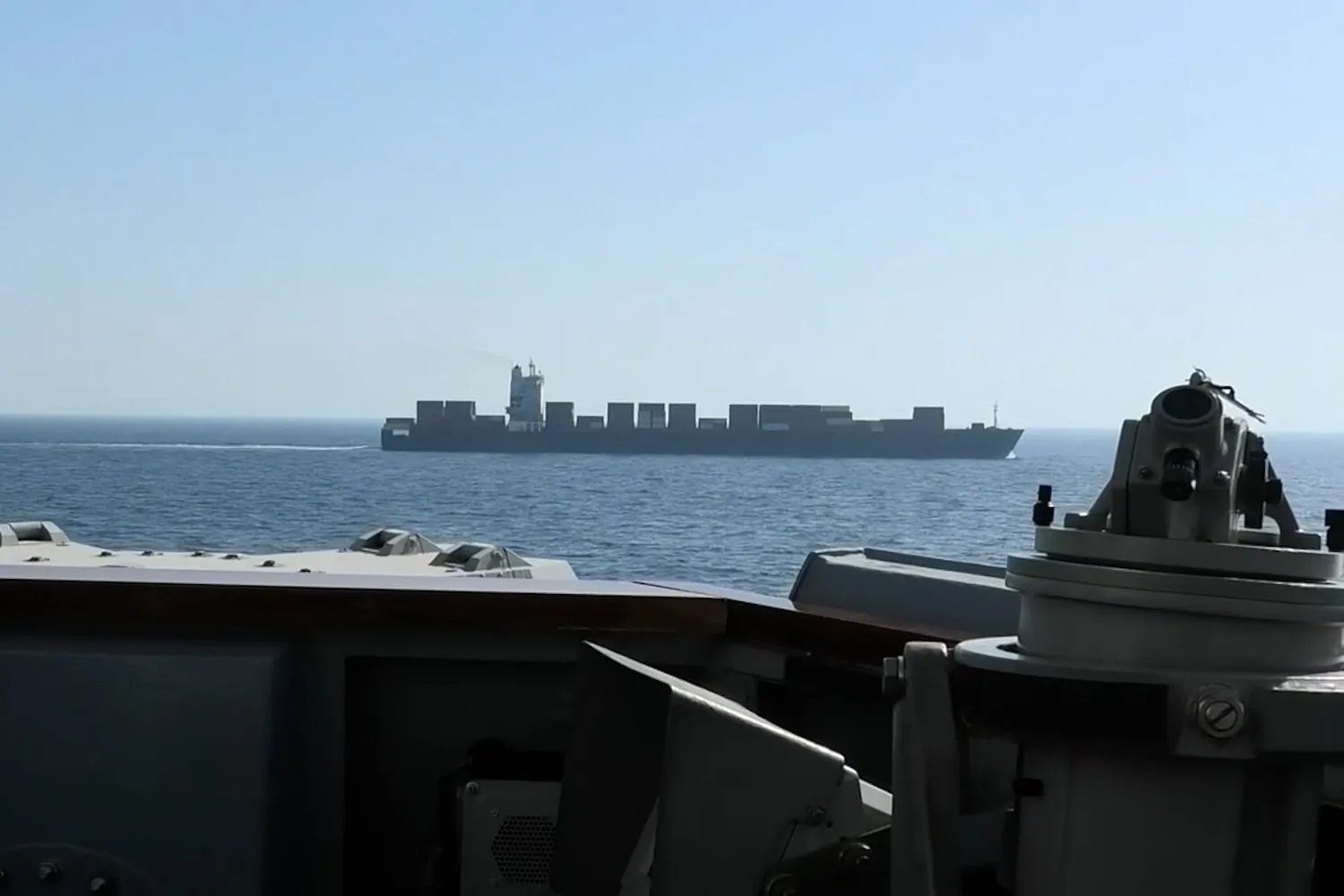
According to a U.S. military official, U.S. Marines are searching up to 5,000 containers aboard the Touska, the Iranian cargo ship that U.S. troops intercepted as part of Washington’s naval blockade on Iran. Since that blockade went into effect last week, the U.S. Navy has blocked 27 ships from entering or exiting Iranian ports, according to U.S. Central Command. Traffic through the Strait of Hormuz remains at a virtual standstill.
“The Iranians desperately want it opened,” Trump told Bloomberg on Monday, referring to the Strait of Hormuz. “I’m not opening it until a deal is signed.”
Meanwhile, the U.S. State Department confirmed on Monday that it will host a second round of ambassador-level talks between Israel and Lebanon on Thursday. The negotiations, aimed at ending the Israel-Hezbollah war, will occur just three days before a 10-day cease-fire between the two sides is set to expire.
Today’s Most Read
The World This Week
Tuesday, April 21: NATO chief Mark Rutte begins a two-day trip to Turkey.
South Korean President Lee Jae-myung begins a four-day trip to Vietnam.
Thursday, April 23: Cyprus hosts an informal two-day European Union leaders’ summit.
Pope Leo XIV concludes his four-country tour of Africa with a Mass in Equatorial Guinea.
Friday, April 24: French President Emmanuel Macron begins a two-day trip to Greece.
Interim Venezuelan President Delcy Rodríguez hosts Colombian President Gustavo Petro.
Saturday, April 25: The West Bank and Gaza hold local elections.
What We’re Following
Moscow’s new foothold. Progressive Bulgaria, a new pro-Russia party led by former President Rumen Radev, clinched a major victory in Bulgaria’s general election on Sunday. According to official results released on Monday, Progressive Bulgaria won around 44.7 percent of the vote, putting it on track to secure roughly 130 out of 240 seats in the National Assembly.
Bulgaria has a history of failed coalition governments. In January, Radev called for snap elections after leading parties were unable to form a ruling coalition to replace the previous administration, which resigned just minutes before lawmakers were set to vote on a no-confidence motion following widespread anti-corruption protests. Sunday’s vote was the country’s eighth election in just five years.
Local polling ahead of the election showed that Bulgarians were frustrated with ongoing political instability and hoped to avoid the need for a government coalition altogether. Their wishes appear to have been answered. With around 130 seats, Progressive Bulgaria now holds a simple majority in the National Assembly, giving Radev the country’s largest mandate in years.
Under Radev, Sofia is expected to shift away from its Western allies as it seeks to restore ties with Moscow. Bulgaria is a member of NATO, the eurozone, and the European Union; it is the EU’s poorest member. Although Radev has condemned Russia’s invasion of Ukraine, he has repeatedly criticized European military aid to Kyiv and has advocated for the resumption of Russian energy imports to the continent.
Regret over Mandelson. British Prime Minister Keir Starmer acknowledged on Monday that he made a mistake when he appointed Peter Mandelson, a close friend of convicted sex offender Jeffrey Epstein, to be the United Kingdom’s ambassador to the United States.
Since leaked emails last September revealed Mandelson’s ties to Epstein, Starmer has faced a barrage of calls to resign. However, the Labour leader has refused to step down—instead trying to survive the political fallout by firing Mandelson; publicly apologizing to Epstein’s victims; launching a criminal investigation into Mandelson’s potential sharing of government information; and dismissing Olly Robbins, the most senior civil servant in Britain’s Foreign Office, after it emerged that the agency had granted clearances to Mandelson despite him failing a top-secret security vetting process.
Starmer told Parliament on Monday that he “would not have gone ahead with the appointment” had he known about Mandelson’s vetting. Yet opposition lawmakers expressed doubt that Starmer had no knowledge of this issue. “It doesn’t appear that he asked any questions at all. Why? Because he didn’t want to know,” Conservative Party leader Kemi Badenoch said, adding that Starmer “has thrown his staff and his officials under the bus.”
Robbins is expected to testify before the House of Commons’ Foreign Affairs Committee on Tuesday.
Cluster bomb warheads. North Korea test-fired several ballistic missiles with cluster bomb munitions off its east coast on Sunday. According to North Korean state media on Monday, five surface-to-surface Hwasong-11 Ra missiles struck an island target, making the successful test “of weighty significance in military actions” to boost the country’s “high-density striking capability.”
Sunday was Pyongyang’s second such launch this month. On April 8, North Korean forces fired several Hwasong-11 Ka surface-to-surface ballistic missiles that also carried cluster bomb warheads. North Korean leader Kim Jong Un and his daughter, who is believed to be the dictator’s likely successor, oversaw both launches. Experts have long suggested that Pyongyang seeks to expand its military capabilities to penetrate U.S., South Korean, and Japanese defenses.
North Korea’s test on Sunday came just a day before the United States and the Philippines kicked off annual large-scale combat exercises in the Indo-Pacific. For the first time, this year’s three-week drills include Japan and Canada as full-time participants. China has already denounced the training, claiming that it aims to deter Beijing’s global ambitions in the disputed South China Sea and Taiwan Strait. Manila, however, has argued that the drills do not target any one nation.
Odds and Ends
Italian authorities sentenced a 24-year-old man on Monday to seven months in prison after he tried (and failed) to commit a crime. Last year, Italian national Deepak Singh purchased a Rolex for 55,000 euros (about $65,000), believing that it was actually worth more than $100,000. After being advised that it could be a fake, though, he sold the watch at a store in Singapore for $74,446, took three other Rolexes worth that price instead of cash, and fled the country to evade arrest. But in a twist of fate, the watch turned out to be genuine, and Singh was charged with one count of attempting to cheat and one count of using an edited photo of his passport during the sale. No harm but certainly some foul.



