
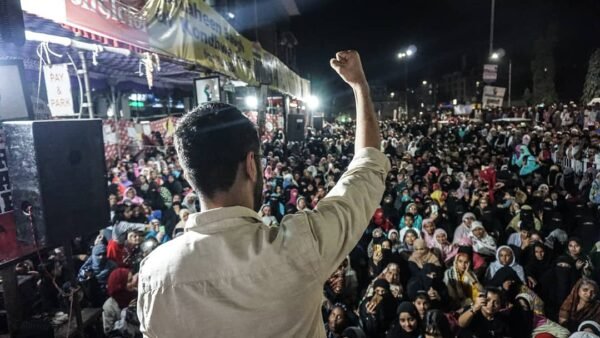
On January 5, 2026, the Indian Supreme Court denied bail to activist and scholar Umar Khalid, ensuring he remains in Delhi’s notorious Tihar jail. After more than five years of pre-trial detention — almost 2,000 days without a conviction — the decision to keep him behind bars is a normalization of “trial by jail.”
“We are not alive though we are living, and we are not in our graves though we are dead,” Khalid has written from the cell he finds himself in. Legal purgatory is where the process is the punishment.
Khalid was arrested in September 2020 following nationwide protests against the discriminatory Citizenship Amendment Act. The law expedites citizenship for six religious groups from select neighboring countries, but explicitly excludes Muslims. When Khalid and others protested the law, the regime responded with force. Khalid, along with 11 other activists, was hit with 29 charges, including terrorism and sedition. The Indian government targeted Khalid with the arbitrary Unlawful Activities Prevention Act, an intentionally vague law frequently used to silence dissenters.
In the same judgment in which the court denied Khalid bail, it released his co-defendants in the case, activists Gulfisha Fatima, Shifa Ur Rehman, Meeran Haider, Saleem Khan, and Shadab Ahmed. While the court attempted to distinguish their roles, the message was clear: the Indian standard of justice is shifting and selective.
The “evidence” presented against Khalid includes using the word “revolution” in a speech and his presence as a silent member of a WhatsApp group chat. Based on this flimsy reasoning, the prosecution labeled Khalid as an alleged key conspirator in the 2020 Delhi riots. And the court ruled that pretext is enough to keep Khalid behind bars, even though he has yet to face trial, much less be found guilty of the alleged offenses.
But the real reason for his continued detention is his influence. As a brave symbol of dissent, Khalid has become India’s most prominent political prisoner, one whose case has garnered global attention, including recently from eight U.S. lawmakers and human rights organizations. To the Indian state, his intellect is what makes him dangerous.
Before his arrest, Khalid advocated for the rights of India’s minorities and marginalized communities and co-founded the community organization United Against Hate, which campaigns against hate crimes in an increasingly intolerant India.
“Why am I dangerous? Is it because I say that this country is as much mine as it is yours?” Khalid asked in a video recorded a few days before his arrest.
Khalid’s case is a stark example of how the Modi government weaponizes anti-terror laws to indefinitely silence Muslim voices and crush dissent. When a scholar is imprisoned for half a decade without a trial for the crime of organizing peaceful protests, the “world’s largest democracy” is at risk. For India to retain global standing in the 21st century, it must demonstrate that its legal system is capable of tolerating dissent. Freeing Umar Khalid is not just a matter of justice, but a step in restoring India’s credibility.



