
Welcome back to Foreign Policy’s Latin America Brief.
The highlights this week: Regional politicians vie for the United Nations’ top job, Peru’s election count continues, and progressive leaders attend a summit in Spain.
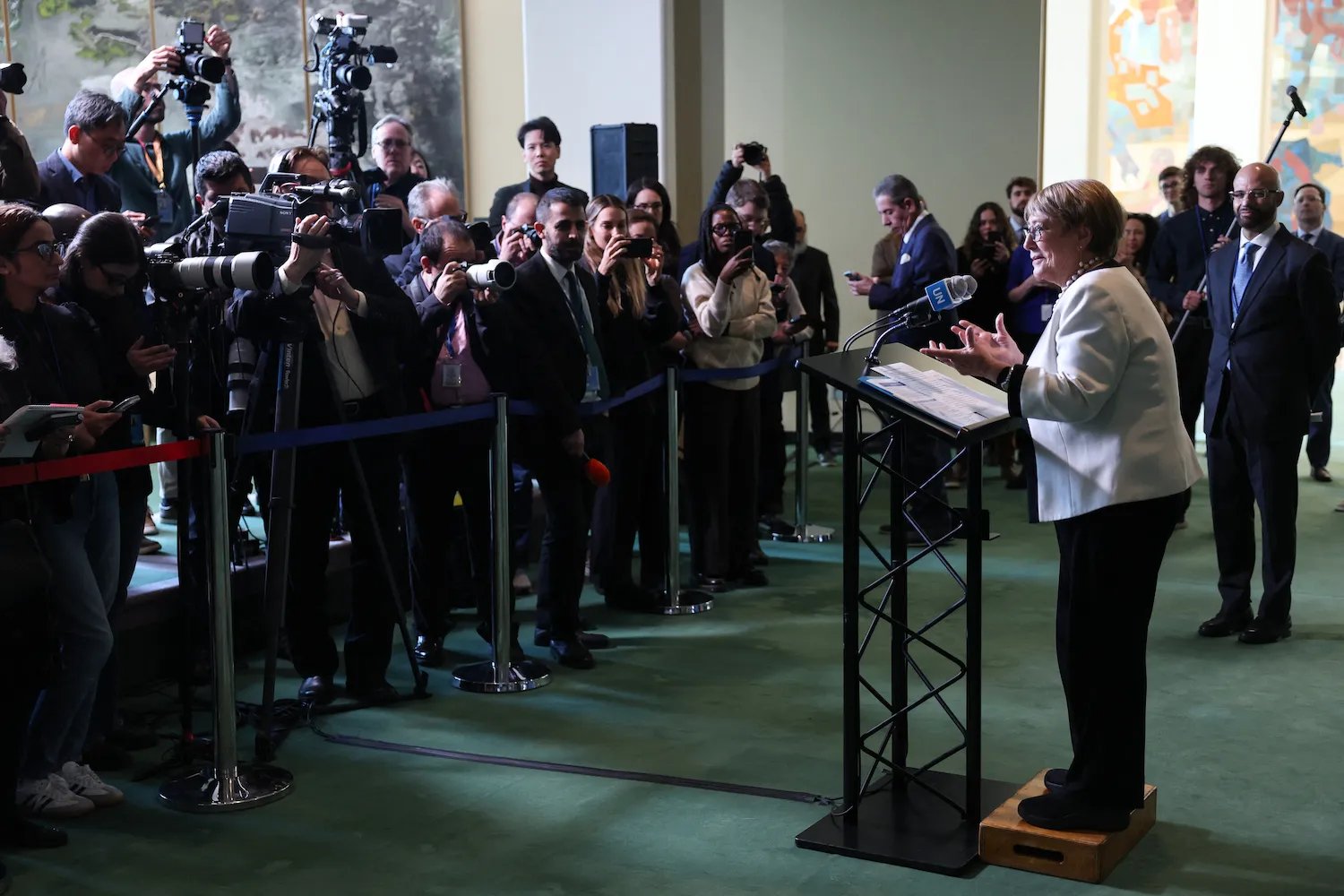
Political heavyweights from Latin America and the Caribbean sat for marathon hearings at the United Nations headquarters in New York City this week, answering questions about how they aspire to head the organization as its next secretary-general. Per an informal U.N. custom, the next organization’s next leader should hail from the region.
Candidates include Rafael Grossi, the Argentine director of the International Atomic Energy Agency (IAEA); former Chilean President Michelle Bachelet; and former Costa Rican Vice President Rebeca Grynspan. Bachelet and Grynspan have both also led U.N. agencies. Only one contender, former Senegalese President Macky Sall, is from outside the region.
“There’s a long history going back deep into the Cold War of Latin American officials playing senior roles around the U.N. system,” said the International Crisis Group’s Richard Gowan. While there is some skepticism toward the organization on the Latin American right, he said, generally “it’s a region that is seen as being amongst the U.N.’s most reliable supporters.”
The election may stretch all the way into December, when outgoing Secretary-General António Guterres’s term expires, and countries could still nominate other candidates. The General Assembly has traditionally endorsed whichever contender first earns approval from the five permanent members of the Security Council, which each hold veto power, according to Gowan.
At this relatively early point in the race, Grossi “is widely considered the front-runner,” J. Alex Tarquinio wrote in Foreign Policy on Wednesday. Grossi has won support across Argentina’s fractured political spectrum and has acted as an interlocutor between warring states such as Russia and Ukraine on nuclear issues.
In his home country, “he is an example of the success of an old school of Argentine diplomacy” prior to an ideological turn under far-right President Javier Milei, said Torcuato di Tella University scholar Juan Gabriel Tokatlian. “His know-how has lots to do with matters of war and security.” For years, Grossi has overseen IAEA reporting on Iran’s nuclear stockpile.
Some analysts, including Gowan’s colleague Daniel Forti, have argued that the U.N. should get “back to basics” of solving conflicts, a mission closely related to Grossi’s expertise. But his prospects could suffer if the United States and Iran do not resolve their nuclear policy standoff in the coming months, Tokatlian added.
Bachelet has a more ideological profile: She is a center-left politician and a vocal advocate for women’s rights. While serving as U.N. high commissioner on human rights between 2018 and 2022, her office’s criticism of authoritarianism in Venezuela opened political space for other countries to speak out, according to Tokatlian.
But the United States has signaled that it might veto a Bachelet appointment. U.S. Ambassador to the U.N. Michael Waltz said last week that he was concerned that Bachelet stopped short of calling China’s treatment of Uyghur Muslims a genocide, as well as about her support of reproductive rights.
Chile’s own right-wing administration withdrew the country’s endorsement of Bachelet after new President José Antonio Kast took office last month. (She had been nominated by the previous left-wing government.) Co-nominees Brazil and Mexico maintained their endorsements of Bachelet, keeping her in the race.
Of the three Latin American candidates, Grynspan is perhaps the least known outside the U.N. system. Since 2021, she has led the U.N. Conference on Trade and Development, which deals with economic policy. In that role, she helped negotiate a 2022 deal that saw Russia allow Ukraine to export grains despite a naval blockade.
“Grynspan gets very good reviews for the work she’s done around development,” Gowan said. As another potential point in her favor, he added, the most powerful countries on the Security Council might prefer “someone without a massive international profile … someone who they expect to be more ‘secretary’ than ‘general.’”
All three candidates pledged in their formal candidacy documents that they would focus on pragmatism, conflict resolution, and restoring trust in the U.N. and international law. Bachelet and Grynspan also talked about fighting climate change.
Grossi did not mention the environment in his submitted statement, although he pledged to work on the issue when questioned at this week’s hearing.
Friday, April 24: Colombian President Gustavo Petro visits Caracas.
Friday, April 24, to Wednesday, April 29: Colombia co-hosts a conference about transitioning away from fossil fuels.
Tuesday, May 5, to Friday, May 8: The U.S. trade representative holds a hearing on the trade practices of dozens of countries, including Mexico.
Mexican President Claudia Sheinbaum greets Spanish Prime Minister Pedro Sánchez at the “Meeting in Defence of Democracy,” a summit of leftist leaders in Barcelona on April 18.Oscar del Pozo/AFP Via Getty Images
Fin de semana in Spain. The leaders of Barbados, Brazil, Colombia, Mexico, and Uruguay traveled to Spain last weekend to participate in a global summit of progressive politicians hosted by Spanish Prime Minister Pedro Sánchez. Some U.S. politicians were there, too, including Minnesota Gov. Tim Walz; New York City Mayor Zohran Mamdani dialed in for a video call.
In recent years, international gatherings of politicians on left have not attracted as much attention as those on the right, such as the Conservative Political Action Conference, which has held events in Brazil, Hungary, and the United States. But participants in the Sánchez-hosted convention said they would try to make it an annual occurrence. They called for taxing the rich, fighting climate change, and opposing war.
Sheinbaum’s appearance in Barcelona was particularly notable. It was her first trip to Europe since being elected in 2024—and represented a significant departure from her predecessor, Andrés Manuel López Obrador. The insular López Obrador rarely left Mexico and had a long-running spat with Spain, which he demanded issue a formal apology for colonizing Mexico. In taking her trip, Sheinbaum buried the hatchet in that bilateral dispute.
Peru’s polls in limbo. More than a week after Peru’s first-round presidential election on April 12, election authorities had still not finished tallying votes by Thursday night. Still, the picture was clearer than a week earlier: Left-wing candidate Roberto Sánchez was more than 20,000 votes ahead of right-wing contender Rafael López Aliaga with 94.8 percent of votes counted.
It appears that Sánchez will make it to a runoff against right-wing candidate Keiko Fujimori, veteran Peruvian political journalist Rosa Maria Palacios wrote Tuesday on X, saying that “Denying Peruvians their votes to try to favor López Aliaga subjects Peru to anarchy.”
Meanwhile, Peru and the United States in the past few days aired and then resolved a dispute over a major defense deal. Peru’s interim president said late last week that he would like to defer the final decision on a purchase of F-16s to his successor. But the U.S. ambassador in the country pushed back, issuing a warning on social media on Friday that he would use “every available tool” against people who undermine U.S. interests.
Two Peruvian cabinet ministers resigned to protest the delay in the deal, and the Peruvian government sent a payment for the fighter jets on Wednesday.
Papal party. The evangelical church has become known throughout Latin America for attracting youth through Christian rock music. Last week, Catholic music fans offered a cultural retort in Buenos Aires. They staged a more than 120,000-person rave in the city’s main plaza with “DJ Priest,” a real-life Catholic priest and DJ who displayed images of Pope Francis to mark the one-year anniversary of his death.
Francis was known to endorse charismatic Catholicism, which bucks the church’s more somber traditional style to embrace the use of music to connect with the masses. While the electro-rave was beyond the decibel level that Francis himself generally participated in, the event demonstrated his enduring cultural power in his home country.
Francis’s successor, Pope Leo XIV, has a Latin American connection as well. What is the name of the city in Peru where he was a bishop for eight years?
Cajamarca
Chiclayo
Cusco
Arequipa
It is Peru’s fourth-largest city. While living there, Leo became a naturalized Peruvian citizen.

A view of an illegal gold mine in the Darien jungle near the Colombian border in Panama on Jan. 30, 2025. Walter Hurtado/AFP via Getty Images
Brazil and Mexico have tried to boost security cooperation with the Trump administration in recent months. But after some signs of success, both clashed with Washington this week.
Brazil and the United States carried out tit-for-tat revocations of work credentials for security officers stationed in each country, triggered by the Trump administration’s disapproval of the role that a Brazilian police attaché played in the U.S. Immigrations and Customs Enforcement’s detention of a right-wing Brazilian politician last week. The politician, Alexandre Ramagem, is a close ally of the pro-Trump Bolsonaro family.
In Mexico, Sheinbaum said she would launch an inquiry after U.S. Embassy personnel died in a car crash following an anti-drug operation that she claimed she was unaware of. Mexican law dictates that international security cooperation be communicated to the federal government ahead of time. Multiple CIA officers were killed in the crash, the Los Angeles Times reported.
Trump has generally pushed for heavy-handed operations against drug gangs in the region. But there is bipartisan support in Congress for anti-crime cooperation with Latin American countries that focuses on financial intelligence, the Inter-American Dialogue’s Gene Kuleta wrote in Foreign Policy last week. A Senate bill introduced last year proposes stifling the money flowing to crime groups by increasing scrutiny of illegal financial flows linked to gold mining.
The Mexican and Brazilian governments, too, have endorsed a financial intelligence-forward approach, and the Trump administration has signaled some interest, despite its public messaging favoring force.



