
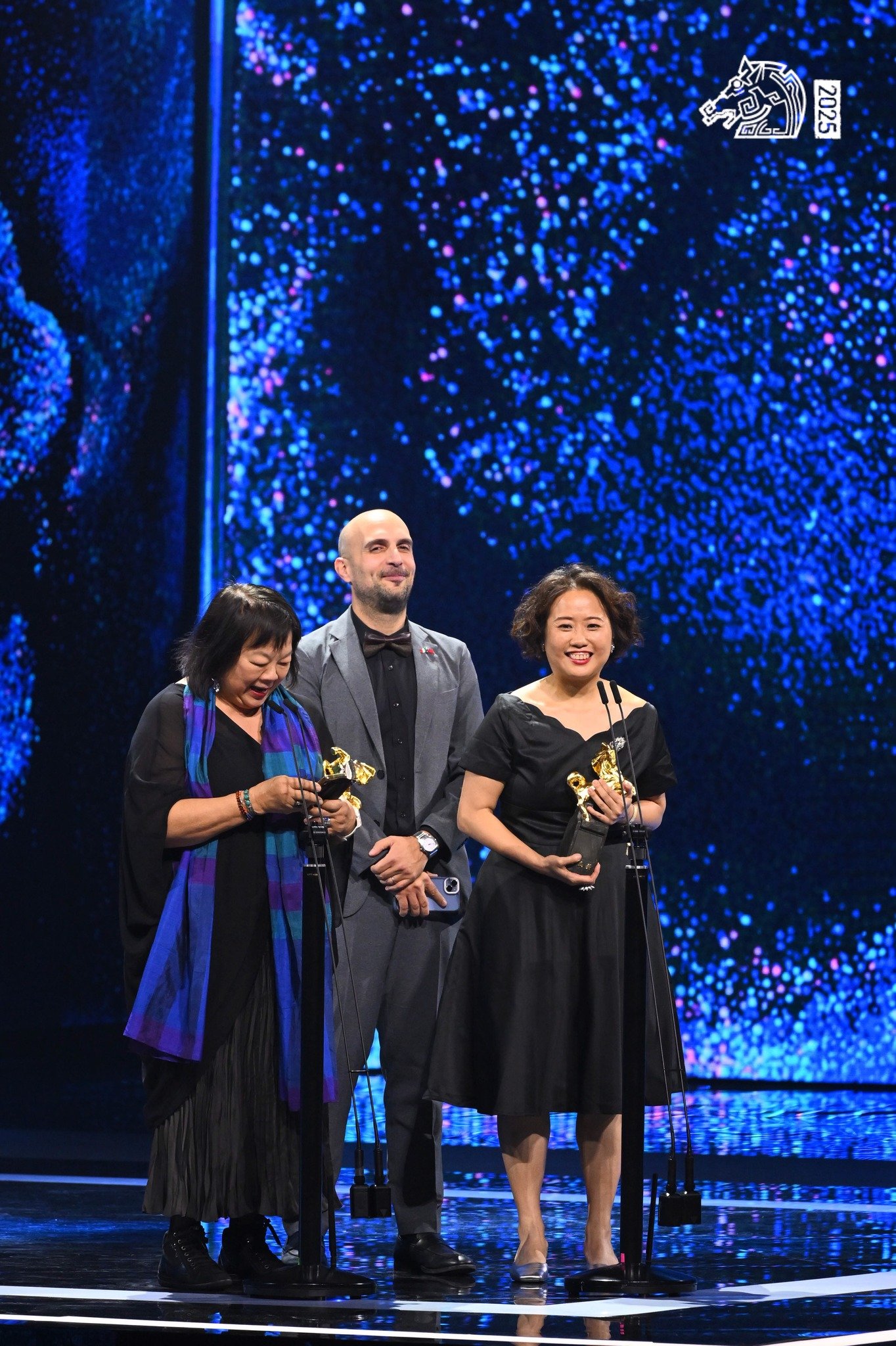
Mary Stephen is a long-time collaborator of Éric Rohmer as editor of ten of his works, is one of the most influential professionals of her generation. Born in British-ruled Hong Kong, she moved with her family to Montreal in her youth and achieved success upon relocating to Paris, where the collaboration with Rohmer began. A director and artist herself, her works include both shorts (“The Great Canadian Puberty Rite,” “The Memory of Water or Jeanne Moreau and Steamed Fish”) and mid-length/features (“Ombres de Soie,” “Vision from the Edge: Breyten Breytenbach Painting the Lines”), whose avant-garde imprint still fascinates cinephiles and film scholars alike.
Stefano Centini (also known as Chen Xiwen), an Italian-born Taiwanese producer, has significantly contributed to the advancement of Taiwanese cinema throughout his career. In 2018, he founded Volos Films, a production company based in Taipei and Rome whose mission is to facilitate coproduction efforts between Europe and Asia, building upon his extensive experience with independent features and documentaries. Among Volos Films’ most successful features are “A Holy Family” by Lu Ying-liang, “In My Mother’s Skin” by Kenneth Dagatan, and “Stranger Eyes” by Yeo Siew Hua.
On the occasion of the 62nd edition of Taipei Golden Horse Film Festival (Nov. 6th – 23rd, 2025), where Stephen’s latest effort “Palimpsest: The Story of a Name” (France/Hong Kong/Taiwan), produced in Taiwan by Centini’s Volos Films, was crowned for both Best Film Editing and Best Documentary Feature, we interviewed them about the significance of this film and its unique production process, as well as about the memories it discloses.
Mary, could you please tell us about the creative process behind “Palimpsest”? How did you come to think of it, and how did Stefano come to be involved in the project?
Mary Stephen (from here on, M. S.): I have been wondering about the origin of my last name for many years, but I wasn’t interested in making a straightforward documentary. Rather, I was interested in making something more cinematic, exploring the nature of cinema. The idea first came to me when this Chinese friend of mine, a writer, told me that Virginia Woolf’s maiden name was “Stephen,” so I thought to myself: “Why not making a crisscross where the stories of the two Stephen families come together?”.
As for Stefano, he has been known in the industry for a long time. He is somewhat unique in our field, as an Italian producer based in Taiwan who speaks Chinese fluently. I began working on the project with the French production company 24images, whose founder Farid Rezkallah has been a friend for several decades and has already been involved in Taiwanese documentary projects. Farid and 24images producer Annie Ohayon were thinking about Stefano joining the project, and Annie organized a dinner at her place so that I could meet Stefano and talk about it.
By that time, Teresa Kwong, a long-time friend and professional collaborator from Hong Kong, who started her own producing company ProduSa Limited, had already got on board since my film is primarily set in HK, my birthplace. Thus, it became a three-way coproduction.
Stefano, during your speech at the Golden Horse Awards Ceremony (where “Palimpsest” was crowned for both Best Editing and Best Documentary), you made some remarks about how the local industry and festivals should be more supportive of independent, arthouse projects. What difficulties did you encounter in producing “Palimpsest,” and how difficult it is to produce similar movies in general?
Stefano Centini (from here on, S. C.): As a country, Taiwan used to favor independent cinema, owing much to the Taiwanese New Wave and its role in making Asian cinema known worldwide. Compared to other countries in the region, this kind of support was more prominent, until two years ago when, following a change of government, the focus shifted towards more ‘commercially viable’ projects. This implies that government funding would be rather granted to larger production companies, not necessarily Taiwanese-owned, and in some cases even to multinational conglomerates.
This change of direction also reflected on TAICCA (Taiwan Creative Content Agency), established under the former President Tsai Ing-wen [in office from 2016 to 2024 for two mandates]. Since its earliest days, TAICCA has been a huge supporter of independent cinema, but following some changes in its funding mechanism, confirmed by its new president [Erica Wang Min-hui, appointed on August 1st, 2025], it has shifted its focus to projects with higher earning prospects.
TAICCA holds an investment fund whose mechanism allows it to earn returns on the revenues of the films it has produced. I believe there’s nothing wrong with this, but it doesn’t feel right to prioritize projects just based on earnings returns: this should be the priority for privately-owned companies, not public agencies.
The point of my speech at the award ceremony, reflecting my European education and the importance of state support to art, is that governments should be concerned more with artistic value rather than financial gain, precisely because private companies in our industry are already concerned with that kind of gain. Doing otherwise would be somewhat in contradiction with the purpose that national governments are supposed to fulfill, and prevent bolder and riskier projects from seeing the light of day. We are lucky enough in Taiwan to still have other entities that support independent cinema, such as the National Culture and Arts Foundation – the only Taiwanese funding body which supported “Palimpsest” – or the Ministry of Culture, but only the former provides (limited) funding for documentaries by non-Taiwanese directors such as Mary. In any case, none of these institutions have a yearly budget that is comparable to that of TAICCA.
Regarding the details of the production of “Palimpsest,” the main difficulty we encountered was dealing with the ambiguity of TAICCA guidelines. For instance, on the requirements’ checklist to benefit from TAICCA funding, one item required the project to be at least one third in a language spoken in Taiwan, with Cantonese (one of the main languages used in “Palimpsest”) also being allowed. However, after submitting our application, we were notified that our project would not be eligible because the language spoken in “Palimpsest” is Hong Kong Cantonese, instead of Taiwan Cantonese. This is but one of the many reasons that was given to us for rejecting our application.
We believe that this happened because a change of policy was in progress within Taiwan. It’s still perplexing to me, however, why one would establish criteria to identify a project with high economic returns. In my experience of previously collaborating with public and private funding bodies around the world, regardless of the size of the production and the content of the project, in the end only two out of ten films make significant returns.
One of the reasons I could think of for this change of policy is the rising nationalism, upheld by the incumbent government. I totally agree with the idea of supporting more Taiwanese directors, but TAICCA’s investment fund is currently the only national fund that provides significant support to projects also by non-Taiwanese directors. The fact that TAICCA prefers funding projects based on financial rather than artistic value, with the decision-making process entrusted mostly to Taiwanese financial experts, creates a situation where funding is more easily available for projects designed for the domestic market –and this is precisely what’s happening, if we take a look at the latest projects supported by TAICCA.
As a result, Taiwanese participation in films that are showcased in A-tier festivals has shrunk compared to before, which represents a contradiction for a government that supposedly aims to raise national visibility. It’s a historical contradiction too, considering that Taiwan owes much to immigration, and that the idea of a unique ‘Taiwanese’ identity draws from the cultural blend of identities that have existed in the island over time.
M. S.: To provide a point of view on how state support works somewhere else, I’d like to mention the example of France. Here, we are very lucky to have many funding opportunities. The public institution CNC (French National Center of Cinema) is a major source of funding for French cinema of all kinds. There are also many other regional funds. ARTE, a French-German arts-and-culture-focused broadcaster, is a unique organization we don’t see anywhere else: they are a main partner for this film, with their amazing auteur documentary program La Lucarne curated by Rasha Salti.
On the other hand, there are other ways to make art films, such as through the Arts Councils that exist in many countries, even though you may need to be ready to accept budgetary restraints. This is going to happen for my next film, that will be almost completely self-produced. In a way, my next project will be a return to origins, as an artist trying to manage everything on their own with the help of some close friends.
“Palimpsest”is a movie where memories are reconstructed through the medium of documentary cinema. As a director and editor, Mary, do you believe that documentary does have the power to disclose a deeper truth than fiction? Has “Palimpsest” actually helped you, on a personal level, to get to some sort of ‘truth’ about your family history?
M. S.: We can say that documentaries are based on facts, but facts do not necessarily equal the truth. Coming from experimental and fiction filmmaking, I gradually understood that documentaries are also based on storytelling. As a result, there is no such thing as an objective documentary: everything that you choose to include in your final cut is subjective. When I started editing documentaries, I realized how great a responsibility a documentary editor has: the film can be edited so as to go in completely different directions, having people watching it feel one way or the opposite.
Whether I have managed to get to some sort of truth about my family, it’s rather the personal journey that matters: it’s the process of looking at the past that is important. Many people who watched “Palimpsest” told me that, even at the end of the film, they couldn’t figure out what had really happened, but there was no promise to lead them to a definite answer in the first place. The point is the personal journey, and the one I embarked on in the making of “Palimpsest” allowed me to learn so much about myself.
Despite different backgrounds, both of you happen to be ‘displaced’ from your supposed place of origin. How have you dealt in the past and how do you deal with your sense of belonging and identity, or lack thereof? In the case of Stefano, does “Palimpsest” resonate on a personal level for you too?
M. S.: Very strangely, the place I feel most at home is the one I spent the shortest time: Montreal, in Canada. I was there only for seven years and a half, which isn’t much compared to my forty years in Paris and fifteen years in Hong Kong. The reason is that those were my formative years, when I learned the most about myself and what I love to do. In terms of identity, some people try to determine it by asking me in what language I dream, but it really depends on the person I have been speaking to before I go to sleep. And very naturally, almost all of my collaborators on this project have some immigration or uprooted identity experience of their own.
S. C.: Definitely, “Palimpsest” is a very important film on a personal level for me too. It was a welcome surprise when Mary asked me to work on it: I understood it was because of the professional network and resources I could provide for from Taiwan, but also because I could relate with her on the main topic of the film. Just like Mary’s, my life was not based in a single place: I was born in Rome and conducted a large part of my studies in Paris, but then I came to Taiwan, and I’ve been living here for fifteen years now. Here I spent my formative years as a producer, and here I decided to start my own company.
In terms of identity, I would say it’s something very fluid. I’ve never felt the need to be exclusive about belonging to either one country or the other, and this reflects in the projects I work on. My company has a branch in Rome too, and there I am working with second-generation directors who show a cultural background halfway between Italy and China. It’s a characteristic shared also by other producers in the industry, such as Fran Borgia, the founder of Akanga Films, who is Spanish-born but based in Singapore since 2004. This allows us to find new stories and new ways of retelling them.
“Palimpsest”is a film in which memories intertwine with the history of places and people. Mary, can you tell us about the research process behind it? How difficult was it to collect all the materials and footage, and to reorganize them through editing?
M. S.: “Palimpsest” is based mostly on family films, which my father loved to shoot. The reels were physically stored in my sister’s basement, and we had been thinking of making something with them for a long time. We decided to digitalize them so that I could examine them in detail: it was a very interesting process in that I was able to see things I had never seen before, such as a reel of me as a baby fiddling with 16mm film cans.
In addition to that, we had a lot of written material: my father’s journals. I must say that I couldn’t read all of them because there was more than a hundred. As you know from watching “Palimpsest,” they are very precious documents about that period, but my father also added a lot of fiction when writing: telling apart every bit of reality from fiction would have been impossible, unless I meant to make a comprehensive study of the journals alone.
I often joke about this, but it’s true that I stopped reading them for the sake of my mental health. You end up getting involved in the past too much: a past that you don’t even know if it’s real, and that can get you to a strange place. That is what I wish to be the final takeaway from watching the film: your destiny is your own to create, don’t get too wrapped up in the past.
As for the editing, it was a very difficult selection process, even more so because I was editing my own film: I didn’t have enough distance to look at my own work. That’s why I asked for the help of an editing consultant, Chaghig Arzoumanian, who is a Lebanese Armenian and belongs to a cultural background different from mine. I needed someone from a different culture but who shared the same experiences of displacement and exile: this would grant enough distance but at the same time understanding of the content, a combination required for the editing of “Palimpsest.”
She helped me a lot in trusting my material. She forced me to look at everything I had collected and pointed out what was interesting to her, and when she was doing it, I could be sure that she wasn’t looking at it from an exotic perspective. I believe it would have been much more difficult to select the material without the help of someone I trust.
And since the film is mainly composed of historical footage as well as my father’s own, it meant a lot to have the incredibly richly-textured sounds created by 3H Sound Studio in Taipei, which was essential to storytelling. I feel very honored to have had the chance to work with Master Tu Duu-chih and his team, alongside Haruyuki Suzuki-san from Japan who contributed with his innovative music. The image composition and color-correction were carried out in post-production in my current hometown of Paris, with Paxine PostMédias and the talented eye of Pascal Torbey, a French national with Lebanese roots. Obviously, the diversity of our team provided valuable nuances to the film.
In “Palimpsest,” Henry is depicted as a man striving for resemblance (in terms of wealth, fashion, and language) with the British, and the ‘West’ in general. If you look at contemporary Asian cinema, do you feel there is a similar tendency towards imitation, or rather that directors maintain their own, authentic voices?
M. S.: When you think about commercial cinema, the model is the same regardless of the country, and that is American cinema. When I was teaching in Australia, I remember that my students were trying to make some sort of “Star Wars” imitation: I told them not to look for inspiration across the Ocean, as their land could provide enough already. Therefore, I don’t believe it’s a matter of ‘imitating the West,’ but rather of imitating that all-powerful model of American cinema.
Talking about Asia, when it comes to independent cinema, I believe that we can appreciate a completely different language. Just as a random example, I can think of contemporary Thai or Cambodian cinema: it’s something genuinely new. Directors tend to express their authentic voices in this kind of low-budget, independent productions. In fact, I tend to be very careful towards films that benefit from large budgets and generate a lot of buzz around them. Often, they don’t provide us with the authenticity we are looking for, even though that is perhaps due to my taste for more ‘difficult’ films.
These days, some of my previous features and shorts that have been restored with the support of M+ Museum in Hong Kong are being screened in festivals at the same time as “Palimpsest.” Younger audience seems to enjoy how avant-garde and radical they look, but I wonder if that’s really the case: there’s a whole generation of filmmakers before me who had been making this kind of cinema, and opened the way – such as Chantal Akerman and Marguerite Duras, for European cinema.
However, our contemporary society is really about mass culture: perhaps the younger generation watches less of this kind of movies compared to when I was a student.
S. C.: I believe imitation is a natural component of cinema, especially with regard to the past. If we take the case of Taiwanese cinema, the previous generation of directors has had such a relevant impact that filmmakers today still feel the need to establish a dialogue with their heritage. However, it’s surprising how the Taiwanese New Wave is more popular among directors from Singapore, Hong Kong, and neighboring countries than among the latest generation of Taiwanese directors.
Overall, I believe imitation can be fruitful as long as the artist provides their own reworking of the original material, expressing their personal evaluation of what the referenced tradition represents. Unfortunately, this kind of ‘fruitful imitation,’ so to speak, is lacking in contemporary Taiwanese cinema: I don’t see that kind of Neorealist drive that had directors take the camera out of the studio, portraying everyday life and people but also criticizing the establishment of those times.
Despite the great changes that Taiwan has gone through as a country in the last forty years, its cinema has been somewhat lagging behind, leaving such changes undocumented on film. Still, I can see why this has happened, because the scene of contemporary Italian cinema is quite similar.



