
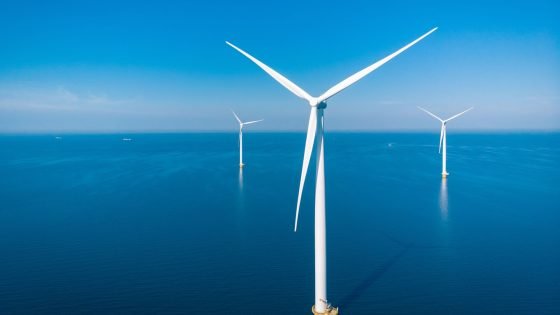
The UK Government has delayed a decision on two 1.5GW Dogger Bank South windfarms just days before the deadline for a decision came due. As a result, the deadline of 10 January 2026 has been moved to 30 April 2026.
The UK Government has delayed a decision on the 3GW Dogger Bank South windfarms just days before the deadline for a decision came due. As a result, the deadline of 10 January 2026 has been moved to 30 April 2026.
Announcing the decision, the minister for energy consumers Martin McCluskey told parliament that “I have decided to allow an extension and to set a new deadline of 30 April 2026. This is to allow time to request further information that was not provided for consideration during the examination period and to give all interested parties the opportunity to review and comment on such information.
“Whilst it is not my preference to extend, I am clear that applications for consent for energy projects submitted under the Planning Act 2008 must meet the necessary standards.”
Applications for both Dogger Bank South West and Dogger Bank South East proposals are affected by the delay, though there are no indications that the delay reflects a more or less likely decision in favour of consent.
Dogger Bank
Dogger Bank has already become what is in effect the world’s largest wind farm, though technically the site is made up of multiple jointly-developed wind farms.
Approximately 125km off the cost of Yorkshire, the site is valuable for being both distant from shore but also having shallow water depths of just 40m to 50m.
The project was originally proposed by SSE, RWE, Statoil and Statkraft in November 2008, with Dogger Bank A, B and C windfarms producing an estimated 3.6GW of energy. A fourth site, now called Sophia, is targeted at 1.4GW.
Far more recently, in 2022,, RWE obtained approval from the UK Secretary of State for Business, Energy and Industrial Strategy (BEIS) to enter into an Agreement for Lease with The Crown Estate in for two new sites – Dogger Bank South East and Dogger Bank South West. The two new offshore wind farms will each have a capacity of 1.5GW generation if they go ahead.
Is a delay bad news?
While the news may prove frustrating for RWE and Masdar, who have been working together on both developments since 2023, such delays may ease the risk of extensive judicial review further down the line if the delay succeeds in reducing gaps in information.
In 2024, the Lower Thames Crossing (LTC) DCO decision deadline was delayed until spring 2025. When that decision was finally made positively for the project, the outcome was not challenged through judicial review at all. LTC executive director Matt Palmer told NCE at the time that “We had a small celebration about the DCO going through, but the thing we’re most proud of is the lack of a judicial review. The fact that we’re the first major piece of infrastructure in the UK, from memory, since about 2014 or 2015, to not get judicially reviewed is a real validation of the work and the effort we put in.”
This view is also reflected among some significant figures in consultant engineering firms, because of the delays judicial reviews can cause even if they ultimately clear a project to go ahead.
WSP UK and Ireland president Paul Reilly told NCE when commenting on planning reform “We’ve got quite a big and well-regarded infrastructure planning team at WSP, so I got them to look at the mathematics of delays. […] Only around four months of the increased time is when plans are in process. And that arguably is a good thing, as it gives us a little bit more time in the actual process of examination to go out and fix things or to get more evidence or to just adjust things and be flexible in our approach to get to a deliverable consent.
“Because then we’ve got the famous delays post-consent, which are about five months on average but for those that have suffered a judicial review, they’re delayed by about an additional 15 months.”
Like what you’ve read? To receive New Civil Engineer’s daily and weekly newsletters click here.
Source: www.newcivilengineer.com



