The impact of the Hindu majoritarian influence on India’s education was visible yet again recently, when the National Medical Commission (NMC), a federal regulatory authority for medical education, announced on January 6 that it was withdrawing permission for the Shri Mata Vaishno Devi Institute of Medical Excellence (SMVDIME) to start a medical degree course in Jammu and Kashmir (J&K)’s Reasi district.
The SMVDIME released its first admission list for the medical degree program for the 2025-26 academic year in November.
Of the 50 pupils in the inaugural batch, 42 were Muslims, most of them residents of the Muslim-majority Kashmir Valley, while seven were Hindus and one was a Sikh. Jammu, where the institute is located, is a Hindu-dominated region.
The institute operates under the Shri Mata Vaishno Devi Shrine Board, a statutory body that manages the Vaishno Devi temple, one of Hinduism’s holiest shrines. It was established last year to provide medical education and healthcare in the troubled region and is attached to a 230-bed super-specialty hospital.
Funding comes mostly from the shrine’s income from donations by pilgrims. However, the institute also receives funding from both the J&K government and the federal government.
Admission to medical programs in India is based on performance in a centralized entrance examination, the National Entrance Examination Test, conducted by the federal Ministry. Those who got into the SMVDIME did so based on merit.
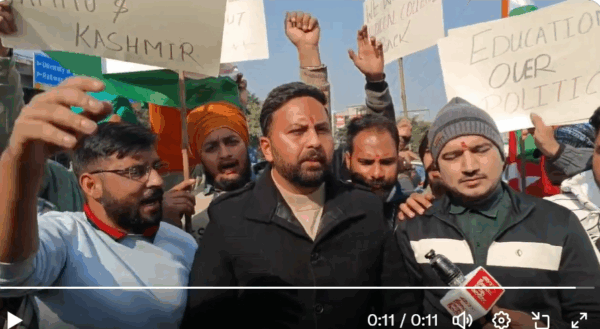
As soon as local Hindu groups found out about the religious composition of the college’s inaugural batch in November, they launched demonstrations demanding that the admission of Muslim students be scrapped. They argued that since the college was chiefly funded from the offerings of Hindu devotees, Muslim students had “no business being there.”
“Only those who have faith in Vaishno Devi should get admission there,” declared the Bharatiya Janata Party (BJP)’s Sunil Sharma, the leader of the opposition in the J&K assembly. The BJP, India’s ruling party, is a Hindu nationalist party that is part of the Sangh Parivar, a family of Hindutva organizations that espouse the ideology of Hindu supremacism.
Agitations led by the Shri Mata Vaishno Devi Sangharsh Samiti, an umbrella group of over 60 Sangh Parivar organizations, erupted, forcing the NMC to withdraw recognition to the SMVDIME, citing infrastructure and faculty deficiencies. The college authorities said they were not even issued a show-cause notice before cancelling the permission.
Even as Hindu majoritarians celebrated the college’s closure, India’s opposition parties criticized the decision. “This is a blatant surrender of the education sector to the likes and dislikes of extremist communal forces. This will pave the way for the deterioration of the quality of medical education,” said the Students’ Federation of India, the student wing of the Communist Party of India (Marxist).
This incident came amidst growing concerns over India’s steady backslide on academic freedom, as academic institutions and policies come under the increasing ideological and organizational influence of the Hindutva forces. There has been a series of incidents of event cancellations; incidents of visa denials to foreign academics; and PhD proposals on politically sensitive issues, such as Kashmir, facing scrutiny or even administrative backlash. All this is in addition to the repeated charge of controlling appointments.
Since the BJP came to power nationally in 2014, functionaries belonging to various Sangh Parivar organizations have been appointed to top posts in government institutes related to education and culture. The campuses have witnessed an ever-intensifying push for neoliberal reforms and promotion of the Hindutva camp’s Vedic Aryan supremacist ideals, through changes in curriculum, policies and practices. They have been reshaping Indian history and calling for combining Vedic education system with modern education, triggering concerns and protests.
“Academic freedom is a central issue of concern in contemporary India,” said Zoya Hasan, Professor Emerita at New Delhi’s Jawaharlal Nehru University, in 2025.
She noted that “rising government interference, incremental political pressure, and a string of ideological curbs on teaching and research” have had a direct bearing on the functioning of universities and academic institutions. “A direct fallout has been an erosion of critical inquiry associated with a vibrant education system,” she said.
On January 6, 2025, the University Grants Commission circulated a draft on faculty and academic staff appointments and promotion. It faced widespread criticism, as it gives overarching power to the federally-appointed governors of different states in selecting and appointing vice-chancellors of various state universities.
Global watchdogs have repeatedly pointed to India’s shrinking space for academic freedom. “The heads of prestigious academic institutions are increasingly selected for their loyalty to the ruling party,”the U.S.-based democracy watchdog Freedom House stated in its latest report. The Sweden-based Varieties of Democracy (V-Dem) Institute’s Academic Freedom Index 2025 classified India’s academic freedom as having slid down from “moderately restricted” in 2014 to “completely restricted” in 2025.
Amidst this downward journey, SMVDIME’s closure will go down in history as a new low.