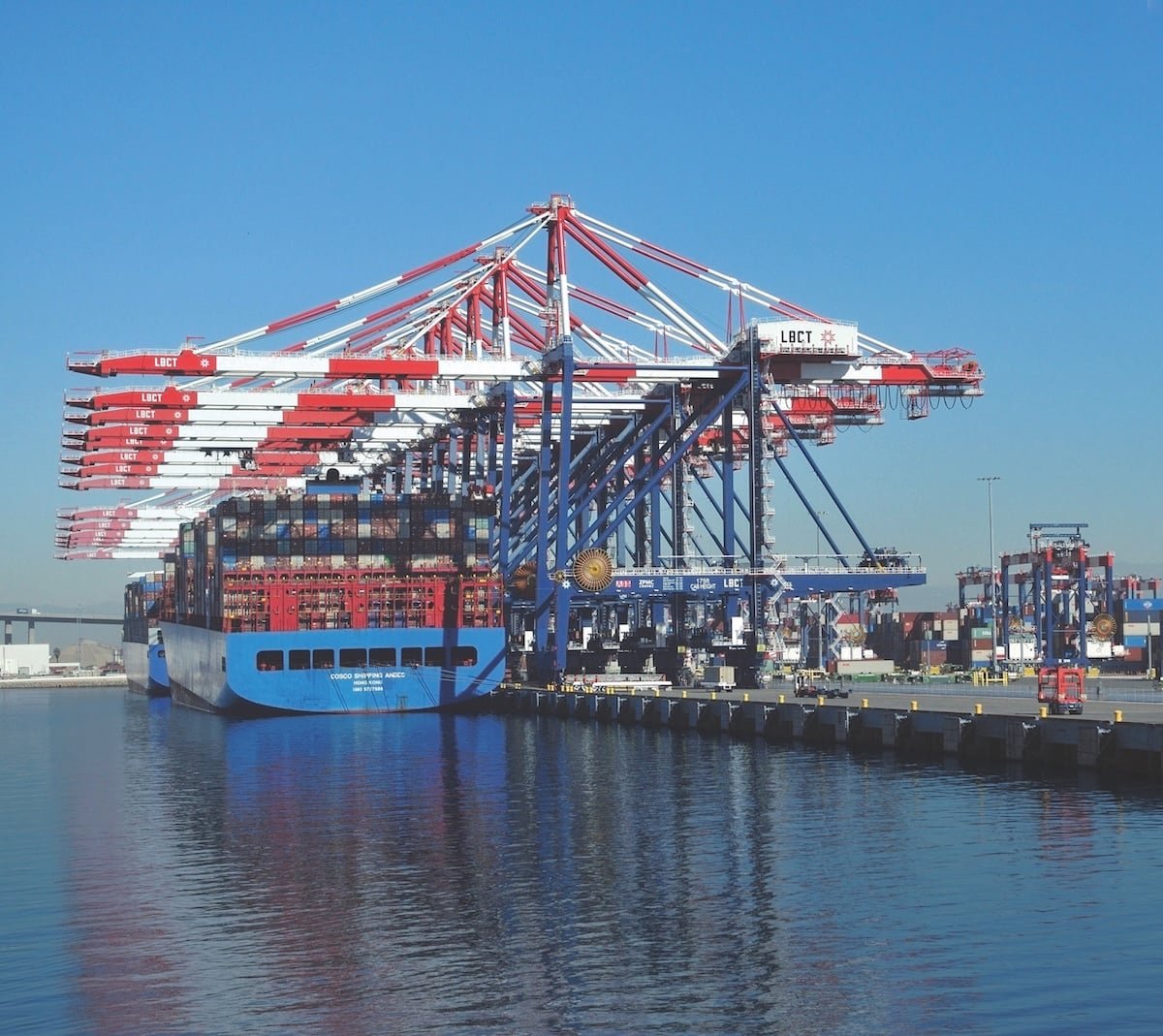
A year marked by a sclerotic trade policy that saw tariffs come and go, rise and fall, did not stop the Port of Los Angeles and Port of Long Beach from hosting a combined record year of cargo movement.
By the year’s end, the two ports – which are by several estimates responsible for about a third of the nation’s imports – saw more than 20.1 million TEUs of cargo move in their terminals.
It’s an achievement primarily borne of shippers racing to bring in as much cargo from Asia – mostly China – before tariffs would start increasing prices for consumers here.
For the Port of L.A. – whose dockworkers handled more than 10.2 million TEUs – it was the third busiest year on record, only 58,000 behind last year’s total.
“I’m proud to say that for the 26th consecutive year, the Port of Los Angeles remains America’s busiest container port,” Gene Seroka, executive director of the Port of L.A., at his State of the Port address last week. “Every record set and every bar raised is a direct result of the dedication and commitment of the people who make this port work.”
For the Port of Long Beach, it was more than 9.88 million TEUs – an all-time record.
“We celebrate the record cargo volume not just for the status but because we know that every container that crosses our docks strengthens the national economy. Goods movement is literally the economy in motion,” Noel Hacegaba, the Port of Long Beach’s new chief executive, said at his own State of the Port address this month. “In the face of historic uncertainty, cargo kept coming and we kept it moving. And, by keeping cargo moving, we kept the economy moving. Once again, we proved to be the heartbeat of the U.S. economy.”

Capping off the year, the ports combined for a solid volume of more than 1.62 million TEUs – the acronym for 20-foot equivalent units, a relatively general way of measuring cargo volume.
Dockworkers at L.A. handled 791,588 TEUs, while those in Long Beach handled 834,119. When broken down, that included 424,499 and 392,153 loaded import TEUs, respectively. On the loaded export side, L.A. sent 108,075 TEUs and Long Beach sent 102,443 TEUs out. The remaining sum is represented by empty containers moving in either direction.
Considering the ports combined volume for this past year have surpassed 2024’s total volume is even more remarkable, since they were in negative year-over-year territory for seven months in 2025. This feat was most bolstered by January 2025’s numbers, which were a nearly 350,000-TEU gain from the prior year – one of the earliest responses to President Donald Trump’s administration’s plans to implement new tariff policies that would disrupt trade altogether following his electoral victory in 2024.
Hacegaba characterized the ports’ success as defiant of the “doom and gloom” that followed Trump’s sweeping tariffs announcements.
“A year ago, amid the prospects of new tariffs on U.S. imports, some were saying, ‘We’ve seen that movie before,’ referring to the 2018-2019 U.S.-China trade tensions,” Hacegaba said. “But the movie we saw last year was not a rerun – it wasn’t even a sequel. ‘Liberation Day’ – when the highest tariffs since the Great Depression were imposed on virtually every U.S. trading partner – was simply sweeping and unprecedented.”
Surely anticipating worsening tensions, shippers reacted accordingly – the first four months of the year saw significant gains in imports. Peak season arrived slightly early, in response to pauses in tariffs amid trade negotiations. It was in this window that the Port
of L.A. handled more than 1 million TEUs in a single month, in July – it’s busiest month
on record.


“From accelerated dips in volume to record highs, it truly was a rollercoaster,” Seroka said.
“There’s a lot of change in our world right now,” he continued. “The global trade map is being redrawn. Shifting trade policies are creating uncertainty and volatility. And the maritime supply chain is at the center of it all.”
The last five months of the year illustrated this point well. Usually, the peak import
season for back-to-school and winter holidays, those final five months saw consisted year-over-year declines.
It was also a year of continuing infrastructure projects at the ports.
The Port of L.A.’s Pier 500 Marine Container Terminal is in the requests for proposal stage. Seroka said he envisions this new development, should it come to pass, as the “greenest, cleanest” new terminal in the world and vital to allowing the port to handle growing cargo volumes.
That port is also presently designing a maritime support facility on terminal island to serve as a hub for chassis parking and container exchange. And Fenix Marine Terminal is working with the port on a plan to develop an unused 40-acre plot of land next to its terminal on Pier 300.
At Long Beach, work continues at Pier G – operated by International Transportation Service – to fill in a slip that nearly bisects the outlet, to the tune of 19 acres of new land to use. This will also create a contiguous wharf that would allow the pier to handle the largest cargo ships on the market.
Construction work also continues on the Pier B on-dock rail facility, which is slated to double the acreage of the current facility and more than triple its cargo movement volume.
Exploratory work on future developments and improvements also continues.
Seroka said he remains in talks with Gov. Gavin Newsom on potentially raising the elevation of the Vincent Thomas Bridge in order to accommodate taller vessels entering the inner harbor. He’d hoped to achieve this during the bridge’s ongoing redecking project but failed to secure funding for it.
Meanwhile, at Long Beach, the former chief executive Mario Cordero – who retired at the end of 2025 and paved way for Hacegaba, then the chief operating officer – helped secure a $20 million state grant toward the development of Pier W, a proposed offshore floating terminal to construct floating wind turbines.