
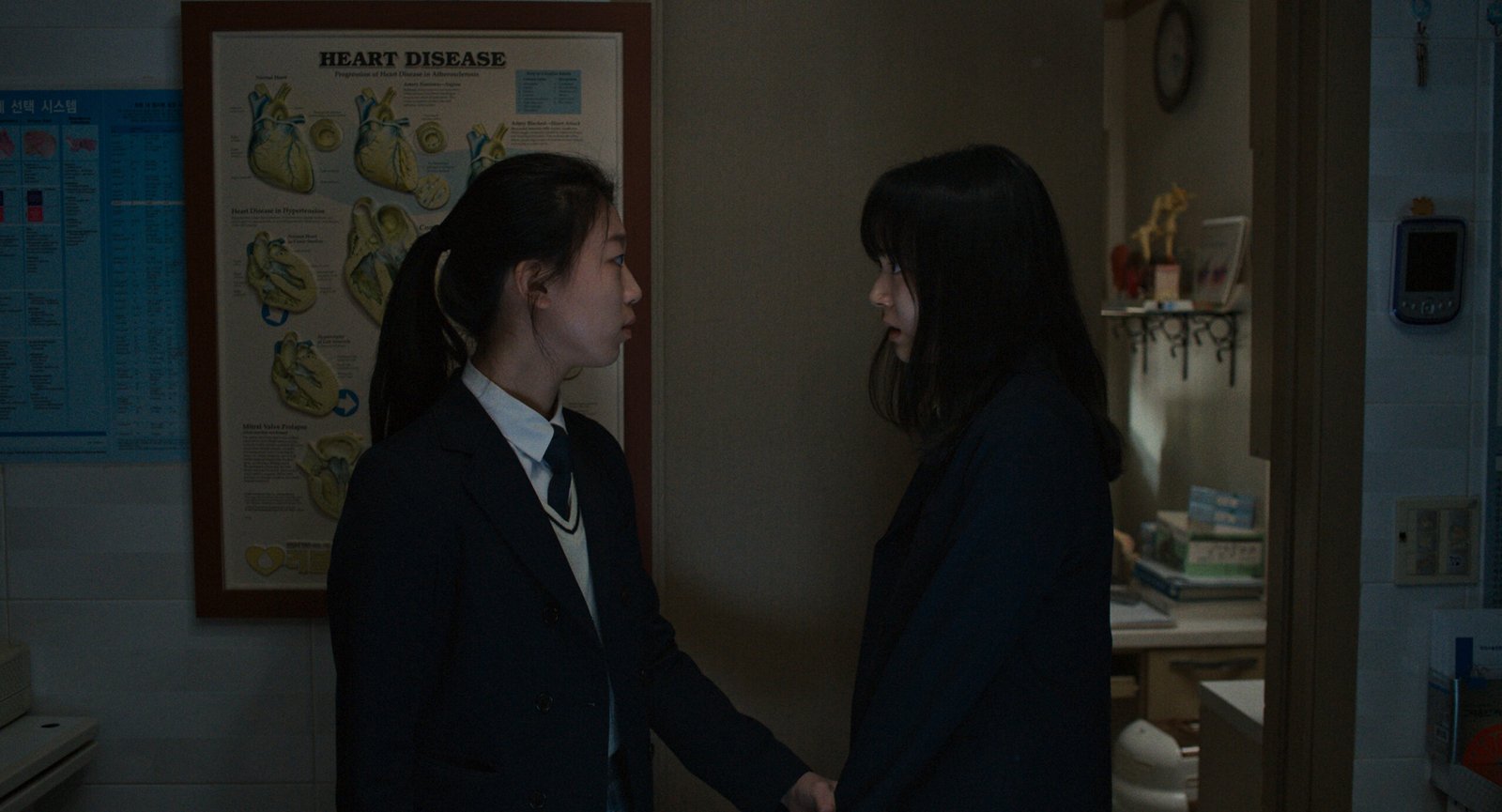
The Korean name of Yoo Jae-in’s feature debut literally means “a road to erasure” – the English title “En Route To” presents a more ambiguous interpretation. The coming-of-age drama, which premiered at the Busan International Film Festival in 2025, screened in the Generation 14plus section at Berlinale 2026. Touching on difficult and stigmatized topics in South Korean society, the director takes her viewers on a journey through ethical dilemmas, heartbreak, and broken trust. A question lingers in the back of one’s mind: where does this road lead to?
One day, a homeroom teacher at an all-girl high school fails to show up. While most of the students are relieved and glad that classes are cancelled, Yun-ji (Sim Su-bin) – a quiet girl – seems visibly uneasy. Doing everything to make the teacher return, she sends him messages, promising to abort his child. Yet being left with no response, she starts taking matters into her own hands: stealing money from her roommate, a popular girl named Kyung-sun (Lee Ji-won), she orders pills on the internet. The whole situation does not go unnoticed by the latter girl, who cannot let the girl get away with that.
Yoo leads the narrative smartly, unfolding the characters’ secrets gradually. At the same time, she does not shy away from portraying various aspects of Korean society, focusing above all on the female experience of motherhood and the choices it entails. Apart from the two main student characters, there are others who have made deliberate decisions either to become mothers or to reject that path altogether.
By offering their own perspectives and motivations, they transform the story from a simple student-teacher affair into a self-aware feminist narration. Rather than delivering clear judgements, the film leaves the viewers suspended between empathy and discomfort, forcing a more personal reflection on responsibility and autonomy.
The two main actresses deliver meticulous performances. Sim Su-bin, who plays the quiet and shy Yun-ji, through her restrained acting and stoic facial expression allows viewers to relate to her situation and sympathize with the helplessness she finds herself in. In contrast, Lee Ji-won’s Kyung-sun – loud and self-confident – introduces a striking opposition that shapes their dynamic. The chemistry between them grows gradually, rooted precisely in these differences. The abortion storyline becomes a crucial point not only for the plot, but for their performance as well: they convey vastly different emotional responses, which simultaneously underline the distance between the characters and the unexpected bond forming between them.
The tension builds steadily, and the question of the final outcome remains unresolved until the third act. Much of this is due to the precise editing by Yoo Jae-in herself and the camera work by Baek Jae-ryung, who previously worked primarily on short productions. A well-drafted narration easily immerses the viewers in the story, guiding them through a rollercoaster of emotions in which light-hearted scenes filled with jokes and laughter collide with more serious, almost tear-jerking moments. Together, these technical choices create a cohesive cinematic language that reinforces the film’s emotional weight rather than overshadowing it.
In the end, Yoo Jae-in’s “En Route To” becomes a story about powerlessness within a society that promises stability and security, yet where adults, instead of offering support, often stand in the way of personal growth. Above all, it is a story about women navigating a world in which men continue to hold invisible authority, despite being – quite literally – absent from the narrative itself. As a well-crafted debut, multidimensional in both its themes and perspectives, it remains thought-provoking while still being genuinely engaging to watch.



