
Quantum computing may sound like science fiction, but it’s here today, and it represents the shiny new thing in high performance computing. Where classical computers make use of binary bytes to store data, quantum computers use the inherent superposition of subatomic states to create q-bits, bytes that are simultaneously on and off, 1 or 0. The result: a computing system that is naturally faster and higher performing.
That additional capability, however, comes with meaningful trade-offs. Quantum hardware is significantly more complex and costly to manufacture than conventional semiconductor chips. Many systems must also operate at extremely low temperatures, requiring specialized cryogenic infrastructure that adds to overall expense and operational complexity.
Despite these hurdles, interest in the technology continues to build. Quantum computing is being explored for applications in artificial intelligence, optimization, materials science, and cloud-based services. According to Precedence Research, the global quantum computing market reached $1.44 billion last year and is projected to expand to $19.44 billion by 2035, implying an approximate 30% compound annual growth rate. North America accounted for roughly 61% of the market.
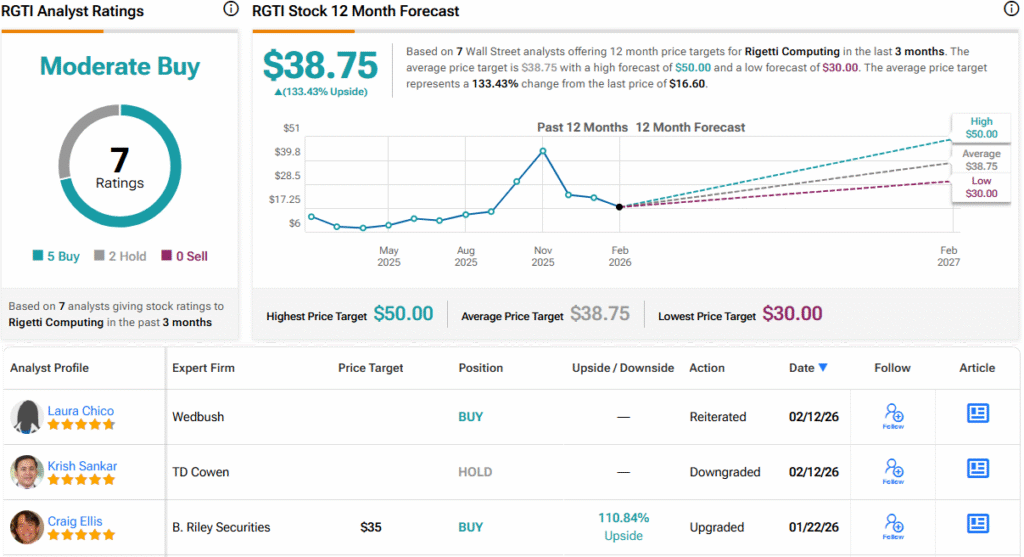
TD Cowen analyst Krish Sankar, ranked by TipRanks among the top 1% of Wall Street analysts, has been closely tracking developments in the sector. After examining two of the leading public players, Rigetti Computing (NASDAQ:RGTI) and D-Wave (NYSE:QBTS), the analyst has identified one as his preferred quantum computing stock at this stage of the industry’s development. Let’s take a closer look.
Rigetti Computing
We’ll start in Berkeley, California, where Rigetti Computing has been bringing quantum computers from the drawing board to the real world since 2013. The company has its hands in all the main aspects of quantum computing systems, and designs, builds, and markets superconducting quantum integrated circuits and processor chips as well as the supercooled dilution systems which those products need to reach a functional quantum state.
Rigetti currently has several commercially available quantum computers, and prides itself on offering flexibility to draw in customers. The company’s flagship system is Ankaa-3, which uses a non-modular chip, and it also offers a smaller quantum computer, Novera, a 9-qubit QPU, designed to operate as a stand-alone unit or linked in tandem. Novera allows customers to set up a boosted quantum computer that can be expanded as needs grow and that provides more power than a single small unit.




