
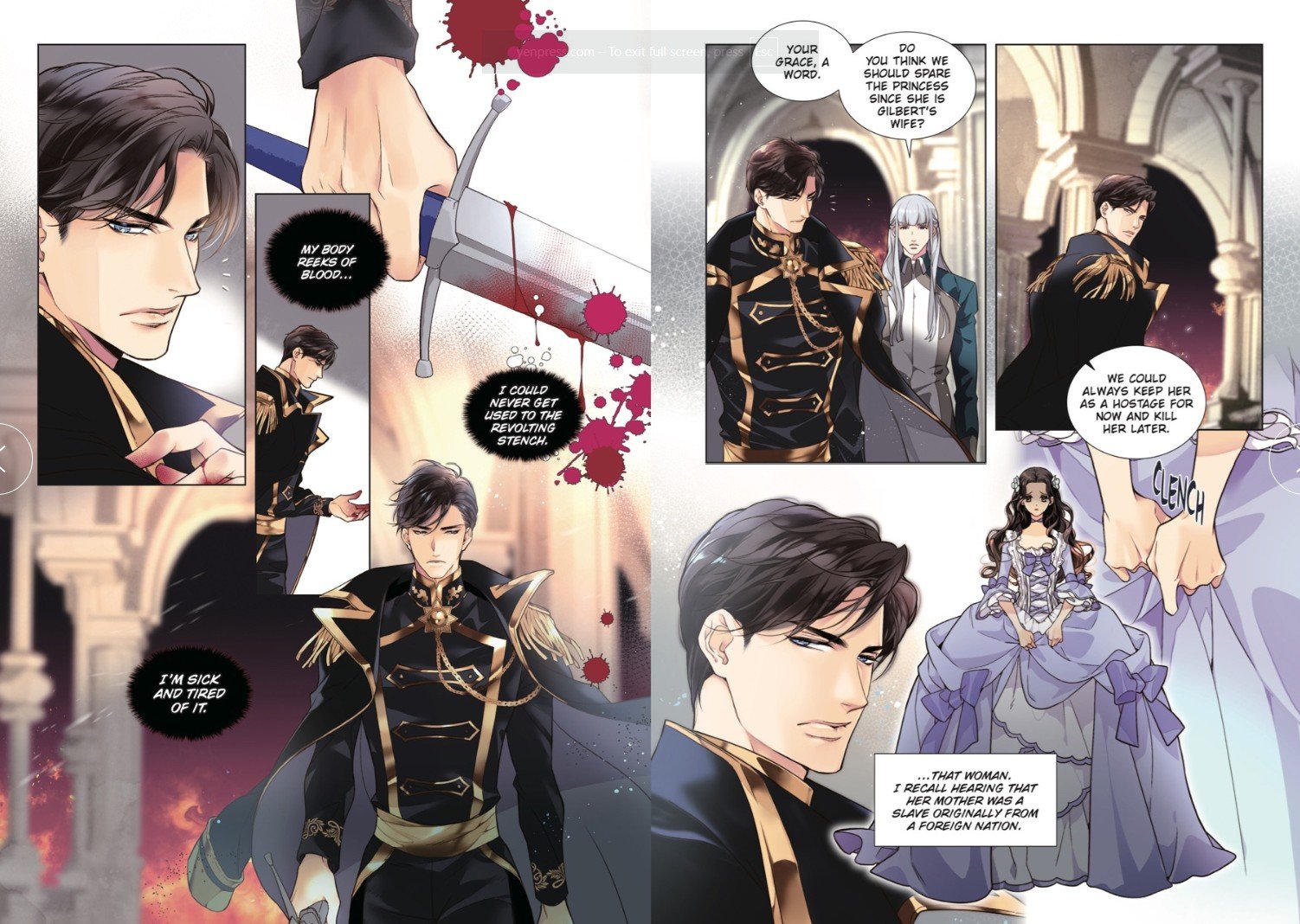
“Beatrice” is written by Macherie and originally began as a webnovel before being adapted into a manhwa released on Tapas, with illustrations by Cierra. Yen Press is now publishing the manhwa in English in volume format. Once more, the premise follows an isekai structure, although the twist lies in the characterization of the protagonist, who appears surprisingly comfortable with her reduced status. Let us take things from the beginning, however.
Buy This Title
by clicking on the image below
Princess Beatrice of Elpasa can do nothing but watch helplessly as Duke Alessandro of the Nosteros Empire invades her country and strips her of her royal status. Unexpectedly, though, she adapts to hard labor with remarkable ease. Having originally grown up as a commoner named Chloe, she quickly reclaims that identity, cuts off her long hair, and embraces the opportunity for a fresh start. As the narrative gradually reveals, before arriving in this isekai world, she had studied Korean medicine. This knowledge soon allows her to stand out within the palace. She is first taken in by a royal physician who recognizes her expertise in herbs. Later, Aron, the prince’s direct attendant, seeks her help to treat his daughter’s insomnia and eventually his own stress. Ultimately, through a series of circumstances, she ends up caring for the Duke’s beloved old horse, a development that slowly brings her closer to Alessandro.
Alessandro, on the other hand, is portrayed as a stubborn young man locked in constant conflict with his father, the King. He rejects nearly every suggestion put forward by him, including becoming the official successor or taking a wife. This tension affects the stability of the entire kingdom. Meanwhile, women continue to pursue the Duke, drawn both to his political position and his appearance. The most persistent among them is Clara Bandoras, the eccentric daughter of the wealthiest family in the realm, who at one point goes to considerable lengths in an attempt to captivate him.
The isekai foundation inevitably recalls “The Apothecary Diaries,” although the setting and overall tone differ significantly. Nevertheless, the pairing of a former medical practitioner who experiences multiple shifts in status and a prince determined to distance himself from both his father and his royal duties forms an appealing central dynamic. This remains true even though, in this first volume, the two characters share limited direct interaction. In particular, Chloe’s trajectory as a lowly servant gradually ascending to more influential positions carries a familiar but effective underdog appeal, encouraging readers to root for her progress despite the somewhat conventional framework.
At the same time, a future romantic involvement between Chloe and Alessandro appears almost inevitable, even if the first volume only lightly gestures in that direction. Macherie even introduces subtle suggestions regarding Alessandro’s emotional distance and ambiguity. Additionally, supporting characters such as Aron, Clara, the palace physician, and the King are sufficiently developed to enrich the narrative and provide further perspective on the protagonists through their interactions.
For the most part, the story maintains a relatively light tone throughout this initial volume, occasionally incorporating comedic elements. Still, the commentary on the position of women within the depicted society, often reduced to instruments of male will, remains clearly present. Where the volume falters somewhat is in the final scene involving Clara and Alessandro, which oscillates between awkward and exaggerated, particularly due to Cierra’s decision to depict the characters in a more childlike visual style during that sequence.
Regarding the artwork overall, however, the quality remains consistently high. The vibrant coloring and meticulous attention to costume detail significantly enhance the material. The Renaissance-like aesthetic of the world is effectively conveyed, while certain panels, especially those featuring the Duke in full figure, are particularly memorable. Although the stylistic approach may not always be groundbreaking, in combination with the coloring it ultimately serves the story well.
Overall, “Beatrice Vol 1” emerges as a competent manhwa that will likely satisfy fans of medieval romance and underdog narratives. Nevertheless, it is in the subsequent volumes that the overall strength and direction of the series will truly be tested.



