
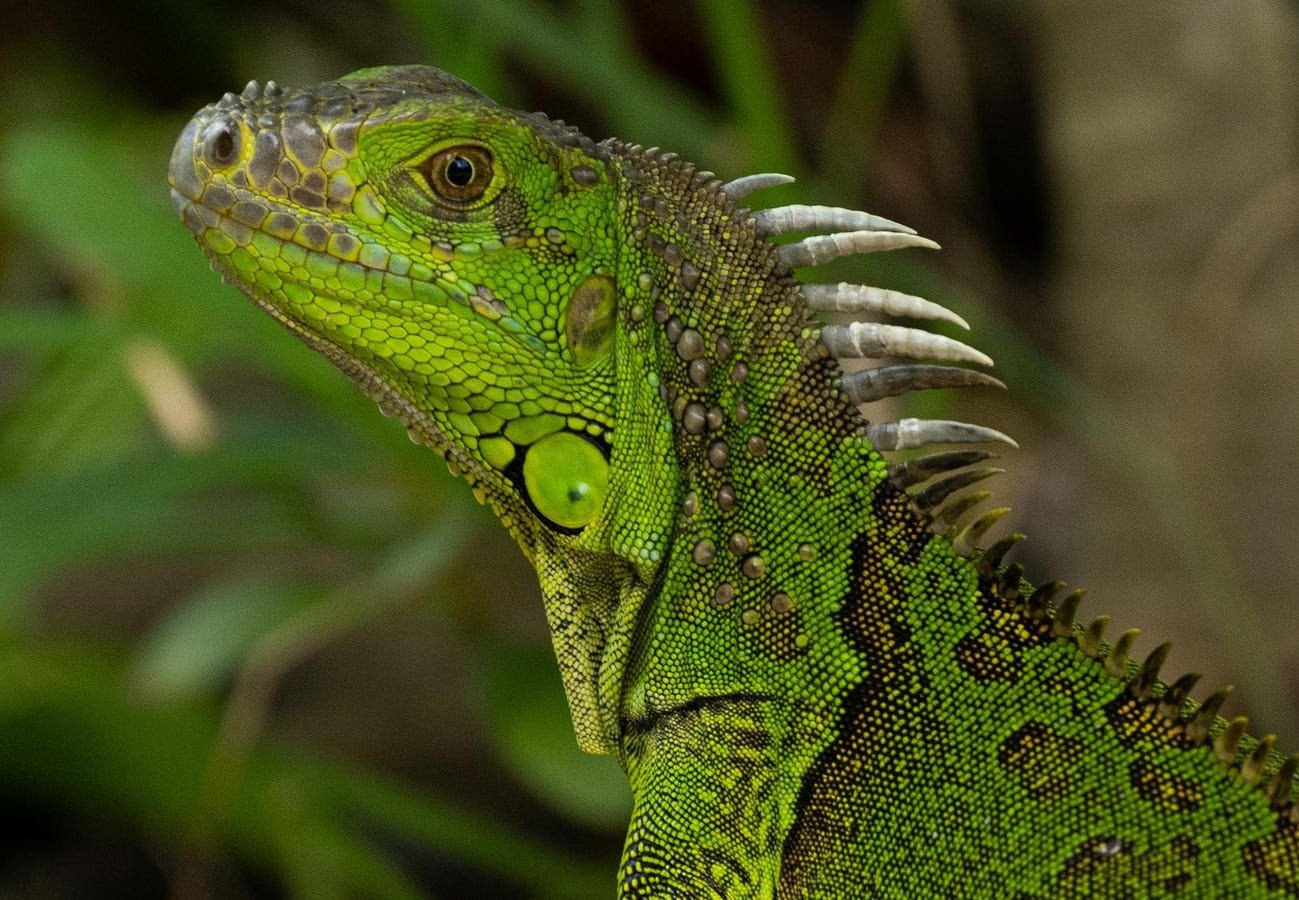
Green iguana in Key Biscayne, Fla.
getty
Extreme freezing temperatures unseen for over a century in Florida resulted in live, cold-stunned green iguanas literally dropping from trees.
Record low temperatures swept across the country including the Sunshine State in late January and early February. Temperatures plunged Feb. 1 to record lows—20 degrees in Apalachicola, 23 degrees in Winter Haven, 29 in Tampa and 30 degrees in West Palm Beach.
National Oceanic and Atmospheric Administration satellites monitored an extreme cold storm over Florida and much of the U.S.
National Oceanic and Atmospheric Administration
Expecting the bitter temperatures would immobilize an invasive species that state wildlife officials have been battling, the Florida Fish and Wildlife Conservation Commission issued an executive order.
Satellite image of the extreme cold storm around Florida producing “cloud streets”—long, horizontal convective rolls of clouds that form as cold air moves over warmer ocean waters.
National Oceanic and Atmospheric Administration
It temporarily allowed Floridians in the south and southwestern regions to collect and transport live, nonnative green iguana without a permit. These immobile reptiles were to be dropped off at specific FWC city locations with 24 hours of capture from Feb. 1-2.
FWC officials issued public reminders against bringing a cold-stunned green iguana into homes or buildings to get warm. When temperatures descend below 50°F, green iguanas become immobilized.
“Iguanas can recover from cold-stunning more quickly than you may expect and, once recovered, can act defensively, with long tails that whip and sharp teeth and claws,” FWC stated.
Green iguanas were first reported in Florida about 60 years ago. They can span over 5 feet long. Males can weigh up to 17 pounds, while females usually weigh no more than 7 seven pounds.
Thousands Caught in 2 Days
Staff member of the BLM’s Jupiter Inlet Lighthouse Outstanding Natural Area holds a cold-stunned green iguana.
Bureau of Land Management
The Arctic blast enabled the easy capture of nearly 5,200 comatose-like green iguanas taken to FWC staff for removal. The following FWC drop-off sites took in:
- 3,882 green iguanas in Sunrise,
- 1,075 at Tequesta,
- 215 in Marathon, and
- 23 at Fort Myers.
“As an invasive species, green iguanas have negative impacts on Florida’s environment and economy,” noted FWC Executive Director Roger Young in a recent announcement. “The removal of over 5,000 of these nonnative lizards in such a short time span was only possible thanks to the coordinated efforts of many staff members in multiple FWC divisions and offices, our partners, and of course the many residents that took the time to collect and turn in cold-stunned iguanas from their properties.”
Florida’s Iguana Problem
A green iguana comes down a palm tree.
getty
Green iguanas mostly eat plants but have been known in Florida to eat tree snails (some of which are endangered) and a thorny vine called nickerbean that is a host plant for the endangered Miami Blue butterfly. These reptiles also consume leaves, flower blossoms, fruit, garden vegetables, ornamental plants, insects and bird eggs.
According to FWC, staff worked to transfer the reptiles to people who have permits authorizing possession of live green iguanas to care for the creatures. Some iguanas were to be sold outside of Florida. “Any iguanas turned in to FWC that could not be transferred to permit holders were humanely killed by trained staff,” the agency stated.
A green iguana eating plants in Florida.
Andy Wraithmell/Florida Fish and Wildlife Conservation Commission
Green iguanas cannot be possessed without a permit in Florida because the reptiles in 2021 became a prohibited species due to their negative impacts on native wildlife and the economy.
“Some green iguanas cause damage to infrastructure by digging burrows that erode and collapse sidewalks, foundations, seawalls, berms and canal banks,” FWC says. “Escaped or released pets remain a primary source of introduced species in Florida, although it is illegal to introduce nonnative species into the state.”
BLM Shares Concerns about Invasive Reptiles
A Jupiter Inlet Lighthouse Outstanding Natural Area staff member in Florida holds a cold-stunned green iguana in February.
Bureau of Land Management
Also concerned with the green iguanas in Florida is the U.S. Department of Interior’s Bureau of Land Management.
BLM notes that these non-native green iguanas in Florida compete with native wildlife for habitats.
In addition, the iguanas “cause substantial damage to public infrastructure. Of particular concern to the BLM, is their tendency to burrow into embankments and shorelines. These extensive tunnel systems lead to the destabilization of the shoreline, increasing erosion and threatening the structural integrity of the historic and natural landscapes,” BLM stated Feb. 4 in a blog about Florida’s problem.
Jupiter Inlet Lighthouse Outstanding Natural Area interns (left and center) and New Solutions ESP member Ivo White wait near cold-stunned green iguanas. The Florida Fish and Wildlife Conservation Commission staff were moving the reptiles for re-home or humane disposal.
Bureau of Land Management
In northern Palm Beach County, cold-stunned iguanas were captured at the BLM’s 120-acre Jupiter Inlet Lighthouse Outstanding Natural Area. Staff there collected 24 of these reptiles in two days.
source: https://www.forbes.com/sites/noelfletcher/2026/02/26/green-iguanas-invaded-florida-nature-fought-back/



