
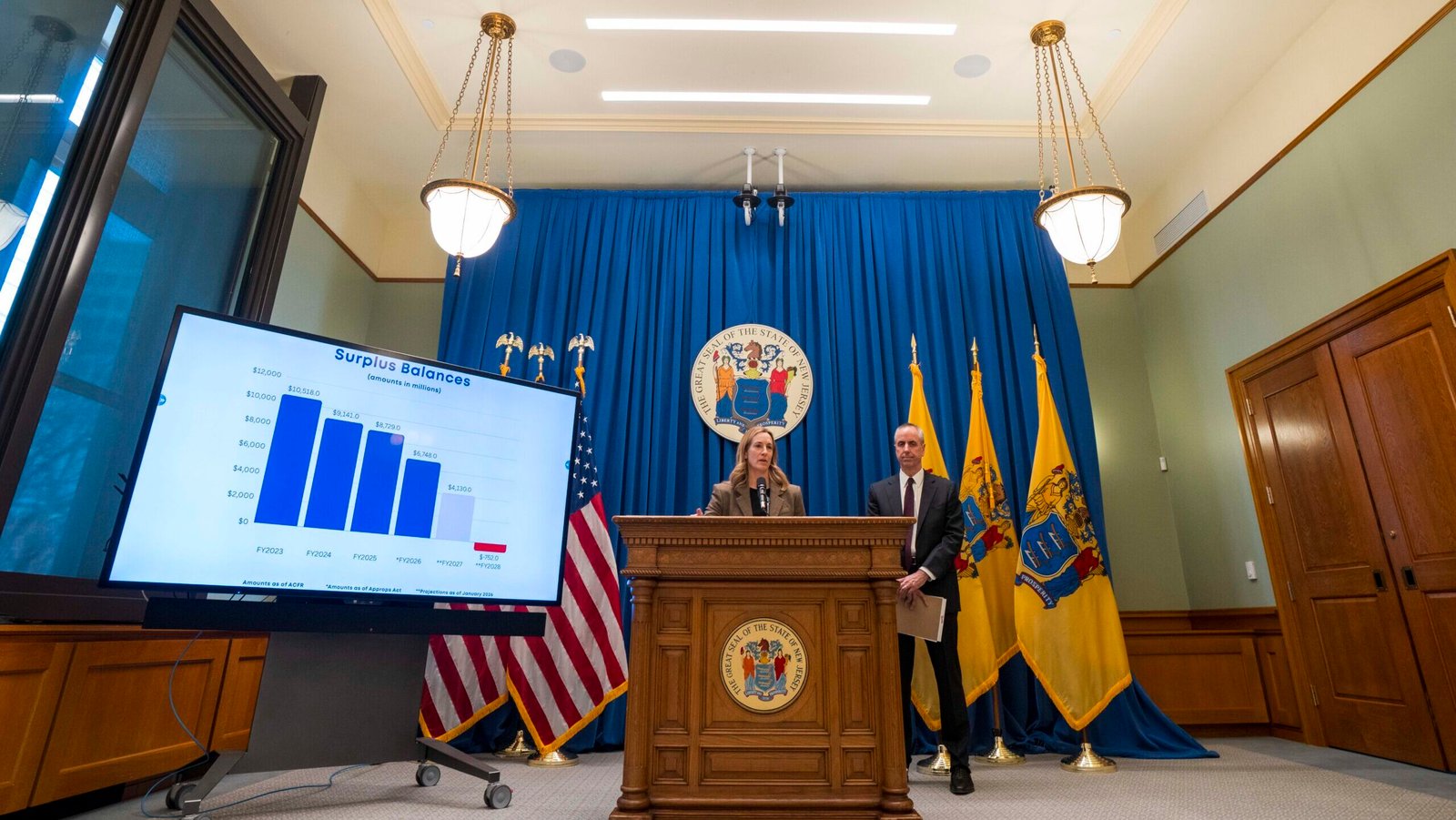
 Gov. Mikie Sherrill seems to have already learned some hard truths about New Jersey’s finances during her first month in office.
She’s inherited a sizable structural budget gap now projected to grow much bigger before the end of her four-year term. And a significant unfunded pension liability that requires billions of dollars in annual spending is also making it harder to find funding for her own fiscal priorities.
As Sherrill prepares to put forward her first state budget plan next week, after getting a few extra weeks from lawmakers to come up to speed, she’s realizing her predecessors often favored short-term expediency over long-term stability.
“Let’s face it, for decades, previous administrations have allowed for business as usual in Trenton, and failed to solve things, long-term,” said Sherrill, a Democrat, during a news conference inside the State House last week.
“We’ve seen too many one-offs, too many temporary fixes,” she said, setting the stage for her March 10 budget address.
In the near term, new budget estimates discussed by Sherrill and state treasurer Aaron Binder during that news conference last week suggest the state will close the current fiscal year in June with a slightly larger budget surplus than was originally forecast.

That’s a positive development, but the effects will be short-lived.
The Sherrill administration is also now projecting the financial outlook will change dramatically after June 30, with a $3 billion gap between projected revenues and planned expenditures now brewing.
Sherrill, a former congresswoman, stopped short of offering up any specific remedies, saying she will share more details on March 10.
But speaking more broadly, Sherrill suggested the fix will require belt-tightening, and not raising taxes. Running at a deficit, something banned by the state Constitution, is also not an option, she said.
It also sounds like Sherrill is looking to use her first state budget to set the table for the entirety of her first term, and not just as a way to skate by for the next 12 or so months.
“I refuse to put off to tomorrow what we have to fix today,” Sherrill said.
After the news conference, Sherrill won immediate praise for talking truthfully about the state’s serious fiscal challenges, including from business-lobbying groups.
“The Governor’s focus on responsible long-term budgeting, finding efficiencies and righting our fiscal ship without relying on more tax increases in an already overtaxed state is very welcome, appreciated and a necessary breath of fresh air for New Jersey taxpayers,” said Chris Emigholz, chief government affairs officer at the Trenton-based New Jersey Business & Industry Association.
To be sure, Sherrill is not the first to suggest that fiscal turbulence was looming, despite a series of credit upgrades touted by former Gov. Phil Murphy during the final years of his two terms in office.
Republicans who serve on the Senate Budget and Appropriations Committee have been warning for months about a structural budget gap that was wider than the Murphy administration had let on.
To back up these assertions, the GOP lawmakers cited disclosures made in writing before a 2025 state bond sale.
 Credit: (Office of Governor / Tim Larsen)
Meanwhile, a group of nonpartisan fiscal and economic policy experts assembled by Rowan University’s public policy center have also issued a series of reports in recent years detailing the potential for future budget deficits based on state government’s latest spending and revenue trends.
And it was just a few weeks ago, on the eve of Sherrill’s Jan. 20 inauguration, that the Trenton-based New Jersey Policy Perspective think tank issued a report warning of a series of “budget time bombs” the new governor would soon have to confront.
These included the structural budget gap, as well as a pending increase in spending required to maintain the costly Stay NJ property tax relief program for senior homeowners.
“NJPP looks forward to seeing the Governor’s plans for how to close these gaps, while balancing the need for affordability for New Jersey’s working families,” the group said in a statement issued after Sherrill’s news conference last week.
To clear the constitutional requirement of maintaining a balanced budget, Murphy and fellow Democrats who control the Legislature in recent years utilized a series of short-term budget fixes to offset structural imbalances.
These included drawing down budget surplus and diverting funding from a dedicated debt-relief reserve, according to state budget documents.
But that debt-relief fund has been drained, and the current administration now has more limited options, said Binder, who was recently confirmed by the full Senate.
“Many of the solutions used in the past are not available to us anymore,” Binder said.
A series of lingering cost drivers, such as rising employee benefits costs and increases in the state’s share of Medicaid, are also straining the budget. And these increases are hitting at the same time new policies enacted by President Donald Trump and a Republican Congress have resulted in cuts in federal funding.
“We need to focus on finding ways to run (state) government more efficiently and more effectively, and that requires us to look carefully at ways to reduce costs,” Binder said.
To even her critics, having Sherrill and her treasurer clearly lay out the state’s fiscal challenges was a big first step.
What remains to be seen is whether a February news conference leads to a sea change in fiscal policymaking in late June, when legislative leaders like to insert hundreds of millions in new spending into the state budget, without offsetting cuts or revenue raisers.
Sen. Declan O’Scanlon (R-Monmouth) said Sherrill’s March 10 budget address will serve as the first “big test.”
“If she delivers on a promise to finally stand against tax and spend Democrats to help people who pay too much for government largesse, we are prepared to help,” said O’Scanlon, a longtime member of the Senate Budget and Appropriations Committee.
This story is made possible in part by the Corporation for Public Broadcasting, a private corporation funded by the American people.



