
WASHINGTON — Republican lawmakers said Tuesday after classified briefings on Capitol Hill they don’t intend to limit President Donald Trump’s ability to continue the war in Iran, though some said sending in ground troops would be a step too far.
Democrats argued that military and administration officials shared no clear objectives or exit strategy for the war, making debate and a vote in Congress more important.
“When there is no set plan … you end up with an endless war, you end up with mission creep, you end up with all kinds of problems,” Senate Minority Leader Chuck Schumer, D-N.Y., said. “What’s really needed is a public debate so the American people, who already are very much against this, can see what we have seen.”
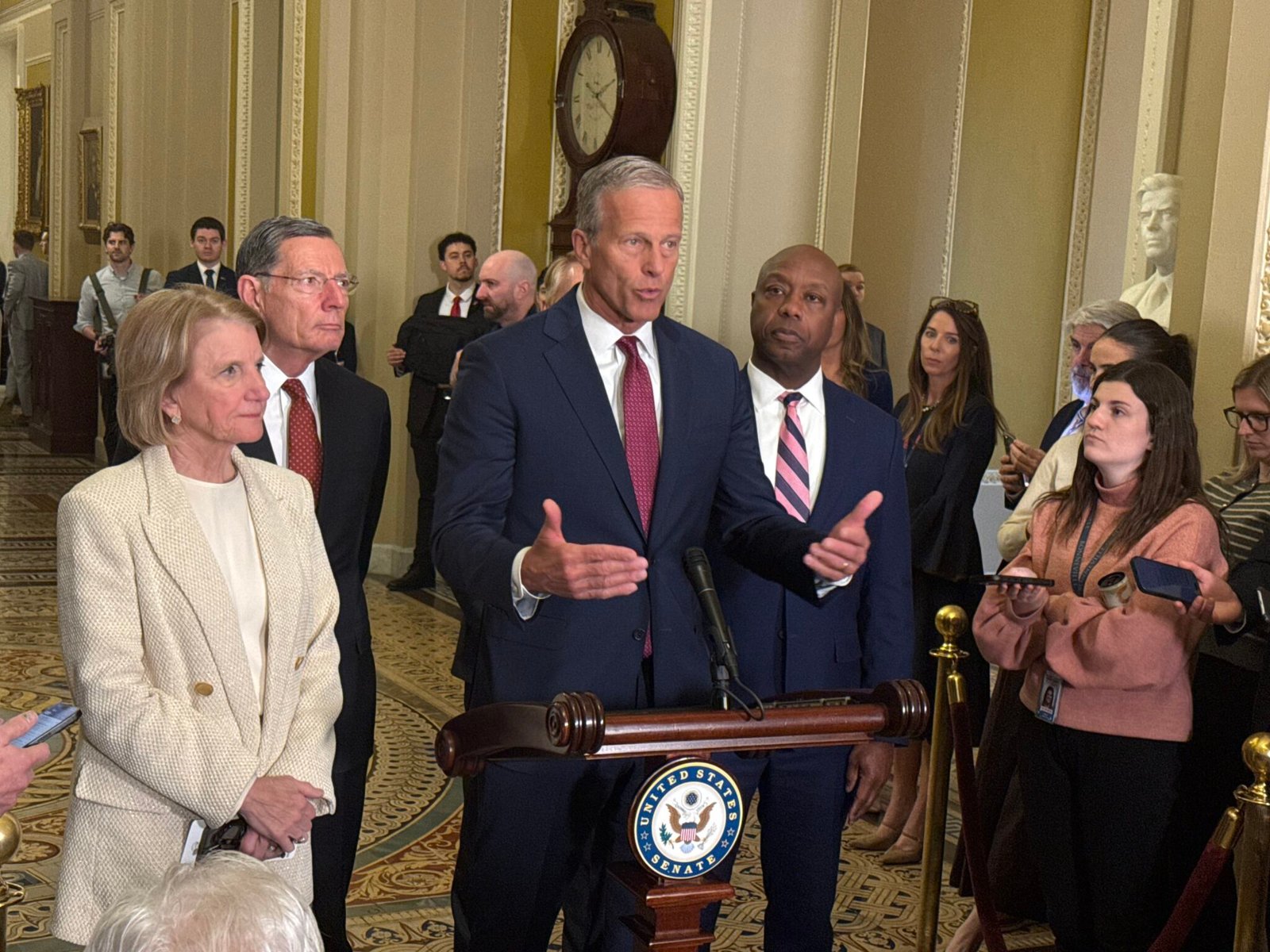
Senate Majority Leader John Thune, R-S.D., said during an afternoon press conference before the briefing that he doesn’t believe Congress needs to declare or authorize the war.
“No, I think the president has the authority that he needs to conduct the activities and the operations that are currently underway there,” he said. “As you know, there’s a lot of controversy around, questions around the War Powers Act. But I think the president is acting in the best interest of the nation and our national security interests by ensuring that he’s protecting Americans and American bases and installations in that region, as well as those of our allies.”
Lawmakers received closed-door briefings from Secretary of Defense Pete Hegseth, Chair of the Joint Chiefs of Staff Gen. Dan Caine, Secretary of State Marco Rubio and Central Intelligence Agency Director John Ratcliffe.
Tim Kaine, Rand Paul push war powers vote
The Senate is expected to vote Wednesday on a War Powers Resolution co-sponsored by Virginia Democratic Sen. Tim Kaine and Kentucky Republican Sen. Rand Paul that would direct the administration “to remove the United States Armed Forces from hostilities within or against Iran, unless explicitly authorized by a declaration of war or a specific authorization for use of military force.”
The House will vote later this week, likely Thursday, on a similar proposal from Kentucky Republican Rep. Thomas Massie and California Democratic Rep. Ro Khanna. Speaker Mike Johnson, R-La., has said that effort doesn’t have the support to take effect.
Senate Armed Services Committee Chairman Roger Wicker, R-Miss., said as he was walking out of the afternoon briefing that the Trump administration will not rule out boots on the ground.
Wicker said he doesn’t believe Congress would need to authorize U.S. troops in Iran, though he declined to answer a question about why he thinks the president holds the authority for a ground war not approved by lawmakers.
A report from the nonpartisan Congressional Research Service notes that while Article I, Section 8, Clause 11 of the Constitution grants Congress the power to declare war, that authority “has been heavily debated.”
“The Supreme Court has observed that only Congress has the power to declare war, but the implications of this exclusive assignment are not well-settled,” the report says. “In particular, the relationship between Congress’s power to declare war and the President’s war powers granted under Article II of the Constitution is the subject of significant disagreement.”
‘This is a massive operation and rapidly changing’
Louisiana Republican Sen. Bill Cassidy said he doesn’t “think the American people want to see troops on the ground. I don’t think that’s the case. And although they left open that possibility, it seems not to be something they’re emphasizing.”
Missouri Republican Sen. Josh Hawley said he believes Congress would need to authorize U.S. troops on the ground in Iran, something he’s unlikely to support.
“I find it difficult to imagine a scenario where I would,” he said.
Hawley said the classified briefing left the impression the Trump administration’s war in Iran will continue for some time.
“I think there’ll be a lot more to come, because one of the things I took away from this is, this is a massive operation and rapidly changing,” he said.
Alaska Republican Sen. Lisa Murkowski said it “was an important briefing that we had today and it is a situation that is clearly evolving rapidly.”
North Dakota Republican Sen. John Hoeven declined to answer a question about whether he would support Trump sending U.S. troops into Iran.
“Well, again, that’s an option, and if and when it would occur, we could deal with it at that point,” he said. “But I think at this point, there’s no indication of that.”
Oklahoma Republican Sen. Markwayne Mullin said that Hegseth is “not going to limit any options to the president” when asked about the possibility of U.S. troops on the ground in Iran.
Mullin described the role Congress plays in authorizing the administration’s offensive in Iran as “debatable.”
“We’re not going to take away the authority of the president of the United States to be able to be the commander-in-chief. … We don’t need 535 commanders,” Mullin said.
Lindsey Graham ‘never felt better about how this ends’
Arizona Democratic Sen. Mark Kelly, a retired Navy captain, said the level of interceptor stockpiles is a “big concern.”
“We do not have an unlimited supply and the Iranians do have the ability to make a lot of Shahed drones, ballistic missiles, medium-range, short-range. And they’ve got a huge stockpile,” Kelly said. “So at some point, we’re probably already in this, this becomes a math problem. And how can we resupply air defense munitions? Where are they going to come from? How does that affect other theaters?”
The Trump administration pulling from the Indo-Pacific Command, for example, Kelly said, would leave troops in that region of the world “more vulnerable.”
“We don’t have an unlimited supply. They’re shooting a lot of stuff,” he said. “Certainly, the number has gone down somewhat over time. But the math on this currently seems to be an issue.”
Senate Appropriations Committee ranking member Patty Murray, D-Wash., said the administration has yet to ask Congress to provide additional funding for the war.
Sen. Lindsey Graham, R-S.C., exited the briefing saying he “never felt better about how this ends.”
Graham said he spoke with Arab leaders by phone earlier in the day and “they’re going to get in the fight in a more direct way.”
Graham also spoke directly to the cameras, in case Trump was watching, he said, to encourage the president to join Israel in bombing Iranian-backed Hezbollah fighters in Lebanon.
“Not only take the mothership of Iran down, also take the proxy of Hezbollah. Settle the score,” Graham said.
Mike Johnson defends Trump constitutional authority
Johnson said Trump took advantage of “a narrow and unique opportunity” to attack Iran over the weekend, and that he was “well within his constitutional authority to do what he has done.”
“We had counsel from the (Department of Justice) here tonight, who said very well, very clearly — fell just short of citing the specific case law — but explained that this has been the tradition for decades.”
Johnson said the U.S. joint war with Israel in Iran has been “very effective thus far” and described the proposed War Powers Resolution as “dangerous.”
The U.S. mission in Iran “needs to be completed,” he said. “We don’t need Congress getting in the way of that.”
Rep. Nancy Mace, R-S.C., who sits on the House Armed Services Committee, said she is a “no for now” on the Wars Powers Resolution vote later this week.
“But if this thing goes beyond a few weeks, I’m going to have a lot more concerns,” Mace said, adding that boots on the ground “would be a very different conversation.”
“That’s not where we are today. That’s not what I heard in the briefing,” Mace said, declining to provide more details from the classified meeting. “I feel very good and very confident about where we are roughly just over 100 hours into the strikes in this conflict.”



