
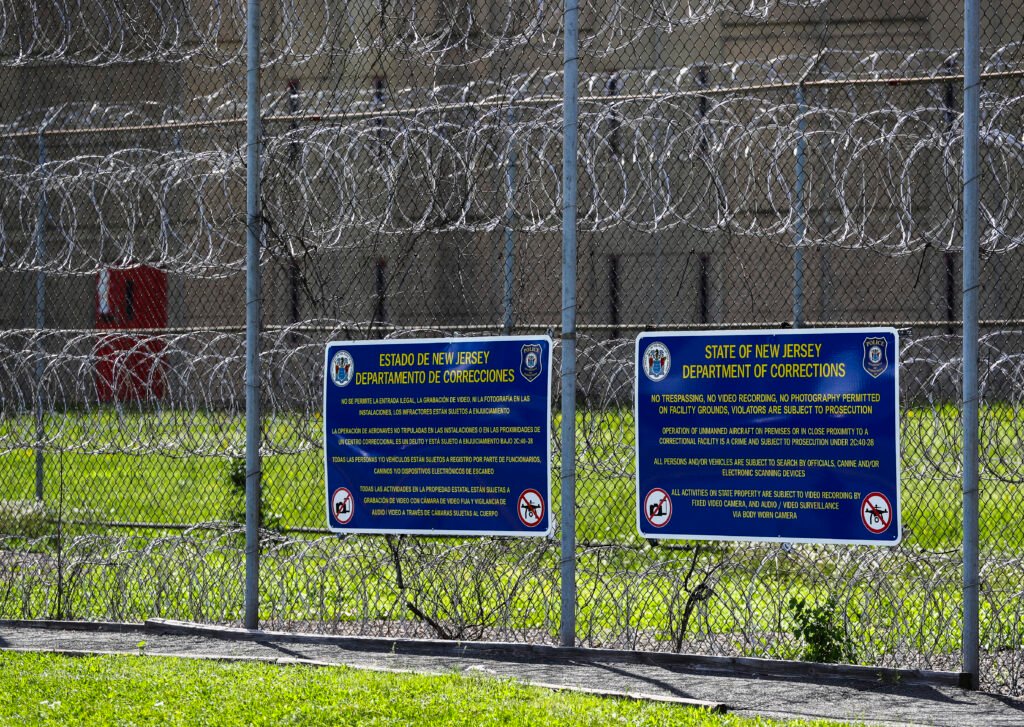
New Jersey is piloting a program to prevent prison suicides that relies on incarcerated people to observe and report on their at-risk neighbors. (Photo by Dana DiFilippo/New Jersey Monitor)
New Jersey corrections officials are trying a new approach to reducing prison suicides: a buddy system.
Department of Corrections officials launched a “peer companion” program last August that pairs incarcerated people with prisoners who are on suicide watch and tasks them with “supportive observation and interaction,” department spokesman Christopher Greeder said.
The program is modeled after a federal Bureau of Prisons program now in place in California and Colorado, Greeder said. Peers sit outside the monitored person’s cell to observe and talk with them, record their observations in unit logbooks, and debrief with clinical staff after other peers come to relieve them, he added.
Graying prison population spikes health care costs, drives ‘budget squeeze’
The program is being piloted with 22 peers at South Woods State Prison in Bridgeton. The job is voluntary and paid, with peers making $6 for a four-hour shift, Greeder said.
The program is meant to supplement other measures the department has undertaken to reduce suicides, which include a self-harm task force created in 2023 to review and recommend best practices in suicide prevention, Greeder said.
One mental health expert applauded the program as “well-intended” but warned it could come with unintended consequences.
Leslie Carpenter is legislative advocacy manager at the Treatment Advocacy Center, a Virginia-based nonprofit that advocates for people with severe mental illness.
“Imagine that the person does end up dying by suicide. Imagine the guilt for that person who was assigned as a buddy,” Carpenter said. “That’s a heavy responsibility, and I think that’s something that needs to be discussed. Is that a fair ask?”
The peers in New Jersey’s pilot program get training — on suicide risk awareness, boundaries, observation, documentation, and communication — by medical and corrections staff based on the federal prisons’ program, Greeder said.
Department officials will determine whether to end or expand the program after assessing outcomes, including its impact on how long a monitored incarcerated person remains on suicide watch and whether the person self-harms or has disruptive or violent behavior, he added.
Terry Schuster, the state’s corrections ombudsperson, called the program “probably a good thing.”
“The guys get a lot of training, and they’re not there to replace staff and mental health professionals — just to be an extra set of eyes and a peer who can talk to someone who’s struggling,” Shuster said. “There’s a similar companion program for patients on hospice, and it’s incredibly meaningful for both the companion and the person who’s dying.”
Researchers who examined such programs in 2024 found that about 15 states, including Pennsylvania and Delaware, had some variation of peer companions for suicide-prevention purposes.
New Jersey’s pilot program comes as prisons and jails continue to grapple with suicides, with the suicide rate typically higher in incarcerated populations than the general public.
Thirteen people died by suicide in New Jersey prisons between 2019 and 2024, with four age 25 or younger, Schuster found in a December report on in-custody deaths. Six had less than two years to serve before maxing out their prison sentence, while seven were being held in a disciplinary housing unit, according to the report.
Ten were housed in single cells, the report says, even though a 2014 study of New Jersey prison suicides between 2005 and 2011 found that the suicide rate of people in single cells was 400 times higher than those who double-bunked.
Prison suicides have proven costly, with relatives of incarcerated people who took their lives behind bars suing about systemic lapses, monitoring failures, and missed red flags.
Carpenter said the best way to prevent suicides is “removal of means.”
“When we’re talking to families and counseling about this, we’ll be talking with them, ‘well, you need to make sure you don’t have a gun in the house. You need to make sure you’re locking up your scissors and any other sharp objects and knives and that kind of thing.’ In prison, they should be able to create a situation in which the person has no means to die by suicide,” Carpenter said.
Searches are a daily part of prison life, with officers conducting more than 707,000 searches in New Jersey’s state lockups last year to remove weapons and other contraband and ensure facility safety, Greeder said. That included more than 364,000 routine cell searches, 13,000 targeted cell searches, and 330,000 common-area searches, he said.
Policymakers also could reduce suicides behind bars by bolstering community-based mental health services and steering people with mental illness to treatment rather than prison, Carpenter said. The mental health needs of the 13,000 people incarcerated in New Jersey’s nine state prisons have climbed in recent years, with data showing they visited with psychiatric and mental health providers nearly 130,000 times in the last fiscal year.
“If we had a more adequate mental health care system for people with severe mental illness, we would have far fewer people with mental illnesses ending up in prison,” Carpenter said.
GET THE MORNING HEADLINES.



