
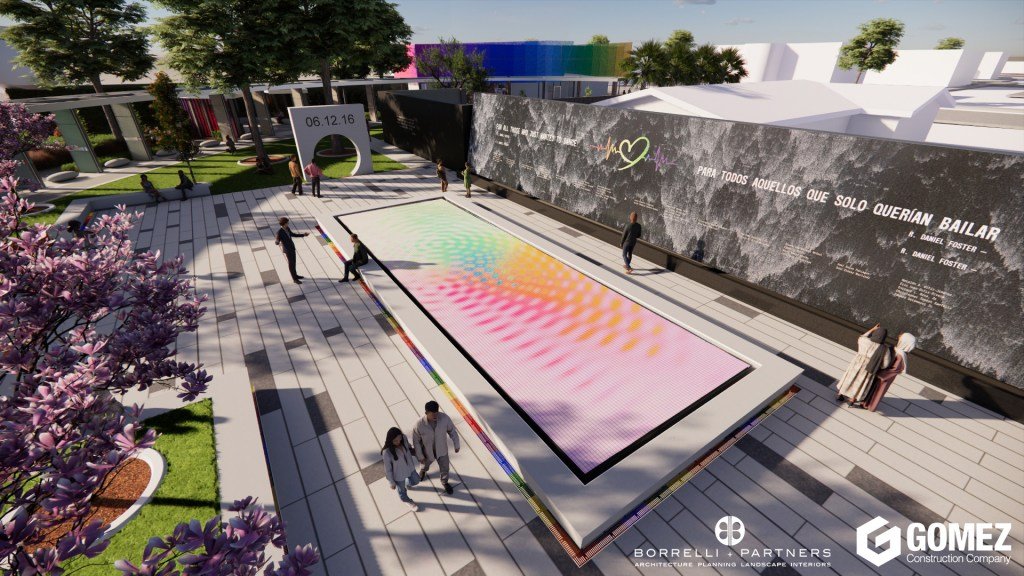
With demolition slated to begin in days and construction slated to start in six months, designers for Orlando’s long-sought memorial to the victims of the 2016 Pulse shooting revealed partial images for the first time Thursday at City Hall.
The renderings largely reflected the conceptual design crafted by an advisory board in 2024 — though with a few notable changes, including about half the original number of columns supporting a metallic, arcing shade structure.
Designers said that modification worked better for the size of the property and also allows more space for reflection and grieving at the column representing each victim.
“The spatial distance between that was no longer intimate, it felt cramped, it felt confined and it wasn’t a quality we wanted to press forward,” said Dan-Michael Trbovich, the project manager for the firm Borrelli and Partners. “It opened the space up and then provides seating … so you have this private area for individuals to come to their angel, to reflect and have that personal space and connection.”
The memorial is planned for the site of the former nightclub at 1912 S. Orange Avenue, where 49 people were killed and 53 were wounded in what was then the nation’s deadliest mass shooting.
The design includes a reflection pool with a rainbow ripple design in the center, alongside an “angel ellipse” curving shade structure featuring tributes to each victim. The north side of the site has a water wall that will also have each victim’s name, along with the quote “For all those who just wanted to dance” etched in English and Spanish.
The LGBTQ nightclub was hosting a Latin Night event the night of the shooting, and more than 90% of the victims were Hispanic.
Jorge Borrelli speaks in front of a rendering during a meeting by the City of Orlando to provide an update on the design of the permanent Pulse memorial as the project has reached the 30 percent design benchmark. (Stephen M. Dowell/Orlando Sentinel)


1 of 17
Jorge Borrelli speaks in front of a rendering during a meeting by the City of Orlando to provide an update on the design of the permanent Pulse memorial as the project has reached the 30 percent design benchmark. (Stephen M. Dowell/Orlando Sentinel)
The memorial will also include a 3,500-square-foot visitor’s center, which will have items connected with the nightclub on display. Designers also pitched the idea of a “survivor’s tree” planted at the site – potentially an olive tree, which is both physically resilient and also has represented peace and unity throughout history.
“Honestly, I think they’ve done a really, really fair job,” said Nancy Rosado, who served on the committee and provided mental health services after the shooting. “This has been unfinished business for 10 years and this is finally moving that forward and helping people to move forward.”
But both of the people who spoke during public comment were critical of the design and the process that led to the drawing. Christine Hanavan contended the city ignored victims and families who disagreed with them and said elements reusing portions of the nightclub in the memorial were insensitive.
“I’m especially concerned with the wood floor and outside patio tiles on the so-called artifact list, and that you’re going to use the unpermitted dance floor as part of the reflecting pool. Dozens of people died on those floors, another person died on that patio,” she said. “All of this is absolutely abhorrent. It shows zero empathy and consideration for the survivors and victims.”
The memorial was delayed for years after the onePulse Foundation, originally tasked to create it, collapsed amid recriminations and excessive ambition that produced a plan for a $100 million memorial and museum it had no ability to fund. The demise of the foundation left a trail of broken trust throughout the region, particularly among survivors and families.
The city ultimately purchased the Pulse property last year for $2 million, as well as a neighboring property for $1 million.
Next Tuesday, crews are expected to begin dismantling the Pulse sign outside of the nightclub. On March 18, the demolition of the nightclub building is expected to begin ahead of the planned start of construction of the memorial in September.
Its planned completion date is September 2027.



