
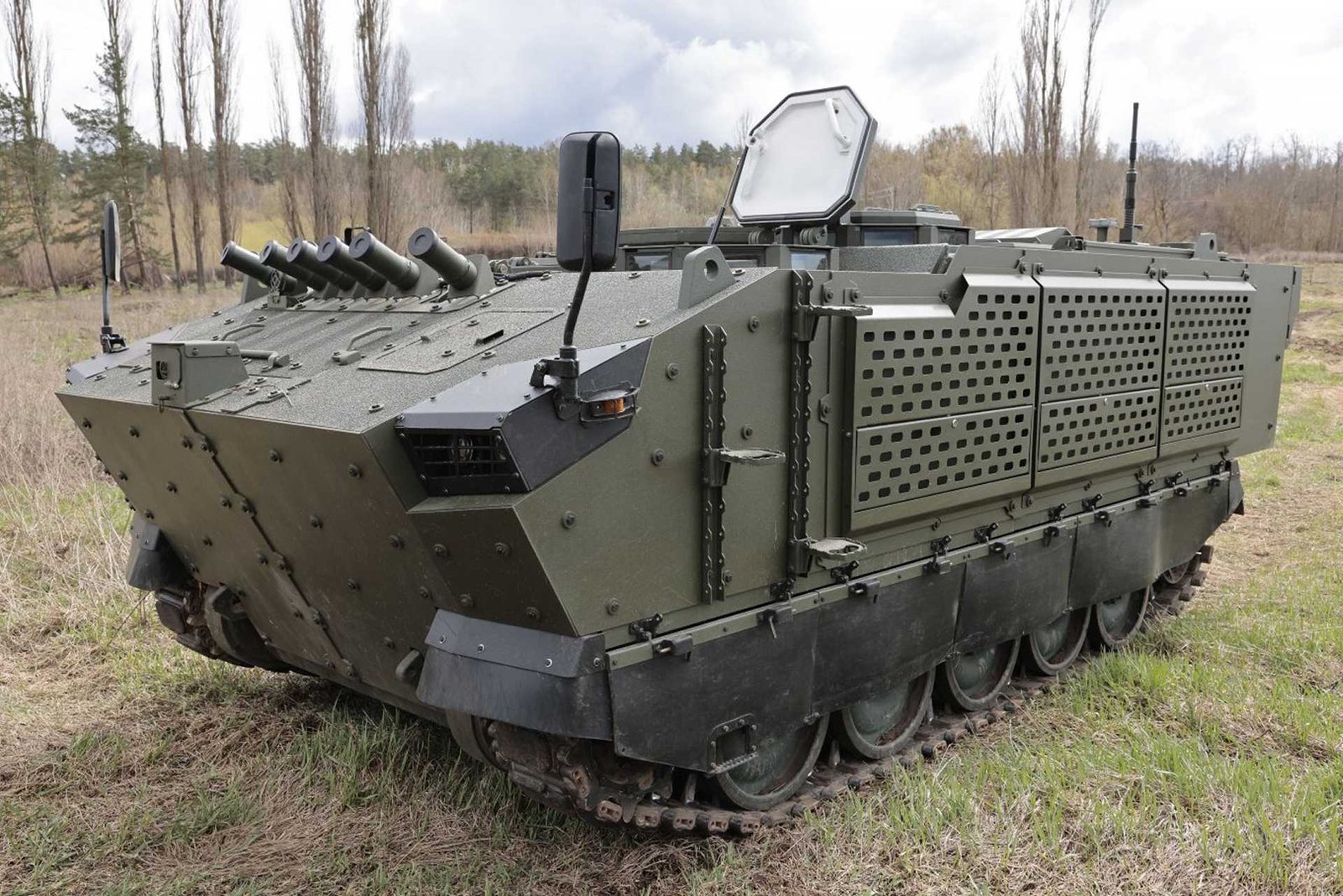
Ukraine has begun testing a new tracked armored personnel carrier designed to move infantry faster and survive threats that have heavily damaged legacy vehicles like the M113. The development signals a push to improve battlefield mobility and protection in harsh terrain where tracked platforms remain critical for sustaining operations under fire.
The Skif prototype combines cross-country performance comparable to the M113 with stronger armor, mine resistance, and a remotely operated weapon station that allows crews to fight without exposure. This mix of mobility, survivability, and protected firepower reflects a broader shift toward more resilient, domestically produced platforms built for high-intensity warfare and reduced dependence on foreign supply.
Related topic: Ukrainian forces to soon receive the first batch of Gyurza-02 armored vehicles with AI-driven target recognition
When compared to the M113, the Skif has a stronger armor protection, a higher firepower with a remote weapon station, and an improved resistance to mines and modern battlefield threats, while maintaining similar mobility performances to the M113. (Picture source: UkrArmoTech)
On April 20, 2026, the Ukrainian manufacturer UkrArmoTech began the testing of the Skif tracked armored personnel carrier, its new prototype developed in response to operational requirements identified during combat against Russian forces. The Skif is the company’s first tracked design after years focused on wheeled vehicles like the Gyurza-02 and reflects a shift driven by battlefield conditions where tracked mobility has remained essential. The Ukrainian APC is intended to produce a domestic alternative to the M113, hundreds of which have been supplied to Ukraine since February 2022 for troop transport, logistics, and medical evacuation.
Testing activities include validation of mobility, structural endurance, and performance under maximum load, with a specific attention to drivetrain stress and suspension durability. The trials are designed to assess whether the Skif can match the M113’s cross-country mobility while improving protection and firepower. The development also aligns with Ukraine’s policy of increasing domestic production of armored vehicles to reduce its reliance on foreign supply chains. The operational rationale for the Skif is directly linked to the extensive use of M113 vehicles by Ukrainian forces and the conditions in which they have been employed.
The American M113 has remained in service since 1960 due to its mechanical simplicity, ease of repair, and ability to operate across rough terrain, including mud-heavy environments common in eastern and southern Ukraine. It can transport up to 7 to 8 fully equipped soldiers and has been adapted for multiple roles, including casualty evacuation with space for stretchers. However, losses have been significant, with hundreds of units confirmed destroyed or damaged, highlighting vulnerabilities in armor protection and survivability against mines, artillery fragments, and heavy machine gun fire. These factors led the Ukrainian Ministry of Defense to define requirements for a replacement vehicle that would maintain mobility while exceeding the M113 in protection and onboard firepower.
UkrArmoTech’s Skif is structured around these requirements, using the M113 as a baseline for performance comparison rather than a direct template. UkrArmoTech’s transition into tracked vehicle development required organizational changes, including the establishment of a dedicated design bureau focused on tracked systems and the cooperation with other Ukrainian industrial entities. Prior to this program, the company’s portfolio consisted primarily of wheeled armored vehicles such as the Gyurza, Tisa, and Desna models, which are used for patrol, transport, and urban operations. The Skif development process has incorporated direct input from Ukrainian military personnel, including feedbacks on M113 performance under combat conditions, particularly regarding maintenance cycles, mechanical reliability, and survivability limitations.
Therefore, the Skif’s design approach prioritizes retaining the M113’s mechanical simplicity to ensure field repairability while addressing the deficiencies identified during combat use. This includes maintaining accessible components, minimizing system complexity, and ensuring compatibility with existing maintenance infrastructure. The M113’s configuration has influenced the general layout, including front-mounted crew positions and rear troop compartment design. The Skif’s configuration follows a conventional tracked APC layout, with a crew of three positioned in the front section behind the engine and transmission compartment. The crew consists of a driver, commander, and weapons operator, with controls and observation systems concentrated in the forward hull.
The rear compartment is designed to carry up to eight infantry personnel equipped with body armor, weapons, and supplies, consistent with Ukrainian mechanized infantry requirements. Access is provided through a hydraulically operated rear ramp, allowing rapid dismount under combat conditions. The internal layout is intended to support extended operations, including transport of equipment and wounded personnel if required. The Skif is designed to operate across a range of environments, including paved roads, off-road terrain, and seasonal conditions such as mud and snow. Like the Gyurza, the chassis is modular, allowing adaptation into variants such as command vehicles, reconnaissance platforms, medical evacuation units, and potentially mortar carriers or anti-tank configurations.
Mobility performance is a central parameter in the Skif’s design, reflecting the operational importance of maneuverability in Ukrainian terrain. The Skif has an estimated combat weight of up to 15 tons in its aluminum configuration and is powered by a 360-horsepower diesel engine, providing a power-to-weight ratio comparable to legacy tracked APCs. The drivetrain and engine mounting system are designed with standardized interfaces, allowing integration of alternative powerplants if required for different configurations or export variants. Tracked propulsion is selected to ensure mobility in soft soil, mud, and thaw conditions where wheeled vehicles frequently lose traction or become immobilized.
Testing includes maximum load operation, endurance runs, and dynamic stress evaluation of suspension and track components to determine long-term reliability. These tests are intended to replicate the M113’s sustained operational use rather than short-duration trials, with a focus on identifying failure points under realistic conditions. The protection levels of the Skif represent a significant change compared to the M113, which uses aluminum armor with limited resistance to modern threats. The Skif is designed to meet STANAG 4569 Level 4 protection in the frontal arc, providing a resistance to 14.5 mm armor-piercing rounds and nearby artillery detonation effects. Side and rear protection is rated at Level 3 to address vulnerabilities seen in M113 deployments.
To respond to the extensive mine warfare in Ukraine, mine protection is specified at Levels 3a and 3b, enabling the vehicle to withstand explosions equivalent to approximately 6 kilograms of TNT under the hull or track. The Skif prototype uses an aluminum hull, marking the first application of this material in a Ukrainian armored vehicle of this category, although a steel variant is under consideration due to supply constraints and improved ballistic resistance. The choice between aluminum and steel hulls will certainly affect overall weight, mobility, and repair requirements. Additional protective measures may include structural reinforcement of the hull floor and integration of blast mitigation features.
The Skif is equipped with a remotely operated weapon station mounted on the roof, replacing manually operated machine gun mounts typical of earlier APC designs. The primary armament options include either a 12.7 mm or 14.5 mm heavy machine gun, supported by a coaxial 7.62 mm machine gun for engagement of lighter targets and smoke grenade launchers for concealment. This configuration allows the crew to operate the weapon system from within the protected hull, reducing exposure to enemy fire. The vehicle integrates modern Ukrainian-produced communication systems for command and control, as well as navigation equipment and situational awareness tools such as external cameras and sensors.
Electronic warfare capabilities are included to counter radio-controlled threats and unmanned aerial systems, which have become a significant factor in the conflict. Like the M113, the onboard systems are designed with modularity, allowing different configurations depending on mission requirements or customer specifications. From an industrial perspective, the Skif is intended to reduce reliance on foreign-supplied armored vehicles while acknowledging current limitations in domestic production capacity. At the initial stage, up to 60% of the vehicle’s components are expected to be imported, including the engine, transmission, suspension elements, and tracks, reflecting the complexity of tracked vehicle manufacturing.
The Ukrainian industry has already localized maintenance and repair of M113 vehicles, including production of spare parts, which provides a foundation for further localization of Skif components. The long-term objective is to increase the proportion of domestically produced components to improve supply chain resilience and reduce costs. The Skif program involves cooperation with multiple Ukrainian enterprises, leveraging existing production facilities, although output is constrained by budgetary limitations and availability of funding. This reflects a broader trend in Ukraine’s defense sector, where production capacity often exceeds procurement levels due to financial constraints.
The Skif’s development also reflects doctrinal considerations regarding the role of tracked armored vehicles in Ukrainian military operations. Combat experience has shown that tracked vehicles maintain mobility in conditions where wheeled vehicles are limited, particularly in mud and soft soil environments common during seasonal changes. Tracks also provide greater resistance to damage from mines and artillery fragments compared to rubber tires, which can be disabled more easily. Ukrainian forces continue to rely on vehicles such as the M113 and the Soviet-era MT-LB for these reasons, despite their age and limitations. The Skif is intended to retain these operational advantages while addressing deficiencies in protection and firepower identified during the conflict. The program also includes consideration of export opportunities, with interest from foreign customers linked to the vehicle’s development based on combat experience and its potential cost advantages compared to foreign alternatives.



