
by Carlo Cielo
“Once Upon a Bridge In Vietnam II” is the second installment of a documentary series that explores the ties that bind and the common pathways that fuse a nation once torn by colonialism & war. Starring its own director, French-Vietnamese Francois Bibonne, it looks into how both he and Vietnam grapple with the legacies of both, spotlighting his childhood and love of music alongside the synergy of sound and sport in the country’s football scene.
Once Upon a Bridge In Vietnam II screened at FICA Vesoul
Produced by Studio Thi Koan, the 43 mins. documentary features news reports, interviews and cartoon illustrations by Lim Lee. It’s structured around Bibonne’s travails on a bridge, with a performance by the Vietnam National Symphony Orchestra as de facto bookends.
Vietnam has a very rich and fascinating history with the world’s most popular sport. Introduced by the French in 1896, it is where the Vietnamese would find themselves standing with their occupiers in the field, and with their fellow revolutionaries when they finally broke their chains and became fully independent. As the Vietnam War drew to a close in the early 1970s, one of the first steps they took is to relaunch their football clubs as soon as possible. In this sense, football is a strident expression of sovereignty as much as a reconciliation with a colonial past.
It is also an event. Fans would troop to the stadiums, not just with the usual noise making instruments but with trombones, clarinets – a full-on orchestra.
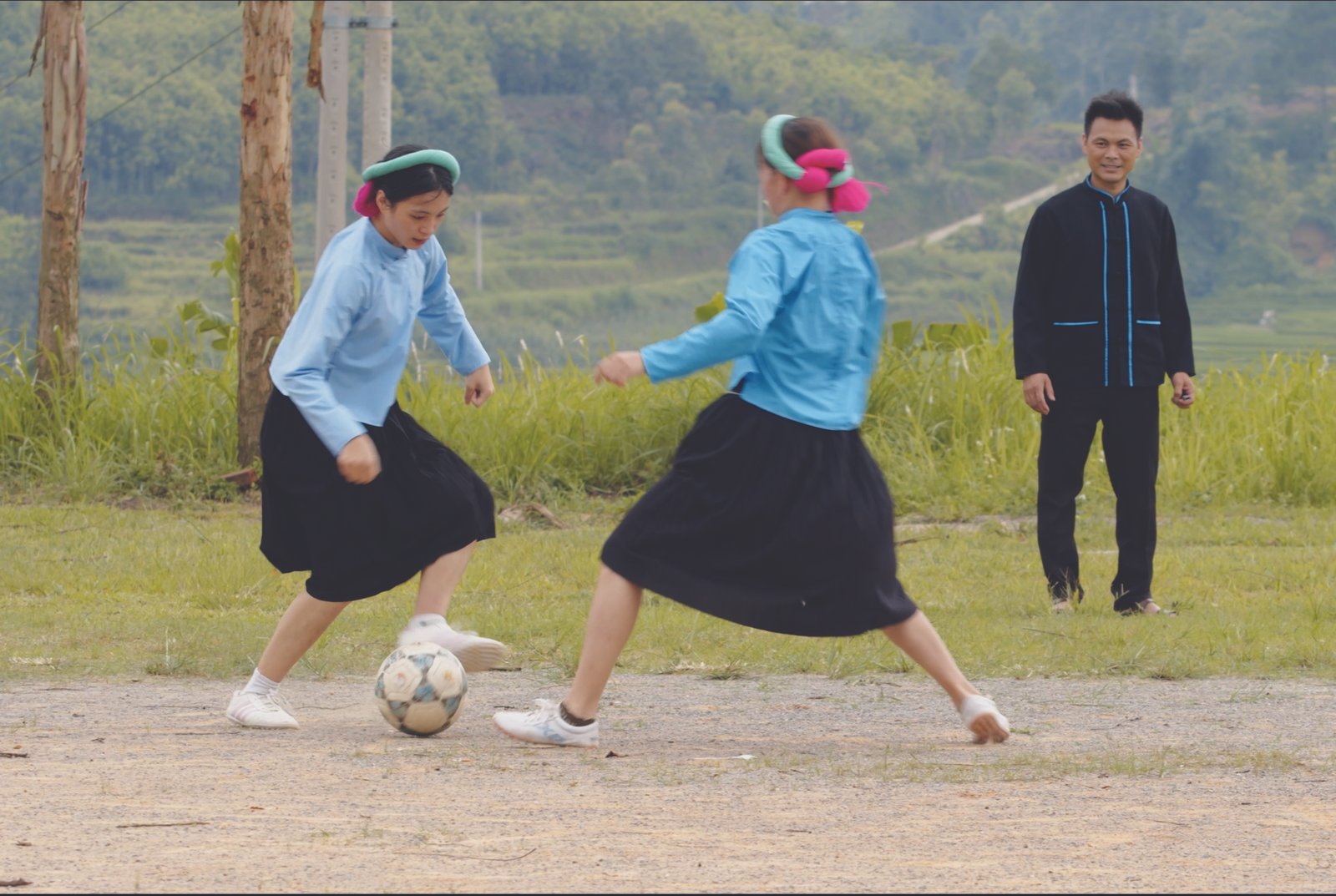
This level of musicality would also extend to the players and the commentators themselves, some of whom are featured in this documentary. There’s football commentator Vu Quang Huy, whose father is a musician at the Vietnam National Symphony Orchestra and who plays the clarinet. Another is Huynh Nhu, the captain of the Women National Football Team, who plays the ukulele and notes the parallelisms between rhythm and rising action during matches. Then, Bibonne goes to the highlands and meets the Bahnar, a Christian minority where the women play in traditional clothes. They are quite the singers, too. Bibonne himself is a piano player who has performed in recitals when he was a child, and sees this as his way in to this football realm as well as his Southeast Asian roots in his grandma’s homeland.
A general vision comes through, of an exploration of identity paralleling a nation’s path towards its becoming. Bibonne also shot and edited this picture while providing narration, giving it a sleek personal touch. He also encodes the music as a unifying thread into the visual beat itself. There’s a sequence wherein the players move their necks and swing their legs to the notes of a symphony piece. It does get across the ‘connection’ between sound and sport that Bibonne is trying to point out, albeit it does this quite superficially.
While it does spotlight the unique musicality of Vietnamese football players and fans, the music is barely glanced upon and is incidental at best. The work would have definitely benefited had it stayed with any of its subjects much longer. The Bahnar stuff, for example, was a highlight. More time could’ve been spent with their views and perspective on what is otherwise a foreign influence and what made them decide to indigenize it the way they did.
Furthermore, the deep dives into the colonial and revolutionary underpinnings of football in Vietnam could’ve been less of educational detours and more of tied to the Bibonne’s personal story.
Which brings us to a major area of opportunity for this piece. In his own pitch, Bibonne admits that football is a world he doesn’t know. Him being a football fan and watching Vietnamese FCs (football clubs) growing up would’ve given the audience a strong emotional through line to latch onto, as he’d have something to truly reckon with.
The film does conclude with a poignant shot of the director walking on a winding bridge and the story being far from over.
Structurally sound yet lacking in catharsis, “Once Upon A Bridge In Vietnam II’ charts a journey to one’s roots that feels oddly disconnected but is determined to reach an endpoint.
Carlo Antonio Cielo is a writer, comics creator and film critic. Sometimes, he directs. His personal heroes are Brian De Palma, John Milius, Takeshi Kitano, Bobby Suarez, Meiko Kaji and Judge Dredd. You can get his works through Shonenbat Collective. He kind of lives here.



