
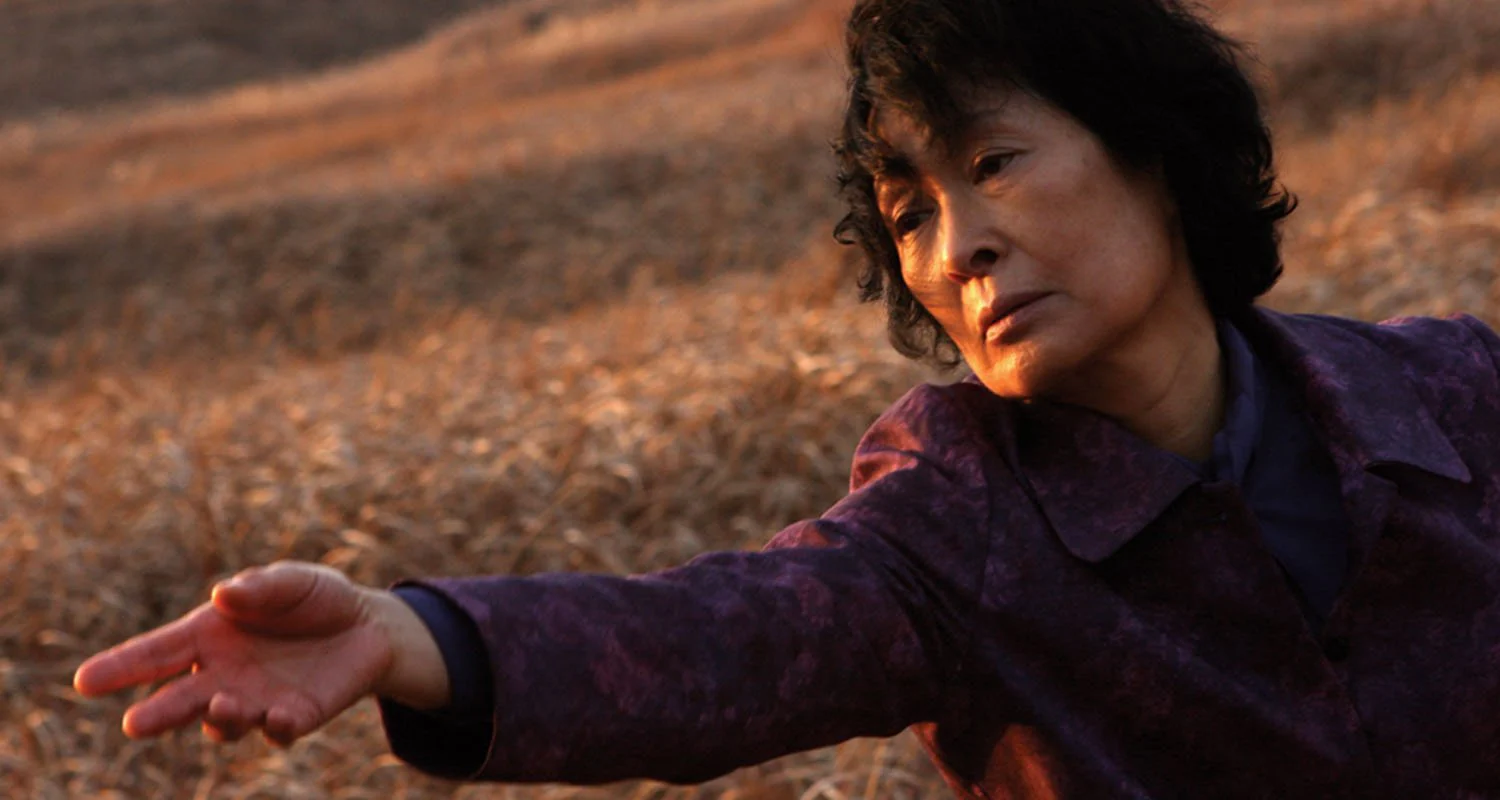
“Mother” stands as one of the most distinctive entries in the filmmaker’s filmography, arriving after the international success of “The Host” and further cementing his reputation as one of the most versatile auteurs in contemporary cinema. Released in 2009, the movie was produced on a relatively modest budget of approximately $5 million, yet went on to become a significant commercial success in South Korea, attracting more than three million admissions and ranking among the top domestic hits of the year.
The film premiered in the Un Certain Regard section of the Cannes Film Festival, further enhancing Bong’s global profile, while subsequent screenings at festivals such as Santa Barbara helped introduce it to Western audiences. The production also gained additional attention through a black-and-white version released later, highlighting its visual precision.
Buy This Title
on Terracotta by clicking on the image below
The narrative follows a widowed herbalist known simply as Mother, who lives with her intellectually disabled son Do-joon. Their fragile existence is disrupted when a high school girl is found murdered, and Do-joon is swiftly arrested by an incompetent police force that extracts a confession through manipulation rather than evidence. Faced with a justice system that appears indifferent to truth, Mother embarks on a desperate quest to uncover the real culprit, navigating a maze of social prejudice, financial hardship, and moral ambiguity. As she delves deeper into the mystery, the narrative gradually shifts from a straightforward investigation into a far more unsettling exploration of truth and responsibility.
Although the premise initially suggests a sentimental drama about maternal devotion, Bong subverts expectations by crafting a narrative that operates closer to a psychological thriller, echoing the tone of “Memories of Murder” while maintaining its own distinct identity. The story unfolds with meticulous precision, gradually building tension through layered character development and unexpected tonal shifts, often incorporating elements of dark humor that momentarily disarm the viewer before plunging them back into unease. This approach allows Bong to examine not only the mechanics of crime and investigation but also the fragility of perception and the lengths to which individuals will go to preserve their own reality.
Contextually, “Mother” can be seen as a continuation of Bong’s exploration of institutional failure and social marginalization, themes that run throughout his body of work. The police force is portrayed as inefficient and careless, prioritizing quick resolutions over justice, while the broader community is marked by indifference and quiet complicity. At the same time, the movie delves into the darker aspects of maternal love, presenting it not as a purely nurturing force but as something capable of distortion and excess. In this regard, the narrative challenges the audience to reconsider the boundaries of morality, particularly as the protagonist’s actions become increasingly ambiguous.
From a technical standpoint, the film excels across all departments. Hong Kyung-pyo’s cinematography is particularly striking, capturing the rundown neighborhood and narrow alleyways with a sense of both realism and suffocating claustrophobia. His visual approach reaches its peak in the opening and closing sequences, which employ a surreal aesthetic that frames the entire narrative in a cyclical and almost hypnotic manner. Complementing this is Lee Byung-woo’s score, which subtly enhances the emotional tension without overwhelming the scenes, while Moon Sae-kyung’s editing maintains a careful balance between clarity and ambiguity, allowing the story to unfold in a way that continuously reshapes the viewer’s understanding.
In terms of performances, Kim Hye-ja delivers a truly remarkable portrayal, carrying the entire narrative with a presence that is both commanding and deeply unsettling. Her interpretation of the character transforms what could have been a conventional role into a complex study of obsession and denial. Won Bin, meanwhile, offers a nuanced performance that avoids caricature, instead presenting Do-joon as a character defined by vulnerability and confusion, whose emotional state remains difficult to fully grasp. Supporting performances, including those by Jin Goo and a number of then lesser-known actors such as Chun Woo-hee and Kwak Do-won, further enrich the narrative, adding layers to the social environment in which the story unfolds.
Ultimately, despite its seemingly simple premise, “Mother” emerges as a deeply unsettling and thought-provoking work that transcends genre boundaries. By blending elements of thriller, drama, and dark comedy, Bong Joon-ho crafts a narrative that is as emotionally engaging as it is intellectually provocative. The film’s exploration of distorted maternal love, combined with its precise technical execution and outstanding performances, results in a work that lingers long after its conclusion, leaving the audience in a state of discomfort that mirrors the ambiguity at its core.



