
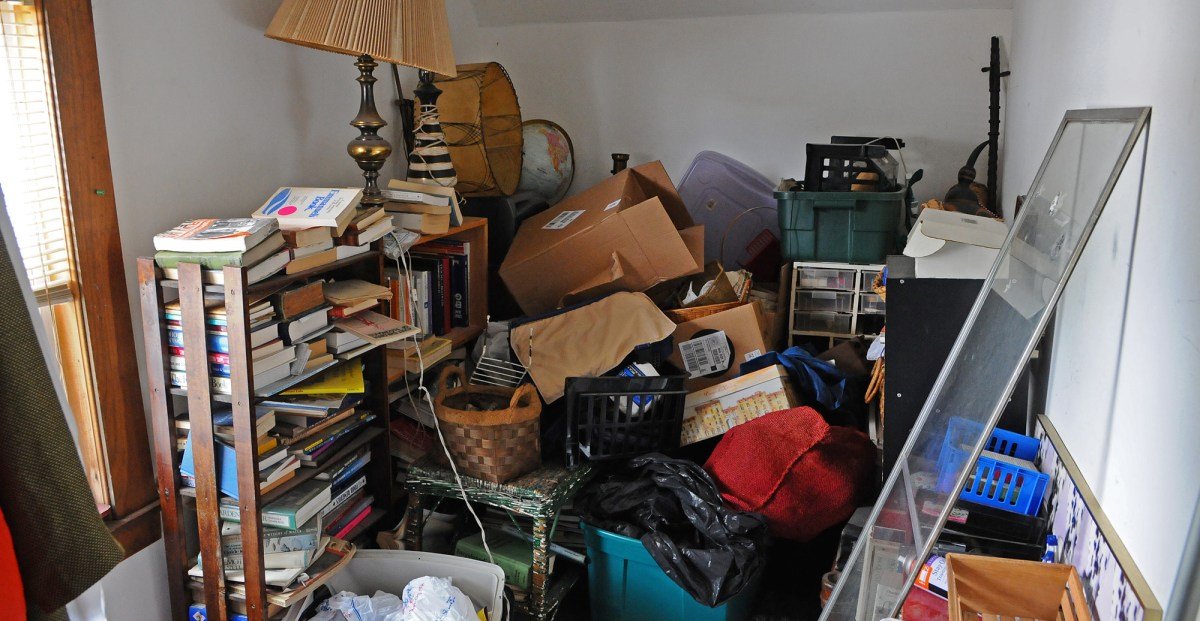
It often feels like people fall into one of two categories: those who throw things away easily, and those who hold onto everything. For those of us who fall into the latter category, tasks like spring cleaning and downsizing can be a challenge, especially when you take into account the amount of stuff we as Americans tend to accumulate.
In fact, 71 percent of Americans say they buy things they already have because they can’t find the original in all of their clutter. And as baby boomers age, they and their children are trying to get a handle on all the things that have accumulated between them.
So what’s the difference between someone who might have a few too many things and someone who could be considered having a hoarding problem?
Mary Dozier is a clinical psychologist and professor at Mississippi State University. She studies hoarding disorder and specializes in intervention to help older adults with hoarding problems, and she says that at the end of the day, it’s subjective.
“The level of clutter that one person finds to be completely functional, another person might find that they can’t use their home the way they want to anymore,” she told Vox. “That’s how I always think about it: is the level of clutter keeping you from using the home how you would like to use it?”
How can we learn to get rid of the clutter in our lives? And when should we hold onto things? Dozier answers these questions and more on the latest episode of Explain It to Me, Vox’s weekly call-in podcast.
Below is an excerpt of our conversation, edited for length and clarity. You can listen to the full episode on Apple Podcasts, Spotify, or wherever you get podcasts. If you’d like to submit a question, send an email to askvox@vox.com or call 1-800-618-8545.
You work with people who hold on to too much stuff in a way that really limits them and impacts their lives in a negative way. But I think a lot of us struggle to manage our things. Why do we hold on? What’s going on with us?
I think of the items we have as an external manifestation of ourselves. We tend to hold onto things from either our past or family members’ past because it gives us this sense of where we’ve come from. But we also often hold onto things because of the promise of who we could be.
The silly example I have from my life is a pasta maker. It’s embarrassing, but a whole decade ago, I took a pasta-making class with my husband, and in the class, it was really easy, and so we were like, “We’re definitely going to go home and make pasta.” We tried it once. It was not easy. And I think some of those dreams are easier to let go of than others.
How often is throwing everything out the answer? Like, should we just throw that pasta maker in the garbage?
I felt my heart rate go up when you said that. Truthfully, one of the things we know is that when people have really, really severe hoarding problems, it’s not safe for them to be in their home.
Sometimes what has to happen is this massive cleanout, but it’s an incredibly traumatic thing that it’s the same kind of a PTSD response as if you lost your home in a tornado, because in essence, you did. A tornado swept through your home and took everything away.
I know that there’s a broad spectrum of minimalism to maximalism, but I think I’m a fan of keeping the things around us that help us feel like who we are. It’s that external way that we present the world, whether it’s through our clothing or our accessories or the clutter that we have in our handbags. The things that we choose to keep on ourselves or to keep in our home signal to the world of who we think that we are.
I’m curious if things like the Marie Kondo method or any of those other kinds of minimalist decluttering hacks work for the people that you help. Is it that simple or is there a little more there?
I think there’s more to it, and especially to the idea of sparking joy. If you put a puppy in front of me, I’m going to say this puppy is sparking some joy right now. There’s a difference between happiness and fulfillment.
I always encourage people to go through your clutter and think about what you want to keep and what you want to let go of. Starting before you even do that, ask yourself what are your values? What do you care about in the world? What’s important for you in a broader sense? And then as you’re going through these items, thinking through if that item is consistent with those values.
You don’t have to hold onto something out of guilt. If somebody gives you a present and you don’t want it, that’s okay. It doesn’t say anything about you or your friendship with that person to not keep that item. That guilt shouldn’t be part of why you’re holding onto things.
In your opinion, what are some of the good reasons not to get rid of stuff?
Come back to that sense of what this item is doing for you. Is it that this is the one thing that seeing it gives you that connection to your grandfather? I think sometimes people get lost in, “I’m going to hold onto everything that reminds me of my grandfather. I’m going to hold onto everything that’s about this dream I could be.” Try to think through why you keep things and how many of those things you need to keep.
Are there ways that we can reframe clutter to better serve us?
I think it can be helpful to take that step back and think, “If there wasn’t anything in this home, what would I want to be in here?” Everything that you keep, you’re making a decision to keep, and sometimes people default to that decision because it’s hard to think through.
But you’re still making that choice. That inaction in itself is still an action, which I think is probably one of those broader truths about life. Are you staying in a relationship because you’re choosing to be in that relationship every day, or are you staying in the relationship just because it’s what you’ve been doing? You can kind of think about our relationships with our items.
I think as boomers age and younger generations start to get more of their stuff it can be like, “What do you do with it?” Do you have any advice for that?
There’s something called Swedish Death Cleaning. I don’t know if you’ve come across it, but it’s basically putting the responsibility on the baby boomers: They’re the ones that should be going through their things before we’re inheriting it. It’s this idea of cleaning out your things before you die.
It’s something that I deal with a lot of my patients that I’ve treated. These older adults who will say things like, “I could get rid of these things, but I want to make sure it goes somewhere where it’s going to be appreciated. I want my daughter to inherit my wedding china but I know that right now she doesn’t want it.” And so they’re holding onto it as this responsibility for it. Our responsibility is to people, but not necessarily to things.
Is it possible to be a happy maximalist?
Absolutely. It comes back to if it’s dysfunctional or not. If your home is filled to the brim, but you’re living a healthy, happy life in that environment, that’s absolutely okay.
It’s all about the subjectivity of it. Just because there might be a current cultural norm for minimalism or — I know cottagecore was in for a while — these trends come and go, but think about what’s your truth of how you like your space to be.
Are you someone who likes a completely blank wall, or do you want it to be gallery style? I think whatever somebody’s truth may be is good if you’re healthy, if you’re happy, if it’s not hurting anyone.



