
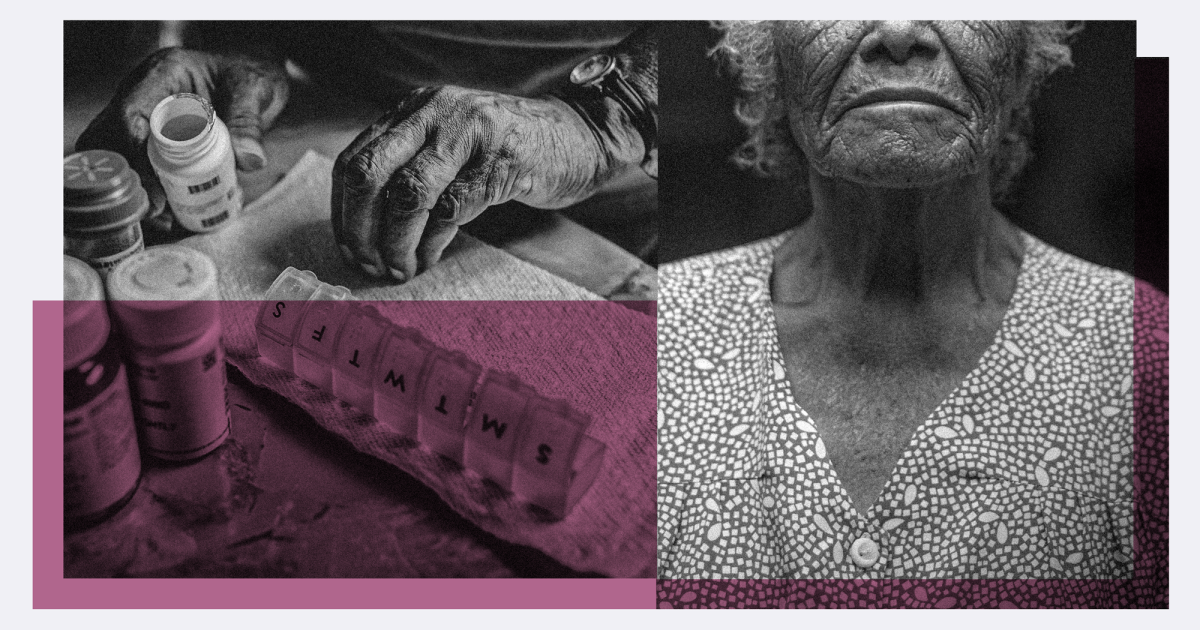
Daniel Reilly takes 19 pills in the morning and 13 at night. He lives with hemophilia and HIV, which he contracted in the 1980s. No one expected him to live this long.
In most respects, that’s a blessing—the product of generations of extraordinary medical advances. But it also means there are entire medical specialties he can’t find.
“I don’t know if there’s such a thing as [a] geriatric hematologist,” Reilly, who is 58 and retired, told me: a physician who would know what it means to age as a person with HIV contracted through a blood transfusion, with an understanding of the effects of decades of antiretroviral therapy on the body and blood—or how HIV-related comorbidities interact with the normal processes of getting old. Reilly recognizes how new, and unusual, his situation is: “The vast majority of us”—HIV-positive people with hemophilia—”who were infected in the early ‘80s have passed,” he said.
Reilly’s situation is emblematic of a gap in the medical infrastructure: a generation of people who, amid a variety of expanding and improving treatments, are the oldest ever cohort with their conditions. HIV patients, like Reilly, are a significant part of that. So are some with severe traumatic brain injuries, like social worker Brason Lee. Then there are the growing lifespans of those on dialysis, like retired judge advocate general Evelyn Dove Coleman, whose Air Force service also led to the inner ear disorder Menière’s disease.
As people with complex immune and neurological conditions age into their 60s and 70s, their lifespans are now often extending beyond the expectations of their doctors—and the design of the systems meant to support them. Health care professionals in most fields typically receive little training in disability, less in aging, and virtually none at the intersection of the two. And as federal Medicaid cuts reduce access to the home-and community-based services some aging disabled people depend on, many rely for their survival on networks of personal connections: siblings, spouses, neighbors.
Attacks spearheaded by RFK Jr. and Russell Vought strike at the kind of research that has let people like Daniel Reilly live far longer than anyone expected.
I spoke with Reilly; Lee, who is 63; and Coleman, who is 72—all of whom have lived with significant disabilities since before the age of 50—about their lives and their intricate medical realities, which involve both their disabilities and the normal processes of aging. All three were able to work: Reilly largely on the business side of specialty pharmacies, Lee in social work, Coleman as an attorney and JAG. They are navigating what it means to age into a system that, in many respects, wasn’t built with them in mind.
In 1986, when Reilly was diagnosed with HIV, the condition as he put it, “a death sentence.” He was 20. The stigma was unfathomably high. There was no approved treatment. He had contracted it through a blood transfusion for his hemophilia; he also contracted hepatitis C, since resolved, in the same way. “It was just kind of numbness and disbelief, because it all just kind of unfolded so quickly,” he said. Growing old with HIV—let alone getting married and having an HIV-negative child—seemed very unlikely.
The world has transformed for people with HIV. For those with access to treatment—in many cases endangered by the expiry of enhanced Affordable Care Act tax credits and by the rise of Medicaid work requirements—it’s now often a chronic condition rather than a fatal one. I spoke with Todd Brown, a physician and researchr who runs a lab at Johns Hopkins University examining the health of those living with HIV.
“In the mid-to-late ‘90s, good antiretroviral therapy became available, and so people are living longer, which is great,” Brown said. “But what we’re noticing is that people living with HIV have a higher burden of many common comorbid diseases, things like cardiovascular disease, liver disease, diabetes, lung disease, and the list goes on and on.” In Reilly’s case, the list includes Type II diabetes and chronic kidney disease.
Reilly’s search for a geriatric hematologist speaks to a less unusual predicament: a medical profession that has not caught up with its own patients.
Reilly is acutely aware of what his survival has required. During his daughter’s university homecoming, he fell and “crushed my left kneecap and broke my left elbow,” Reilly said. “For 12 weeks, I was in a stabilizer where they were waiting for the bone to grow back together…and my wife was there the entire time taking care of me. I wouldn’t be here if it weren’t for my wife. I really would not.”
His daughter Liv, who lives with her own chronic illness, has benefited from Reilly’s decades of hard-won knowledge. “He really has been sort of a guide on how to gracefully deal with it to the best of his abilities,” she told me.
Brason Lee’s introduction to life with a disability was sudden. At 18, he was riding his motorcycle without a helmet in San Diego when an accident left him in a coma for a week, in the hospital for a month, and with a severe traumatic brain injury for the rest of his life. He spent more than a year in intensive rehabilitation and many more months in and out of different types of therapy.
“When I first met my speech therapist, she said that I couldn’t write a complete sentence,” Lee recalled. Even that ultimately took him more than six months.
Lee went on to pursue an undergraduate degree, then a master’s, facing tremendous cognitive challenges and lifestyle adjustments on the way; he took seven years to complete his bachelor’s degree. Lee nevertheless excelled in internships and found steady employment as a social worker. But he didn’t marry until 40 and was, for much of that time, deeply lonely.
Now 63, Lee has developed a set of strategies for navigating daily life with his injury. He employs text-to-speech software to read documents aloud, tools designed for blind users that turn out to be tremendously valuable for people in Lee’s situation—and which did not exist in anything like their current form when he was first injured. And he relies on his wife, Ling, to organize other elements of his life.

But Lee now confronts newer cognitive issues, and faces fresh difficulties in trying to understand which stem from regular aging and which are long-term consequences of his traumatic brain injury. The difference in best-practice treatment could be major. But—not unlike Reilly’s challenge around geriatric hematology—the medical expertise simply is not there yet. It’s a distinction his doctors cannot yet make clearly, in which respect Lee is left waiting for new generations of researchers and physicians to develop answers.
A traumatic brain injury “is really one of probably lots of factors that go into developing aging, or dementia, or behavioral concentration problems down the line,” said Jared Knopman, a neurosurgeon at Weill Cornell Medicine in New York. “It’s really hard to narrow down this causative effect of TBI and aging.” Most research on traumatic brain injuries and aging focuses on people who sustain them when older, leaving a significant gap in understanding the long-term trajectory of people like Lee, who have lived with severe cases for decades.
“In health care in particular, there is very limited education or training of any professional at any level of care specific to aging. And there’s very, very little specific to disability.”
Coleman, the former judge advocate general, faced prolonged noise exposure at her Air Force base. That led to Menière’s disease, eventually resulting in deafness in one ear. Her experience with hearing-related disability as a veteran is far from unique: Approximately 1.3 million veterans receive compensation from the Veterans Administration for hearing-related disabilities. “Most of these veterans have a hearing loss that’s not only difficulty hearing soft sounds, but also not being able to listen to speech and engage in conversations and environments that are most important to them,” said Victoria Sanchez, a clinician-scientist in the University of South Florida’s Department of Otolaryngology. Those difficulties are associated with loneliness and social isolation—which in turn is linked with accelerated aging.
Coleman knows that Menière’s also puts her at risk of falls, another major concern for aging adults. But that has nothing on her experience with kidney disease, for which Coleman received a kidney transplant in late 2024. Life expectancy for dialysis, which she requires, has risen significantly in recent years, from well under a decade to as much as 30 years.
Still, said Coleman, who used to run five-kilometer races, “You can’t be carefree and just run around and do what your mind wants to do. You have to follow what your body is able to do.”
That’s made possible for Coleman above all by her sister, Dee, who moved to Coleman’s home in North Carolina to help care for her, managing her medications and providing the daily oversight that Coleman’s medical situation requires; by her brother, Bill, who credits their walks with keeping his sister’s spirits up when they’re together; and by her faith and community volunteer work.

The support networks that Reilly, Lee, and Coleman rely on are not incidental to their survival. They don’t lack for community. (All three also have meaningful relationships with their adult children.) But many disabled people do experience gaps in community that could be substantially addressed—and in other contexts has been—with more robust federal and local support for social services. It’s a structural failure in particular for people who, like them, contend with complex medical needs.
Michelle Putnam, director of the Gerontology Institute at the University of Massachusetts, Boston, described a compounding dynamic: many disabled people are excluded, earlier in their lives, from environments where adult relationships are normally built.
“One of the challenges for anyone growing older is sort of when you leave the sort of common pathway, whether it’s education or work, you sort of move outside of formal groupings,” Putnam said. “And for younger people with disabilities, they may have had difficulty getting into those pathways in the first place because they didn’t have employment or had trouble having access into groups and organizations.”
For aging people with multiple disabilities, that can mean a more limited social fabric at exactly the time when it’s most needed. That Reilly, Lee, and Coleman are, in important ways, exceptions to that rule is partly why it was possible to talk to them at all: they have strong ties that let them manage their conditions exceptionally well, and that have helped them beat the odds.
The underpinning of future breakthroughs is being dismantled.
The data for the wider population is less promising. Not only is social isolation linked to accelerated aging, with physical inactivity (which many disabilities compel) and disrupted sleep (which many disabilities cause) among the contributing factors, but adults in the United States already face exceptionally high levels of loneliness: around one in three US adults between 50 and 80 reported a lack of companionship, in a society that is unaccommodating of informal networks of care.
For disabled people, finding community can be exceptionally difficult—the product of inaccessibility, difficulty with transit and commutes, and rising sentiment against, or simple failure to create, the kinds of remote activities that became commonplace during Covid stay-at-home orders.
“Social isolation and loneliness are recognized as a national and global public health concern, adversely impacting physical, cognitive, and mental health, quality of life, health care expenditure, and longevity across the lifespan,” said Cecilia Poon, a geropsychologist and the chair of the American Psychological Association’s committee on aging.
Senior centers, a legacy of the Johnson administration’s Great Society initiative, address some of those needs: training for caregivers, support with public benefits, and potential training sites “for health education and caregiver support programs,” Poon said. But the overall gap in community support for aging disabled people is matched by gaps in how the health care system itself is equipped to treat them.
“What we can say pretty clearly is that in health care in particular, there is very limited education or training of any professional at any level of care specific to aging,” Putnam told me. “And there’s very, very little specific to disability.”
There is also, she said, inadequate research on how disabled people who have been disabled since before age 50 are faring in the health care system and what their specific needs are. Reilly’s search for specialties like geriatric hematology is part of a wider predicament: a medical profession that has not fully caught up with its own patients.
That deficit ties back to a broader dynamic examined in a 2024 study in the journal Gerontologist: the link between ageism and ableism. Surveying nearly a thousand people, researchers found that ageism was associated with ableism, including among older adults who had internalized ageist beliefs about themselves. Positive feelings toward older adults were associated with lower rates of ableism—suggesting that those forms of discrimination are mutually reinforcing, and that efforts to reduce one may help reduce the other.
“Public policy initiatives to address community-level interventions and targeted training to inform discourse about ageism and ableism are critical,” the researchers wrote. That intersection may also help explain why some aging disabled people do not identify as part of the disability community at all.
The population at stake is not small. According to the Census’ 2024 American Community Survey, more than 7.5 million people living outside of institutions over the age of 65 have a disability that makes living independently difficult, over a tenth of that age group. As disabled people with complex health issues live longer, that number will grow. And it will grow during a period when home- and community-based services will be cut across every state as a consequence of sweeping attacks on, and reductions to, Medicaid services.
Then there’s the cost of being disabled. What the disability community calls the Crip Tax is already a constant pressure: mobility devices that insurance won’t cover, cumulative costs of medications, like the more than 30 that Reilly takes, and transit services like rideshares for those who need them. Many disabled people, as Rebecca Cokley wrote in the Nation, are forced to work until they die, purely as a consequence of the cost of living. Those systemic issues are daunting and arguably disabling in themselves.
All the while, biomedical research is being cut by the Department of Health and Human Services under Robert F. Kennedy Jr., and elsewhere in the administration by Office of Management and Budget director Russell Vought, among others in the Trump administration. Their attacks strike directly at the kind of research that has made it possible for people like Reilly to live far longer than anyone, themselves included, were led to expect. The underpinning of future breakthroughs is being dismantled.
Still, for Reilly’s wife, Jacque, who has been with him since the early 1990s—in a life made possible by radical medical progress—those existing wins are a source of hope: “a vision for the future of what could be possible,” in her words.
Those breakthroughs require a health care infrastructure designed to preserve and build on them, with professionals trained to treat the people who benefit from them, and support networks that are better-funded and less at the mercy of election cycles. Living for decades with conditions like Reilly’s is no longer unimaginable. In a growing number of cases, it is simply what aging looks like, amid systems that have yet to adapt.
This article was written with the support of a journalism fellowship from the Gerontological Society of America, the Journalists Network on Generations and the John A. Hartford Foundation.



