
On Wednesday, the New York Times published the preliminary findings of a US investigation into the recent airstrike on Shajarah Tayyebeh, an elementary school for girls in the Iranian city of Minab. The investigation confirmed what all public evidence had pointed to: that an American Tomahawk missile destroyed the school, killing roughly 175 people per Iranian estimates — most of whom were children.
Alongside the article, the Times posted a verified video from the school in the hours following the bombing. You can see, on the remains of the building’s outer wall, a light blue mural depicting a child playing with a butterfly. You can hear, in the video’s audio, the inhuman wails of someone who had just lost a child dear to them.
The day after this damning news report, the White House released a video depicting the Iran war as a Nintendo game.
The video, set to jaunty childlike music, depicts the United States as a player in various Wii Sports games — tennis, golf, bowling, etc. When the player character hits a hole in one, or bowls a strike, it cuts to real-life footage of a US bomb hitting an Iranian target. “Hole in one!” the Nintendo announcer declares, as we watch human lives being erased.
The video’s overtly childish imagery would be appalling at any point. In the wake of the news about Sharajah Tayyebeh, it approximates a form of moral horror. Yet it is what we have come to expect from the Trump administration, which has been releasing this sort of trivializing propaganda throughout the war.
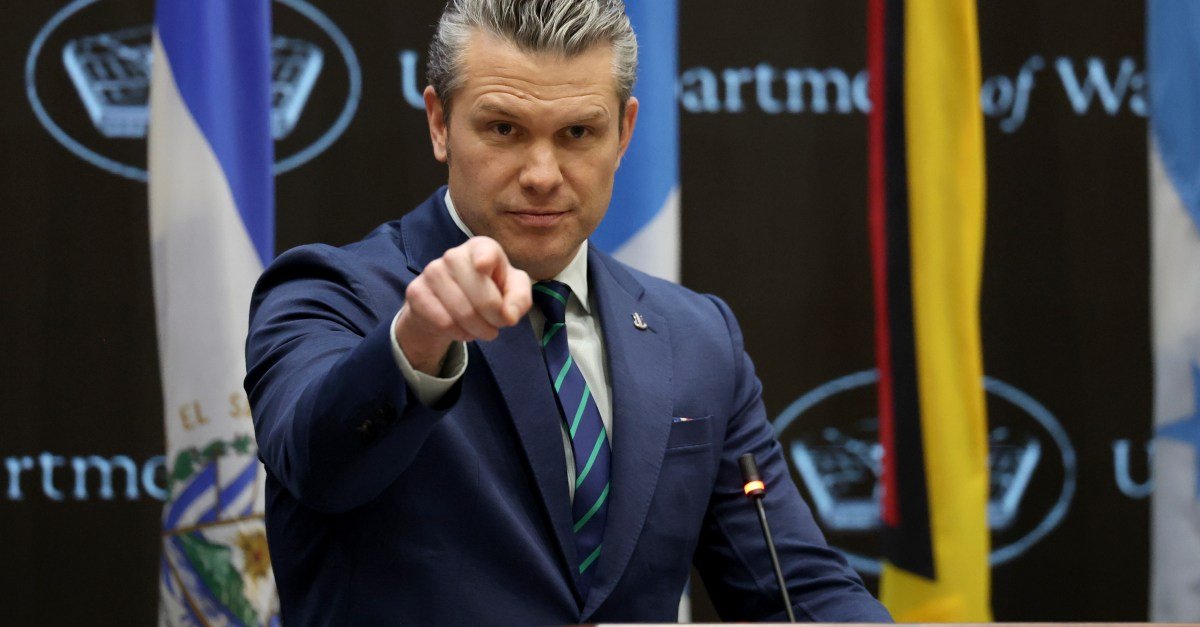
Various official X accounts have posted videos intercutting real bombings in Iran with clips from more violent video games, war films like Braveheart, sports highlights, and speeches from Secretary of Defense Pete Hegseth set to movie-trailer-style epic music.
War is not hell, for this White House — it is fun.
In some ways, this is not a surprise. The Trump administration is staffed, from top to bottom, by inveterate posters. They have turned everything — from the end of foreign aid to ICE raids — into memes. Why treat war any differently?
But war, and the school attack in particular, illustrate the pernicious function of this method of governance. Living online becomes a vehicle of moral trivialization, where tangible consequences of stakes of policy become secondary to the more immediately accessible world of likes and reposts. They are doing war for the chat.
In this world of Content, the meaning of a bombing raid is not the lives lost or strategic gains won but how good it looks when repackaged into a sizzle reel featuring Master Chief from Halo. Dozens of dead girls matter less to the White House than how Hegseth sounds when he says “lethality.”
This online war, lacking in any clear real-world justification, creates its own. And in doing so, it turns atrocity into afterthought: killing not with a clean conscience, but with no consciousness at all.
The origins of online war
Historically, American wartime propaganda follows a fairly predictable script.
The president deliberately builds a case that war is a terrible necessary: that some grave American interest, or noble moral cause, requires the spilling of blood. Once the war begins, official government propaganda remains relatively restrained; the vicious stuff, like the racist depictions of Japanese during World War II, tends to come after some major event inciting the public against the enemy (like Pearl Harbor). And even then, the most lurid content gets outsourced to the press and or popular culture.
Nick Cull, a scholar of propaganda at USC’s Annenberg School of Communication, sees the current Iran war as a break with this pattern. The Trump administration not only failed to convince the public that the war is necessary, but it scarcely even tried. Once the war began, the administration almost immediately began publishing death and destruction fancams.
Previous administrations used “to talk carefully and regretfully about military actions,” Cull says. Under Trump the US “reduces American military activity to team talk — high school football cheering.”
This is, Cull theorizes, a function of the administration’s preoccupation with media imagery — for reasons that had been theorized about 35 years prior.
In 1991, the philosopher Jean Baudrillard wrote a famous essay series arguing that the Gulf War was, in essence, a kind of media fiction. Baudrillard was not denying that the United States was dropping bombs on Iraq, but rather that the visual spectacle of the war created on then-novel 24-hour cable news networks had constructed a public narrative that bore only questionable resemblance to the war actually being waged.
“All those journalists who set themselves up as bearers of the universal conscience, all those presenters who set themselves up as strategists, all the while overwhelming us with a flood of useless images,” Baudrillard wrote.
In this synthetic reality, war was imagined as a fireworks show of high-tech precision weapons over night-vision skies, and not the bodies piled up where they landed. While he was pessimistic about observers’ ability to establish the truth behind the broadcast — “we do not have the means,” he wrote — Baudrillard believed it was nonetheless important to “not be duped” by the “virtuality” of the war.
Much of this seemed overheated at the time — even paranoid. Coverage of the Gulf War was hardly perfect, but responsible journalists at outlets like CNN had strong professional incentives to avoid brazenly detaching their broadcasts from reality.
But by the time the second Iraq War rolled around, a moment when post-9/11 fear and jingoism pushed media in a more openly chauvinistic direction, Baudrillard’s critique of cable news stung harder. And in today’s social media environment — where responsible gatekeepers have been dethroned, our feeds are a continuous tide of unverified images and contextless short videos, and attention is a currency that spends regardless of underlying accuracy — it feels uncomfortably prescient.
As Baudrillard’s essay suggests, the US has been accused for decades of presenting its citizens a videogame version of war. What’s perhaps most different this time is the degree to which the government takes this criticism as a compliment: You’re damn right it’s a video game. Come over and let’s play!
Their motives for doing so are not as simple as conscious manipulation. The relevant policymakers are enthusiastic consumers of this type of propaganda just as much as they are producers.
The president is a former reality TV host and social media addict. The defense secretary is a former Fox News personality, as were at least 20 other high-level hires. The vice president is a poster, the FBI director a podcaster. The administration’s most influential private sector ally is, of course, Elon Musk — a near-trillionaire who owns the right’s leading social media outlet.
With this class of person calling the shots, there is a persistent tendency to treat the online as the real zone of political conflict — almost more real than actual reality. The line between lying, confusion, and performance becomes blurred, almost indistinguishable. What matters is not only whether the American military is truly beating Iran, but the extent to which they can convince themselves and their online supporters that they are.
The wartime sizzle reels fail as actual propaganda: No one who doesn’t already support the administration will be impressed by grainy bombing footage paired with a clip of Walter White growling, “I am the danger.” Yet if the audience is understood to be the right’s very online cadres, which now include the top policymakers in American government, it makes perfect sense: They believe they can meme the war they want into existence.
This reduction of real-world issues of life and death into a quest for likes has infected the White House at every turn. And the further away from people’s daily lives and experience the damage, the more thoughtless and triumphant the memes.
Consider roughly a year ago, back when Musk was in charge of DOGE. His signature accomplishment during that time was not making government more efficient or even reducing spending, which has since gone up. Rather, he and his team succeeded in one key objective: destroying USAID, the agency dedicated to providing lifesaving aid to the world’s poorest people.
The real human stakes of this decision were absolutely enormous: One estimate suggests that roughly 800,000 people may have already died as a result of Musk’s actions. Yet he destroyed USAID not based on any kind of serious evaluation of its policy, but rather on his social media obsessions.
DOGE agents first began scrutinizing the agency not because of its budget, which was tiny, but in order to find examples of “viral waste” they could easily mock on social media. In the hours before the agency’s destruction, Musk was chatting with right-wing influencers on X about how USAID was a “criminal organization” that needed to “die” based on a web of conspiracy theories shared back and forth between them. And after his precipitous decision to cut off its funds, which caused medicine and food supplies to literally rot in warehouses, he joked about the whole thing being an imposition on his social calendar.
“We spent the weekend feeding USAID into the wood chipper. Could gone to some great parties [sic]. Did that instead,” he wrote on X.
That post got 21,000 reposts and 159,000 likes. And there is no doubt that Musk experienced each and every one of those accolades as more meaningful than the life of every child who died from preventable cases of malaria or AIDS. The online world is more immediate to him, the polluted water in which he swims, what happens there shapes his actions and sense of self more than the ultimate consequences of his behavior.
The Trump administration’s communication strategy seems designed to cultivate this incuriosity among themselves as much as anyone else. The real-world pain of ICE deportations, communities upended and families ripped apart, is replaced with stylized footage of teched-out federal agents and AI-generated Miyazaki memes of crying migrants. The officials involved bathe in the online accolades from their supporters, immersing them in a cocoon where they do not truly have to consider what they have done.
And now, we are seeing what it looks like to run a war on these principles.
The mass murder at the Minab girls’ was, it appears, a targeting accident: Years ago, the school used to be part of a nearby Iranian navy facility. Yet this accident may well have been preventable; the Pentagon used to have dedicated offices designed to assess intelligence and targeting decisions that might lead to undue civilian casualties. Hegseth spent the past year demolishing them, describing military lawyers as “jagoffs” who got in the way of the “lethality” of America’s “warfighters.”
There is, in short, a plausible straight line between Hegseth’s bluster and atrocity. Yet the bluster will continue, with no self-reflection: A thoroughly mediated creation, Hegseth is nothing but his persona. He will not give it up.
Nor will Trump make him. The president has responded to the news in Minab with a mix of disinterest and risible lies — at one point, claiming that an Iranian Tomahawk missile blew the school (Iran does not have these American made-weapons). The actuality of events has not penetrated his bubble; he is dancing to YMCA as oil tankers burn and bodies cool.
The wartime sizzle reels are another manifestation of this ethos. Built not to persuade a neutral audience, but rather to appeal to those already-bought in, their primary service is thought-deadening: replacing any serious consideration of consequences with collective reveling in memes. “When you didn’t want the US involved with Iran but the submarine kill videos are sick,” one popular right-wing X account tweeted, with a GIF of an ambivalent Larry David posted below the text.
It thus is not just collective self-deception at work for the administration and its very online supporters: It is collective exculpation. The crimes at Minab, and anywhere else, pale in comparison to sick kills.



