
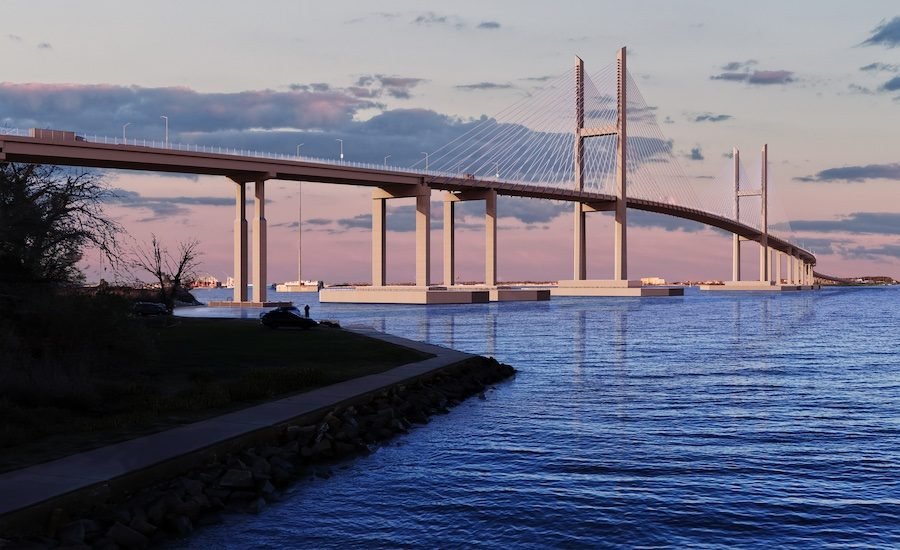
The Maryland Transportation Authority (MDTA) will not retain Kiewit Infrastructure Co. for the second phase of the Francis Scott Key Bridge reconstruction project in Baltimore, opting instead to seek bids from other contractors to complete the multi-billion-dollar effort.
Selected for the initial phase of the progressive design-build procurement in late August 2024, Kiewit has been developing plans for a replacement of the collapsed Patapsco River crossing. Kiewit’s bid of $1.2 billion was at least $20 million higher than the other two shortlisted teams.
By March 2026, Kiewit’s design development reached 70%, setting the stage for negotiations with MDTA on the second, full-construction phase. In that time, the rebuild’s projected construction costs had accelerated to more than $5 billion—nearly triple MDTA’s initial estimate that the agency said had been necessary to request federal emergency relief funding to launch the expedited removal of collapsed bridge debris from the main navigational channel serving the Port of Baltimore following the March 26, 2024, allision with the M/V Dali. The project timeline also began stretching beyond the original target of fall 2028.
Even though Congress had already fulfilled then-President Joe Biden’s promise of full funding for a replacement bridge, Trump administration officials have repeatedly criticized Maryland’s project oversight and contracting practices. In November, Gov. Wes Moore (D) promised to work with federal officials to on ways to reduce costs, which he attributed to “federal design and resilience standards—not discretionary state choices.”
After weeks of engagement with Kiewit on the rebuild’s next steps, however, “it became evident that the contractor’s proposed price and timeline for moving forward was unreasonably high and therefore unacceptable,” Moore said in an April 28 statement, leading to the decision to initiate the process of off-ramping Kiewit from the project.
Instead, MDTA said in its own statement that it “will go back to the market to negotiate the best deal to deliver this bridge as quickly and safely as possible.” The agency has scheduled an industry forum for May to share additional information about next steps in the procurement process.
Kiewit spokesperson Teresa Shada said in a statement that while the company has been unable to reach an agreement to continue with the project, “we’re proud of the progress achieved and the strong working relationship developed throughout Phase 1.” Shada added that although the company is disappointed by MDTA’s decision, “we’re committed to completing our current scope of Phase 1 work, in addition to integral early construction packages.”
According to MDTA, remaining tasks authorized under Kiewit’s $73-million Phase 1 contract include driving foundation piles and building a temporary trestle to support construction activity. That work is expected to last at least through the end of 2026, MDTA says.
Meanwhile, Maryland Attorney General Anthony G. Brown announced earlier this month that the state had reached a settlement in principle with the owner and operator of the M/V Dali, the vessel that struck the original Key Bridge, resulting in the structure’s collapse and the deaths of six construction workers. Grace Ocean Private Limited and Synergy Marine Pte Ltd. had fought the litigation, claiming that maritime law limited their liability to far less than the billions Maryland hoped to recover from the incident.
The settlement, details of which have not been announced, resolves claims brought on behalf of the state, MDTA, the Maryland Port Administration (MPA) and the Maryland Department of the Environment. It does not resolve any pending claims the state may have against Hyundai Heavy Industries, which built the Dali and the electrical system that the National Transportation Safety Board determined was the source of vessel’s loss of power and subsequent uncontrolled drift toward the Key Bridge.
Source: www.enr.com



