
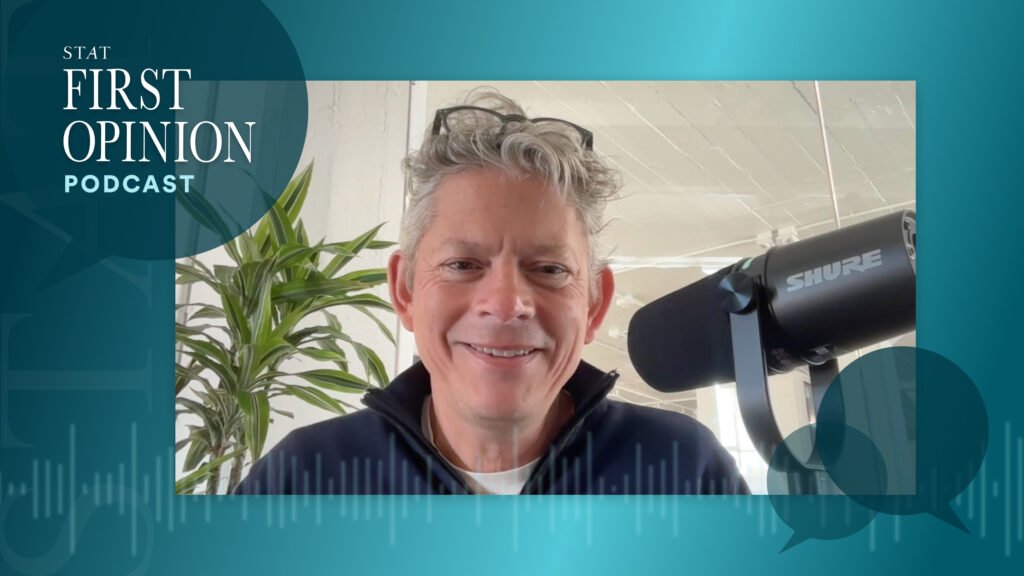
Below is a lightly edited, AI-generated transcript of the “First Opinion Podcast” interview with Thomas Goetz. Be sure to sign up for the weekly “First Opinion Podcast” on Apple Podcasts, Spotify, or wherever you get your podcasts. Get alerts about each new episode by signing up for the “First Opinion Podcast” newsletter. And don’t forget to sign up for the First Opinion newsletter, delivered every Sunday.
Torie Bosch: Whether it’s Ambien or Wegovy, ivermectin or fluoride, every drug in your medicine cabinet or advertised on TV has a story behind it. Not just how it came to be, but how it ends up affecting society in unexpected ways, big or small.
Welcome to the “First Opinion Podcast.” I’m Torie Bosch, editor of First Opinion. First Opinion is STAT’s home for big, bold ideas from health care providers, researchers, patients, and others who have something to say about medicine’s most important and interesting topics. This season, we’re focused on the intersection of medicine and culture.
And today I’m speaking with Thomas Goetz. He’s a journalist, an entrepreneur, and the host of the new podcast “Drug Story.” After a quick break, I’ll bring you our conversation about public health, parasites, and Big Pharma.
Thomas Goetz, welcome to the “First Opinion Podcast.”
Thomas Goetz: Thank you for having me, Torie.
Bosch: So congratulations on your new podcast. For anyone who has unfortunately not listened to it yet, can you tell us a little bit about the premise?
Goetz: Sure. Well, just what the world needs, another podcast. But I had this idea that I could not shake, which was that there’s a whole world of health and medicine behind the drugs we take. That in every drug, every medication, that there is a much larger story to tell about health and medicine and society and business and economics. This idea of using one drug at a time to tell larger stories about disease and health in society, and how we got there — how these diseases emerged, how we recognized them, how we diagnosed them — it just became, to me, a very powerful way to help people understand both the promise of medicine and medicines, but also the limitations of medicine, medicines, to solve what can sometimes be larger social problems.
And so that is what I try to do. And every episode is a different drug, and that lets you get into all sorts of different things, from depression to obesity to autoimmune disorders, whatever it is. As I always say, there are a lot of drugs out there. And so there’s a near infinite way of telling the story of human civilization through the prism of drugs.
Bosch: Yeah, and you sort of format or structure each episode in this really neat way. Can you tell us a little bit about the three parts?
Goetz: I was thinking, OK, well, if I want to tell the story of a disease and diseases and treatments, how do you structure it? So I stole a page from the best, which in this case is “This American Life,” which always does, you know, every episode in a series of acts. Being a English major, I was drawn to the idea of structure.
And so I came up with these three — it’s not brilliant, it’s pretty obvious — there’s the diagnosis, the prescription, and then side effects. So the diagnosis is a way to explain the disease, what is the actual disease in play and how did that emerge over the years? The prescription is about the drug, where we actually talk about how the disease is treated largely through the one drug. And then side effects is not so much the immediate so-called adverse effects or adverse events of the drug itself so much as the larger social consequences or contextual consequences of using X drug on Y disease. And so side effects, basically it’s a rhetorical device or a narrative device, this 3X structure, that lets me go lots of different places. It lets me to go to ancient Babylonia or to the halls of Congress or to inside marketing departments at pharma companies. But it’s enough of a structure to kind of tell the story. And it turned out that it’s a useful device.
Bosch: Yeah, I have to confess that on the recent ivermectin episode, I did not make it past the diagnosis. It was a little hard to listen to the tales of parasites.
Goetz: Oh, well, so the parasites, I mean, ivermectin, that was a great example of what the disease, the disease that the drug was originally created or discovered to work on, which is parasitic infections. In that idea of prescription, all of a sudden the idea came, well, can we repurpose the drug? Which is a great idea, a great use of pharmaceutical drugs. Some repurposing has opened the door to all sorts of new uses and new treatments and new help for people. But in the case of ivermectin, it’s, in many ways, the hope for repurposing rather than the actual effect of repurposing, at least to date, in terms of Covid and maybe even cancer.
Bosch: I’ll go back [and listen to] to the side effects. For sure. I just … the part where you’re talking about a parasite whose name escapes me largely because I don’t want to have nightmares about it — a parasite that replaced its host’s tongue and then starts to live as a tongue in its host.
Goetz: Yeah. Oh, yeah. Well, it’s a fish, to be clear. It’s not a human. That’s not a human parasite.
Bosch: Nevertheless.
Goetz: Yeah, that’s my favorite parasite because it is the nightmare scenario of what a parasite could do and, and does, and yeah, it eats the tongue and then takes the place right in the mouth, right inside the fish’s mouth. and does all the work that a tongue does, but, takes a little off the top for itself.
Bosch: Need to connect to Disney about the next “Finding Nemo” movie. It seems like a great premise to me. So as much as I could keep talking about that …
So you recently, alongside the debut of “Drug Story,” which we should say just started in January, is that right, January? So alongside the debut of the show back in January, you wrote a really compelling essay for First Opinion and STAT about how Americans expect too much from drugs. So I wonder if you could elaborate on that a little bit and how that idea might animate your approach to the show.
Goetz: Right, so I was glad for the opportunity to write this because this is an idea that had been bouncing around my head for years, really. It starts from the perspective of the patient when they go into the doctor’s office with a concern and oftentimes get a diagnosis and get a prescription. And so many times the patient leaves with that prescription, I’m pretending I’m holding a piece of paper but it’s probably on their phone. And they think it’s gonna solve their problems, right? The expectations, the hope is so high for that prescription to be the salve for their ills.
But in reality, it doesn’t work that way. It oftentimes is not the solution. Oftentimes it’s that prescription is only the first step on this series of trial and error and adjustments and titration and other medications that they have to try. The prescription is rarely the solution. And in fact, the prescription can create its own body of complexity and side effects, not just in the body, but in terms of, you know, can you afford the drug? Is it something that works with the other medications you’re supposed to be taking, etc., etc.? So it’s the first step into another world of complexity.
I was really curious about this tension between what oftentimes is the hope. I mean, it’s actually great. The examples, the best example is, you know, the [direct-to-consumer] drug commercials that are allowed. They kind of come in two parts. The first part is the dark clouds parting and the sun shining through and the patient, the people have a new world of opportunity and promise and health, and then comes the second half of the drug. Where it’s the very fast, talking about all those side effects and all those problems and consequences that were not intended.
And so that duality between what we want out of the drug and what the reality is, I think is something that, we as a society just are so hopeful and so … so desirous of a positive outcome, but it’s a lot more complicated than that. And so that was really what I was trying to get at. And I think that goes back all the way to, I mean, I think of “Romeo and Juliet,” when at the end of “Romeo and Juliet,” Romeo goes to the apothecary to get the drug that will put Juliet into a deep trance for a couple days so that they can escape together and run away and live their life happily ever after. Well, it doesn’t work that way, right? “Romeo and Juliet” is a tragedy. The drug does not work, but they want it to be a magic potion. And, well, actually it does work.
Bosch: The drug sort of does work, though, right, and it’s just not used as directed?
Goetz: Yes, exactly, not used, as directed, and Romeo jumps the gun thinking that she’s actually died, etc., etc. But yeah, so the disconnect between our hopes and the reality is really what I was trying to get at.
Bosch: And so the show really captures that as well. You know, I’m thinking about the recent episode on Ambien, which began with a really fascinating sort of historical look at insomnia as a modern creation. And it does seem that you seem to be focused at least initially on these drugs that really intersect with the ails of modern life, right? So insomnia, obesity, addiction. Is that sort of a special area of interest to you?
Goetz: Well, I’m a public health guy, so those are all kind of what are often called the social determinants of disease or sometimes the commercial determinants of disease. So I’m very interested in those areas. I’m also interested in the way they’ve been described as mismatched diseases where our bodies were evolved to do X, Y, or Z and then the world we built is not is not the world that our bodies were evolved to inhabit. And then you have commercial forces like the food industry or the electronics industry, forcing other things into the equation that kind of make things very complicated.
And so we’re basically not using our body as directed, if you will. And so then we come up with drugs like Ambien, which can be very effective, but also can, you know, teasing out the effect from some of the consequences can be really challenging. So I think I’ve always been interested in this idea of, how deeply does the problem go? How deeply does the disease go in terms of going back and back and back?
Obesity is a great example. It’s not just a problem with hyper-, ultra-processed foods, but it’s also a problem with the cheapness and ubiquity of grain. One of the greatest inventions in the last 100 years was scientific industrial agriculture allowed [us] to feed billions of people, but it also made grain really cheap and so that, you know, you can follow the trajectory. So I think that is one of fun — well, I say fun. To me, it’s a compelling story that hopefully helps the listeners of the podcast understand their world a little better and understand how we got to the disease in question a little more thoroughly.
Bosch: And so, you know, for years before the podcast, you were a reporter reporting largely on health, is that right?
Goetz: Yeah, I was technology and a business journalist. Then I was executive editor at Wired, and then I got my [master’s of public health] at Berkeley because I saw around the corner to the future of journalism, and it did not look bright. And so I figured, OK, I better get a little more expertise under my noggin. So that was public health.
Bosch: I have definitely looked at the MPH program at Johns Hopkins late at night imagining what my future might look like. So I identify with that.
How do you think having an MPH has changed your approach to journalism?
Goetz: Oh, well, I mean, it ultimately transformed my career. I am very keen to understand systems and structures and contexts. That to me is like, if you can make those invisible structures visible, it helps me understand the world and hopefully it’ll help people understand the word. And so that’s what public health is in many ways. It’s understanding the context of disease, the other forces beyond the health care system that manifest in disease or health or illness. And then just thinking about how you make sense of that mess. So epidemiology as a science is trying to turn the cacophony of everyday life into something that you can parse it enough to understand maybe causation. Those rules and rule sets, I think, have been very powerful to me in telling stories that help people make sense of their lives, make sense of the challenges they face in terms of their health decisions, their medical options, and so on. To me, those are concerns and issues that are as prominent as climate change for modern society, like those are the great opportunities, but also the, maybe our largest, some of our largest problems.
Bosch: Should more journalists be getting masters of public health?
Goetz: Well, I encourage everyone to get a master’s in public health, especially M.D.s, you know, the M.D.s who I know, including my own sister, who have gone ahead and gotten the MPH, it kind of opens dimensions, multidimensional universes by which you don’t just think about one patient, you think about whole populations of patients, or better yet, not just patients but people. I feel like it’s an incredibly powerful degree and a very powerful kind of frame of reference. For journalists, I think it’s powerful because public health is so many different things. It’s everything from health care, health care administration, hospital systems, economics to biotechnology, epidemiology. It gets complicated fast.
But I find that for anybody who’s considering it, I always am like, yeah, go ahead. Tried to do it as fast as possible. And I mean, I was very lucky. The program I was in was the interdisciplinary MPH at Berkeley, which meant you took a little bit of everything across the public health menu. And that was very helpful to me as a journalist, just so I have a passing ability to understand or to start to think about some of these deeper questions like infectious disease, right? Like that’s another area where it turns out that it matters. It’s good to know a little bit about something about infectious disease these days.
Bosch: For sure. So ahead of our conversation, I was looking through your old author page on Wired. And I think this is from when you were executive editor. I was really struck by a feature from [2006] titled “The Thin Pill: 75 million Americans may have something called metabolic syndrome. How Big Pharma turned obesity into a disease — then invented the drugs to cure it.” Do you remember writing that story very clearly?
Goetz: Oh yeah, I forget the name of the drug, but it was in many ways the precedent for GLP-1s. And at that time it was, you know, that was seven years before the American Medical Association recognized obesity as a disease. And it was also this idea that medicine as a treatment for obesity had a lot of promise, but it also would be a very fundamental shift in how society thought about this condition and how we can use or might use medicines to address it. I have to read that again. I probably was more skeptical of the idea of using drugs to treat it than I would be today. But I think it was an example of kind of trying to use this lens of enough public health to think about medicine. So yeah, it’s an old saw I’ve been sawing at for a while, I guess.
Bosch: Yeah, I mean, so I found it super interesting to read. I vaguely remember reading it at the time, I want to say. And I think I was just sort of interesting, comparing it to your coverage of Wegovy, which I think talked in somewhat similar terms about the idea of obesity as a disease and a pill to cure it. And as you say, with the Wired piece from [2006], you did seem so much more skeptical than in discussing it, albeit with, of course, lots of nuance on “Drug Story.” So I was wondering if you could maybe talk a little bit about your thinking about the topic and how that’s changed as sort of indicated by your writing about it.
Goetz: One of the things that I’ve really come to appreciate in the last, since I got my MPH, since 2007, say, the last 20 years of covering health and digital health and medicine and technology is how so much of health is this tension that is actually a very fundamental American tension between personal responsibility and a common good or a greater good. And in many ways, the kind of issue of obesity is a great example of that tension. So there’s a lot of emphasis on personal responsibility, free will, personal choice, when it comes to what we eat, right? And the idea that diet and exercise are up to you. And I think that is true to some extent. We do have choices there.
But there are also greater structures and systems at work that, I think, 20 years ago, I was not giving enough heed or paying enough credit to the idea of a common good. The idea that there are these larger systems that are often being manipulated by commercial interests like the food industry and manipulated on an individual basis. It’s basically taking advantage of our ability to make choices, to basically entice us to make what turn out to be bad choices. And I think you see that right now a lot with MAHA and the emphasis on personal choices, personal responsibility, and the real, in some ways, the real attack on the idea of actually there is a common good and there is an obligation of government, of regulators, of our health infrastructure, to protect our citizens and to create some standards of, and access to, standards of health and medicine. And obviously that’s always been, that goes back over a hundred years in this country. That is an enduring tension in our medical care and in our country at large.
But I do think it has come out and is really brought to the fore in the debate around GLP-1s and obesity. And in, you know, my 2026 self actually believes that GLP-1s actually don’t solve the problem. They are not a solution to our social problem of an increase in rate of obesity. Our social problem of bad food being so prevalent and so cheap and being subsidized by the government. Like, if the government is subsidizing agriculture, on the one hand, why do we expect personal choice? Like, we should have some government on the other side, too, maybe trying to protect us from some of those, some of the effects of those subsidies.
Anyway, I feel like it’s a great example of where we actually need, especially now, this idea of a common good and a common health and an expectation. All of our citizens [should] be able to live a healthy life. You know, to have healthy food, to have healthy water, to have safe streets. These are the basic protections of government. And they have massive health implications. And there are structures and systems that, unfortunately, are under attack and being questioned in ways that they never had been in the last hundred years. Sorry about that rant.
Bosch: No, it was fantastic. Because as you were talking, I was thinking so much about your First Opinion essay about expecting too much from drugs. And in some ways, then it feels like it’s less that Americans expect too much from drugs individually, though, of course, I’m sure we do. But more that the system, as you’re discussing, expects the drug to fix the system’s problems, right? Or the problems created by the system, right? So the system creates the problem of obesity and then creates a pill to solve it rather than fixing the big system.
Goetz: Yeah, which is totally true. I mean the EpiPen, the first episode of the podcast, is a great example of that, right? There was this creation of a drug delivery system that, you can deliver a treatment for allergy very quickly and effectively. And everyone with food allergies now carries not just one, but two EpiPens, which is great.
Why is there such an upsurge in food allergies in the United States or in Western nations? What’s going on with the way we eat in our immune systems that has changed? Well, it turns out that the guidelines for almost 20 years from the [American Academy of Pediatrics] were exactly wrong in recommending that parents minimize their infants’, young babies’ exposure to potentially allergic foods: peanuts, milk, eggs, what have you. And so those guidelines created, or helped create, I should be careful in my words, helped create an epidemic of food allergies that was driven by human decisions and by well-intentioned policies that were fundamentally flawed, misguided understanding of what actually is happening in our immune systems, which is an incredibly complicated system.
I think the fact that we have a drug now to treat those conditions or to treat the anaphylactic shock or anaphylactic reaction, it’s wonderful. But it is a great example of how the certitude that we might have around our recommendations or guidelines or policies in health and medicine are always subject to change, are always subject to new science and new understanding. And medicine is a science through the vessel of human understanding and the limits of human understanding. You know, that’s the playing field on which medications will always be kind of out there.
Bosch: Absolutely. I have a 2-year-old, and I will never forget trying to convince her to drink pureed salmon when she was 7 months old to try to stave off any future fish allergies on our pediatrician’s recommendation. She was not interested.
Goetz: That is dedication.
Bosch: I tried.
Goetz: Show me a 7-month-old who would be.
Bosch: Lots of them, apparently. So, as we start to wrap up, where is “Drug Story” heading next?
Goetz: Well, I’ve just finished the first season, so it was incredibly gratifying. It took me a year to come up with 10 episodes, and I put it out not really knowing what was gonna happen with it. And it’s been thrilling to see so many people respond to it. And for a brief window of time, it outranked Oprah on Apple Podcasts. And I have a screenshot of it and everything. It’ll be on my gravestone.
But it’s really been thrilling to see that there is an audience for stories about not just medicines, but the secret is, it’s really about public health. It’s really these structures and systems of the human layer and how we how we treat and think about disease, and a lot of people like those stories. So that’s wonderful, and I’m incredibly gratified that that it has been a success. So I’m gonna do a second season, and I have a list of 30 drugs.
As I always like to say, there are over 3,000 drugs behind a typical pharmacist counter. So there are a lot of drugs out there that have stories and that kind of opened the door to these kind of human levels of understanding. So I have another 30 that I’m gonna cut down and hopefully before the end of the year, my goal is before the of 2026, I’ll start a second season. I should say, I’m doing this independently. I have no distributor or production company. I’m out there shopping my own show to get sponsors and support. So if I can get a couple of those pieces in place, then we’ll have another episode or another season by the end of 2026. And like, I haven’t done insulin and diabetes. I haven’t done ADHD and Adderall. I want to talk about Humira and autoimmune disorders. I have this amazing three-part miniseries on fortified foods, iodine in salt, and vitamin D in milk, and folic acid in flour. And they’ve just added folic acid to corn masa [in California] — I’m excited about that. So these are all amazing stories to tell that I believe will continue to bring the story of health and medicine to more and more people. So I’m exited about that second season.
Bosch: Well, I can’t wait. It’s just such a fun show to listen to, in terms of bridging, as you say, the big-picture public health with individual stories and wild anecdotes, which always make for some compelling listening. So thank you so much for the show. And thanks for coming on the “First Opinion Podcast.”
Goetz: Thank you, Torie. Thank you to STAT. I’m a loyal subscriber, and I hope to get the chance to contribute again.
Bosch: And thank you for listening to the “First Opinion Podcast.” It’s produced by Hyacinth Empinado. Alissa Ambrose is the senior producer, and Rick Berke is the executive producer. You can share your opinion about the show by emailing me at [email protected]. And please leave a review or rating on whatever platform you use to get your podcasts.
Until next time, I’m Torie Bosch and please don’t keep your opinions to yourself.
Source: www.statnews.com



