
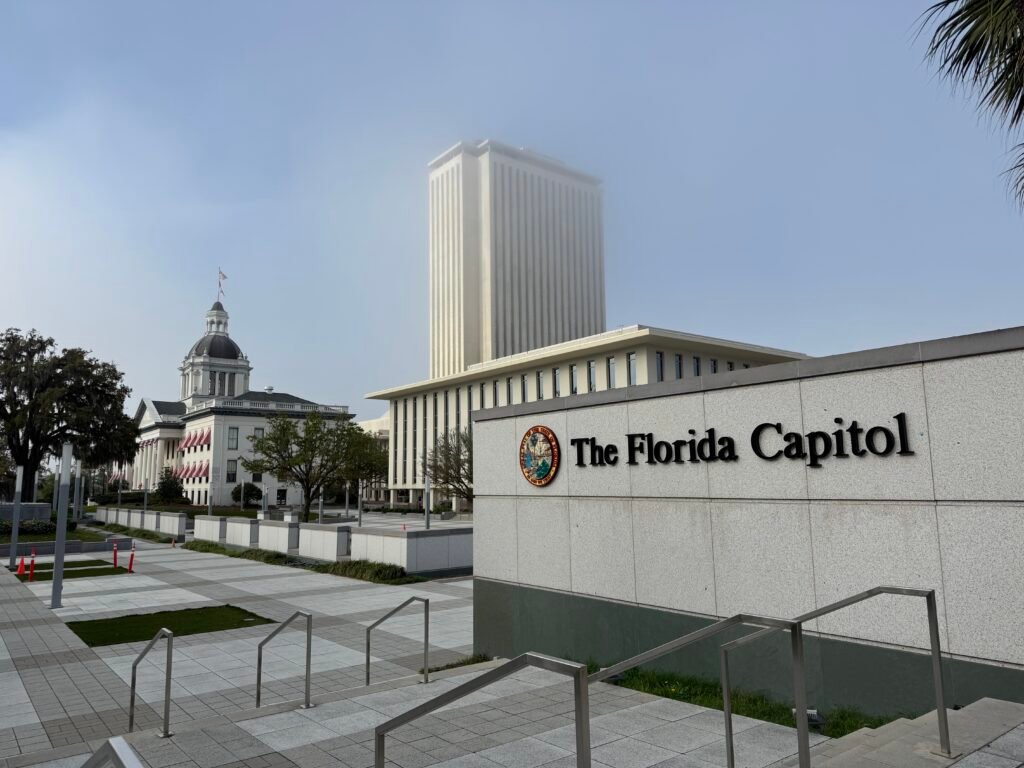
The Florida Capitol building on March 11, 2026, as the legislative session neared its end. (Photo by Jay Waagmeester/Florida Phoenix)
Legislators added a provision eliminating zoning requirements for small private schools into a Democratic-led bill in the waning hours of the 2026 legislative session.
Both GOP-led chambers of the Florida Legislature on Thursday passed SB 182, allowing private schools with 150 or fewer students to operate in commercially zoned buildings.
The bill was introduced by Democrat Sen. Shevrin Jones from Miami Gardens and the House version by Democrat Rep. Yvonne Hinson from Gainesville. The bills at introduction solely addressed creating a teacher mentorship program.
The provision remains, but some House Democratic colleagues stopped supporting the bill after the Senate unanimously added the zoning piece.
“It’s a good bill, for her, her portion,” Rep. Michele Rayner, a Democrat from St. Petersburg said on the House floor, acknowledging Hinson. “I can’t talk about the other portions. Unfortunately, because there’s been a train that’s attached to your bill, I cannot vote up on it, and that’s sad, because I really wanted to.”
“Train” refers to attaching provisions as a session winds down to a bill on its way to passage.
It passed the House, 91-11, with only Democrats, but not all, voting in opposition. In the Senate it passed unanimously.
The final bill allows schools enrolling 150 or fewer students to operate in commercial or mixed-use zoning districts without rezoning or requiring a special exemption. The bill would allow counties and cities to require “proportionate mitigation measures necessary to mitigate vehicular traffic and pedestrian safety.”
The building still must meet educational occupancy requirements in fire codes.
Teach Florida, self-described as a grassroots movement of the Jewish Orthodox Union seeking “equitable funding for nonpublic schools,” prioritized passing the bill.
According to Teach Coalition, existing law is “blocking school growth.” The organization told the Phoenix that 41,000 students statewide hoping to attend private schools have been unable to cash in their state scholarship vounchers because there are no available private school seats.
“This bill is a game changer for Florida families,” Melissa Glaser, Executive Director of Teach Florida, said in a statement to the Phoenix. “For too long, zoning restrictions have kept students stuck on waiting lists, unable to access the schools they want. This legislation removes that barrier and opens the door for more schools to be built, so more students can get the education they deserve.”
A board member of Teach Florida, Yossi Rosengarten, is the incorporator of a recently state-approved scholarship funding organization with a focus on Jewish schools.
Rosengarten is also chair of Teach Florida PAC, which sent tens of thousands of dollars to lawmakers who guided the private school zoning legislation.
“What we have in the end is, we have a piece of legislation that is not perfect for anybody, but we honor you, representative, and we honor your service,” Rep. Jennifer Canady, a Republican from Lakeland and future House speaker, said, acknowledging Hinson.
During the last quarter of 2025, the most recently available campaign contribution data, Teach Florida PAC gave $22,500 to Canady’s PAC. She chairs the final committee that approved HB 833. It gave $7,500 to Rep. Hillary Cassel’s PAC, who sponsored the private school provision in its first iteration.
It sent $36,000 to U.S. represenative and gubernatorial candidate Byron Donald’s PAC last summer.
Step Up for Students, by far the largest scholarship funding organization in the state, also lobbied in support of the private school language, as did the Foundation for Florida’s Future, former Gov. Jeb Bush’s policy organization.
The conservative advocacy group Americans for Prosperity and CES Academy, a biblically-based school were in support as well.
Hinson said of the private school provision, “That’s the only part [her caucus] seem to be upset about; the rest of this is pretty good legislation, so I’m going with it, ladies and gentlemen.”
Presidents
The House amended the bill to include previously passed legislation that would require display of portraits of former presidents George Washington and Abraham Lincoln “in a conspicuous place at each public school in the district.” The state will select the portraits to be used.
The House also added in requiring testing for cursive writing.
GET THE MORNING HEADLINES.
Original bill
The mentorship program, if the governor signs the bill into law, would place retired teachers in classrooms at schools with D or F grades.
Those retired teachers could mentor new teachers who are rated as needing improvement or “struggling with behavior management within the classroom.”
The retirees must have three years of experience and been rated highly effective. They may be paid up to $3,000.
The state requires the mentor to “not have a personal agenda other than assisting his or her mentee in developing and reaching the mentee’s goals.”



