
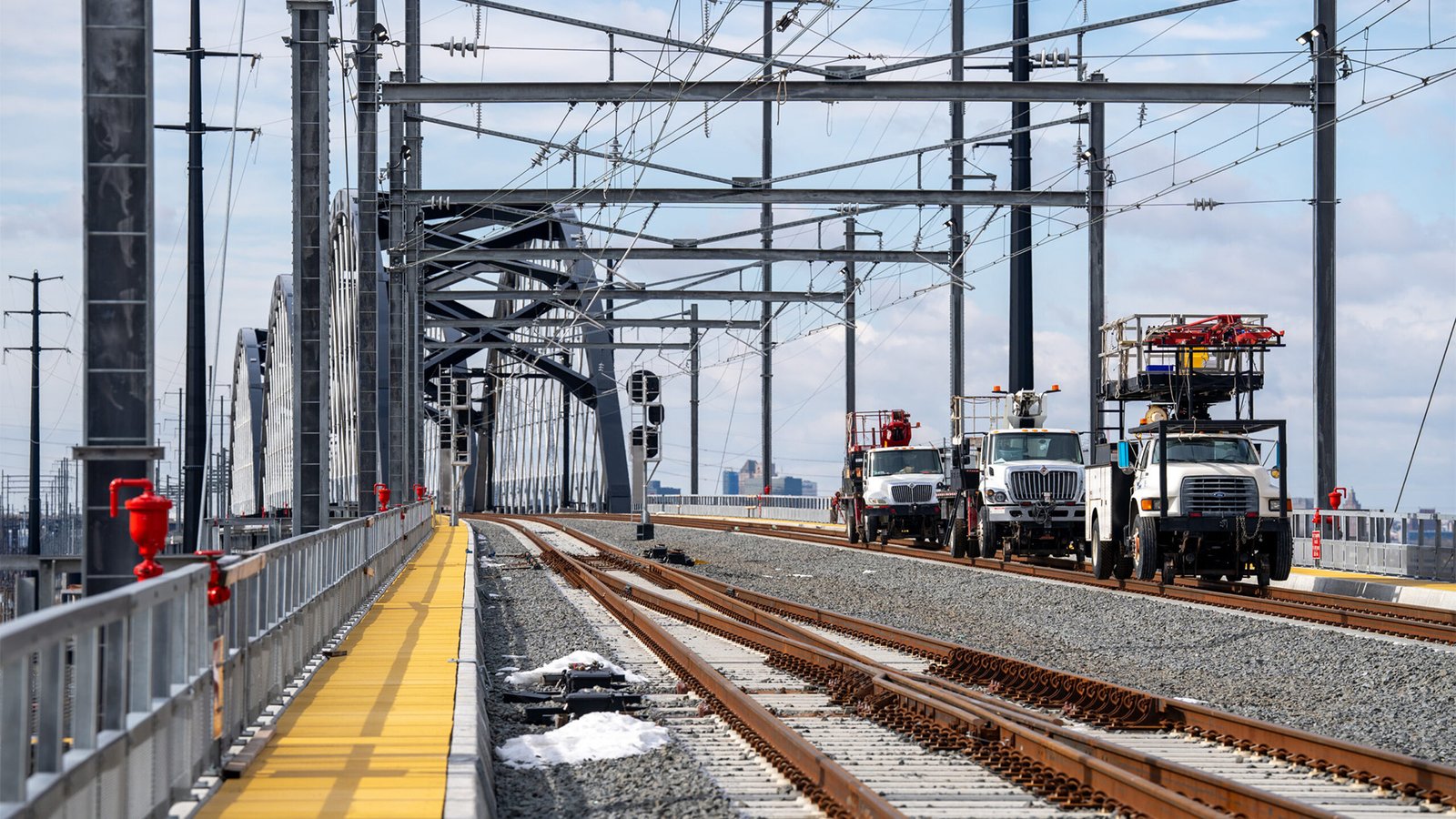
The new Portal North Bridge in the Meadowlands was put into regular rail commuting service for the first time on Monday — two weeks earlier than planned — after construction crews finished a track-shifting stage of the $2.3 billion project. Another set of rails will be realigned in the fall, followed by the demolition of the span’s predecessor, a 116-year-old swing bridge that opened for marine traffic but didn’t close reliably. The malfunctions for decades were a major choke point on the Northeast Corridor, the busiest U.S. passenger rail route.
NJ Spotlight News sat down with Kris Kolluri, president and chief executive director of NJ Transit, and also executive director of the New Jersey Turnpike Authority. This interview has been lightly edited.
Joanna Gagis, anchor: The Portal North Bridge opened ahead of schedule. Explain what went into that process.
Kris Kolluri: We had a generational snowstorm. We had more fog and rain than you can count on your fingertips. And we had multiple challenges while we were trying to run trains next to the brand-new bridge. So the fact that the team choreographed and finished a generational project — once-in-a-century project, actually — ahead of time is a feat of engineering. That’s a feat of human determination.
JG: It was significant on Friday, right when we had problems on the old bridge. What happened there and how did the work on the North Bridge really save you?
KK: Somebody discovered there were four bent catenary poles near the old bridge. So Amtrak and New Jersey Transit worked through the morning. I got my first call, I think, at 4:45 in the morning. By 5:45, they made a decision to open their first track on the brand-new bridge two days ahead of schedule. Thank God for that. It tells you a lot about how critical these infrastructure projects are and how critical the infrastructure itself is. So the fact that Portal was open and ready to go was a big deal for that day.
One not enough
JG: What would have happened if it didn’t open?
KK: The Northeast Corridor was going to shut down. There was no other way to get into New York City, and that would have been an untenable position. That means we would have had to drop everybody off at Newark, interrupting the PATH to Hoboken and then take the ferry or go there. Look, could you have done it? Sure. But it was just not the right way to do it.
JG: This is just the first phase of that project, right? What happens in the fall?
KK: Exact same thing for the second track. So our goal is to start it four weeks before Thanksgiving and be finished before Thanksgiving.

JG: So help us understand right now: There is one-way track on the Portal North Bridge, and now we’re going to do the other way.
KK: That’s right. We will decommission the one track that’s on the old bridge and commission the one track on the new bridge. The new bridge will have two tracks by Thanksgiving.
JG: Somewhere in the future — tell us the timing — there will be an entirely new bridge built duplicating this. When is that happening?
KK: We don’t have money for that yet. The plan is eventually to make sure we have excess capacity. To have 30, 48 trains go into New York City an hour, you need the second portal bridge. But that is a long ways off, certainly past probably my tenure here. But I want to emphasize: This was a project that was needed almost for four decades.
The fact that we were able to get it done on time — actually ahead of schedule — to meet the needs of the customers is exactly what you should expect. Do we always get it right? No. But it means a lot to my colleagues that they worked so hard to make this happen. And I’m so grateful to them.
JG: And certainly to the commuters between New York and New Jersey, this is one critical piece of infrastructure. Can you tell us what else is in the queue when it comes to upgrades? Because we’re about to enter the summer months — we have the World Cup coming.
KK: Dock Bridge, which is right near Newark train station. I just signed the agreement to repair that, to build a brand-new structure, improve structural improvements, catenary wires, the Hudson tunnel project — which is a longer-term project — but that has to continue going. What this shows us is the criticality of the infrastructure between Newark Penn Station and New York Penn Station. It’s the busiest 10-mile corridor in the Western Hemisphere. If any one of these segments fail, that means the entire Northeast Corridor and the 350 trains that we use a day will not be able to go into New York. That is not a situation that any one of us should be comfortable with. And that’s why the governor is so focused on this.
JG: You mentioned Gateway funding. We know that the appeals court ruled in favor of New Jersey and New York, that the money has to keep flowing. Do you expect that this case is headed to the U.S. Supreme Court?
KK: The federal government has the ability to appeal the decision. I think [Tuesday], if my memory serves me right, let’s see what happens. Despite all these legal challenges, not one person has said that the project itself is not meritorious. They talk about other things.
So I hope that calmer heads will prevail in the end and let the project go forward. Ultimately, these are hard-working jobs that will be supported by this project, and will make life easier for the riders of the entire region, which is good for the country.
‘I love fun’
JG: Are you concerned with the speed that it could take if this were to go to the Supreme Court? The first case and decision in the lower court and then to the appeals court moved pretty quickly, allowing the money to free up without too much of a work stoppage. If this does go to the highest court, do you think this could cause delays that add on to the cost?
KK: Any delay will add on to the cost. Let’s see what the appeals schedule looks like. I’m hopeful that we don’t have to keep fighting these legal battles and let the hard-working men and women who are building the project do their jobs.
JG: You took on the New Jersey Turnpike Authority because you just don’t have enough to do in a day, right?
KK: I love fun.
JG: The governor came out with a pretty significant decision in terms of the Newark Bay Bridge. What has she decided in terms of the expansion or not of that space? And what will it mean for commuters?
KK: Look, I think the governor made the right decision. Her point was you have the ability to put out a $6.7 billion project, the single largest project the turnpike has ever put out by building this bridge, because we have to decommission the current bridge by 2031.
JG: The National Transportation Safety Board says that it will be structurally unsound.
KK: That’s right. It’s already structurally deficient. It certainly is functionally obsolete. We have to make decisions that are pragmatic. And the governor’s decision is pragmatic.
JG: Her decision really is that it will not go to eight lanes. It will remain four on the new bridge.
KK: We were always going to do a four -ane bridge in the first phase. So her point is do the bridge that you have money for, focus on it and get it done for safety and for mobility. And that’s what she has asked us to do and that’s what we’re doing. That’s the kind of pragmatic governance that is required. And I think she’s leading by example.
JG: And of course, environmentalists are lauding that decision.



