
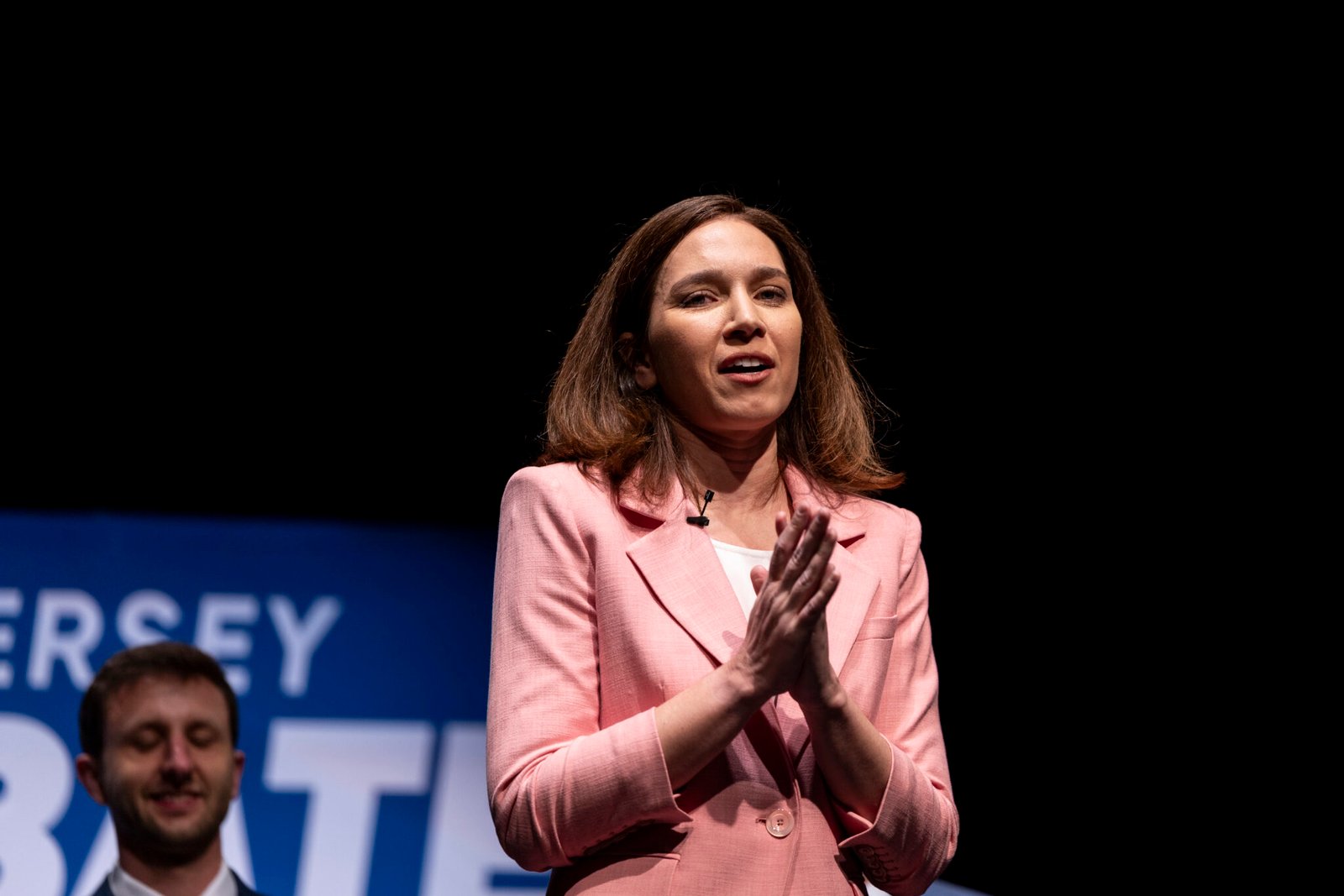
A leading Democratic candidate in the race to take on Republican Rep. Tom Kean Jr. raised alarms over apparently doctored images in a mailer highlighting her opposition to abolishing U.S. Immigration and Customs Enforcement.
The mailer, sent by an independent expenditure group, depicts a smiling Rebecca Bennett standing among officers decked in riot gear and declares the candidate is “standing for ICE” and “wrong for New Jersey.”
Bennett, who is the lone Democrat in the 7th District House race to stop short of calling for ICE to be abolished, called the mailer unconvincing.
“This is the best you’ve got? This like really crappy AI-generated version of me, it doesn’t even look like me. If you’re going to send out attack ads, you might want to upgrade from the freemium version of ChatGPT,” she said in a video posted to social media.
12th District Democrats trade barbs over candidate’s ties to the ‘blind sheikh’
Bennett has previously charged that the PAC behind the mailer is backed by Republicans who hope to damage her campaign so Kean might face a different candidate in November.
Other ads backed by the Real Change PAC have attacked Bennett over her opposition to ICE abolition and boosted primary opponents that hold a harder line. But the mailer’s use of likely altered images revives concerns over deepfakes and AI-generated images that have swirled for years.
“The question on this mailer is really to what level can a campaign, or an independent expenditure group for that matter, provide imagery that never really happened but they want to use it as if it happened,” said Ben Dworkin, director of the Rowan Institute for Public Policy and Citizenship.”
The PAC did not return a request for comment.
Bennett is competing in the June 2 Democratic primary against Michael Roth, Tina Shah, and Brian Varela. Kean is seeking the GOP nod unopposed.
Though New Jersey law criminalizes the use of deepfakes or other artificially generated imagery to aid the commission of a crime — including to threaten harm to elected officials, or to coerce them — the state does not directly bar or regulate the use of generated imagery in political advertisements.
In current and past legislative sessions, lawmakers have introduced and even advanced legislation to create criminal penalties for undisclosed synthetic imagery released close to an election, but those efforts stalled in past sessions.
“It is the wild west right now. There just aren’t any rules that are enforceable,” said Dworkin.
Earlier in May, two Assembly committees unanimously advanced legislation that would levy fines for election-related deepfakes that do not carry a disclaimer, but the bill has not won a Senate companion since its introduction in March and has not reached an Assembly floor vote.
Doctored images are nothing new to campaigns. In 1950, a composite photograph altered to show U.S. Sen. Millard Tydings in conversation with Earl Browder, a former head of the American Communist Party, contributed to Tydings’ election loss, Dworkin said.
Likewise, image editing software has long allowed for the creation of deceptive media, but the speed and ease with which artificial intelligence creates synthetic media could attract cash-conscious campaigns.
“It’s a very seductive cost-saving measure, but it obviously has very real ramifications for that candidate, for their opponent, and for the morals and the ethics of that campaign and within our system in general,” said Ashley Koning, director of Rutgers University’s Eagleton Center for Public Interest Polling.
Generative AI could save campaigns tens of thousands of dollars on ad production alone.
But viewed broadly, AI is little different from other strides in campaign technology — like microtargeted advertisements and a growing reliance on data to court the most reliable voters — seen in recent decades, Koning said.
The political world isn’t the only one to face those questions, she said.
“This is question across virtually every industry right now: What are the guardrails of AI, especially as it’s getting easier and easier to use AI in these particular circumstances,” Koning said.
GET THE MORNING HEADLINES.



