
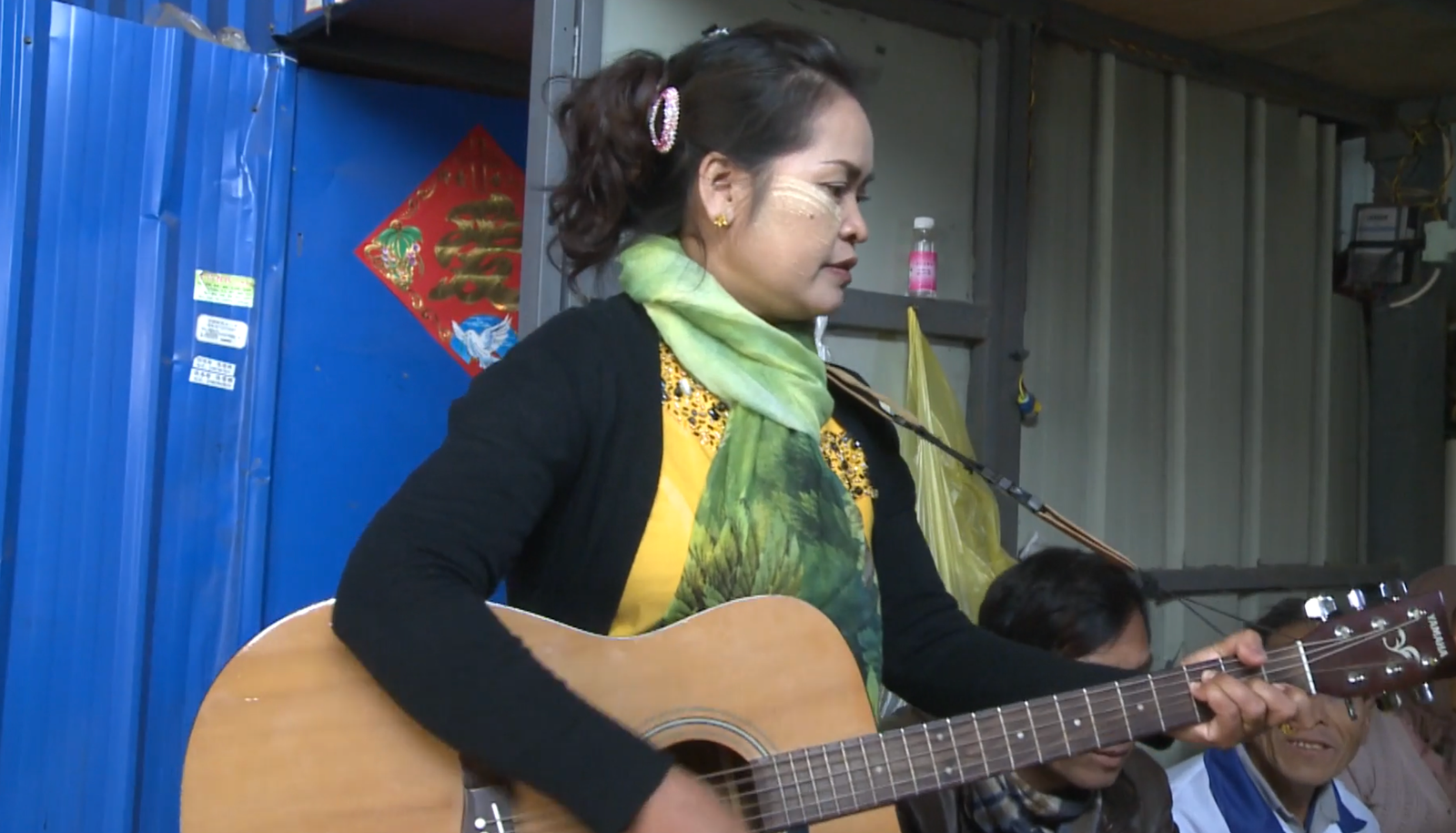
“Myanmar Bride” (in Chinese: Miandian xinniang, which means exactly the same thing) is a 65-minute ethnographic documentary from 2016. Journalist and filmmaker Huang Shudan, born in 1991 in Yichang, Hubei Province, examines, as the title suggests, a phenomenon commonplace along the border between the People’s Republic of China and Myanmar: marriage between Chinese men and Burmese women.
Watch This Title
on CathayPlay by clicking on the image below
It’s important to note, however, that the Chinese men in question are largely not members of the Han ethnic majority, but rather belong to one of the ethnic minorities found in southwestern China. In the three prefectures of Mangshi, Dehong Dai, and Jingpo in Yunnan Province, no fewer than five such minorities reside: the Dai, the Jingpo, the De’ang, the Achang, and the Lisu. Minority policy is a sensitive issue in China. While the official view is that China is extremely tolerant of these ethnic groups, promoting and preserving their language and culture and largely supporting their autonomy, neutral observers are not entirely convinced by this supposed model policy.
In any case, these five minority groups naturally live not only in China but also in neighboring Myanmar, and so the step into marriage is not such a big one, even though the People’s Republic’s economic advantage over Myanmar, one of the poorest countries in the world, is enormous. While this isn’t so noticeable in the predominantly rural, agricultural regions, the difference is certainly there, for example, in the school system.
Huang Shudan noted in a statement that she became aware of this area through media reports about human trafficking, forced sales of women, and forced marriages. After rather brief conversations with three other young women, she subsequently focused on three very different women, Ma Azhen, Ma Yong, and Lang Han’ai, all from Myanmar and all married in China. She subsequently lived for three months in the vicinity of these women, who are of different ages and come from diverse backgrounds.
One thing they all have in common, however, is that none of them were sold or forced into marriage, but rather met their husbands in a “traditional” way. Azhen, the youngest and arguably the most “modern” of the three women, is married to a young farmer, and together they cultivate sugarcane, among other things. The topic of bride-buying—the two essentially marry live on camera—is addressed here rather jokingly. Ma Yong’s Chinese husband died young; this story is more explosive because she brought a son from her first marriage in Myanmar with her, whom the Chinese authorities persistently refuse to grant citizenship to, albeit without any real justification. Han’ai, who speaks excellent Chinese, is a devout Catholic, and studied at university, even points out that she married her husband who is of humble origins out of love and defended her decision against her disapproving parents.
Thus, this short but affectionately and empathetically crafted film paints a picture of a region and its people that were probably unknown to most people in the West. Huang Shudan who obviously did all the filming and editing herself, maintains a close connection with her protagonists throughout. Music and folklore play a central role in these women’s lives and are given due recognition. One might wonder why the negative issues that led to the film’s creation are only touched upon briefly. However, it can be assumed that such complex questions could not be addressed within the limited timeframe of what most likely seems to be a television documentary.
According to her concise biography, Huang Shudan has since studied at the University of South Carolina in the USA and is now pursuing other career paths. This interesting little film may well be her only one.



