
Robert Mueller III, who led the FBI in the aftermath of the 9/11 attacks—overseeing its rapid modernization as an intelligence and counterterrorism organization—died on March 20 after a yearslong battle with Parkinson’s disease. He was 81.
A jut-jawed former Marine and federal prosecutor, Mueller was widely respected across party lines for his fidelity to the rule of law and his patrician dedication to public service.
But in the twilight of his career, after he was appointed to be the U.S. Justice Department’s special counsel to oversee the investigation into Russian election interference, Mueller found himself caught in a partisan buzzsaw. U.S. President Donald Trump branded the 2017 Russia probe a “witch hunt” and seethed over what he saw as a plot by Democrats to undermine his election victory.
While Mueller brought multiple indictments in the case, including against a Russian troll farm accused of using information warfare to influence the 2016 presidential campaign, he declined to prosecute Trump, citing the Justice Department’s longtime guidance that sitting presidents, in most cases, cannot be criminally charged.
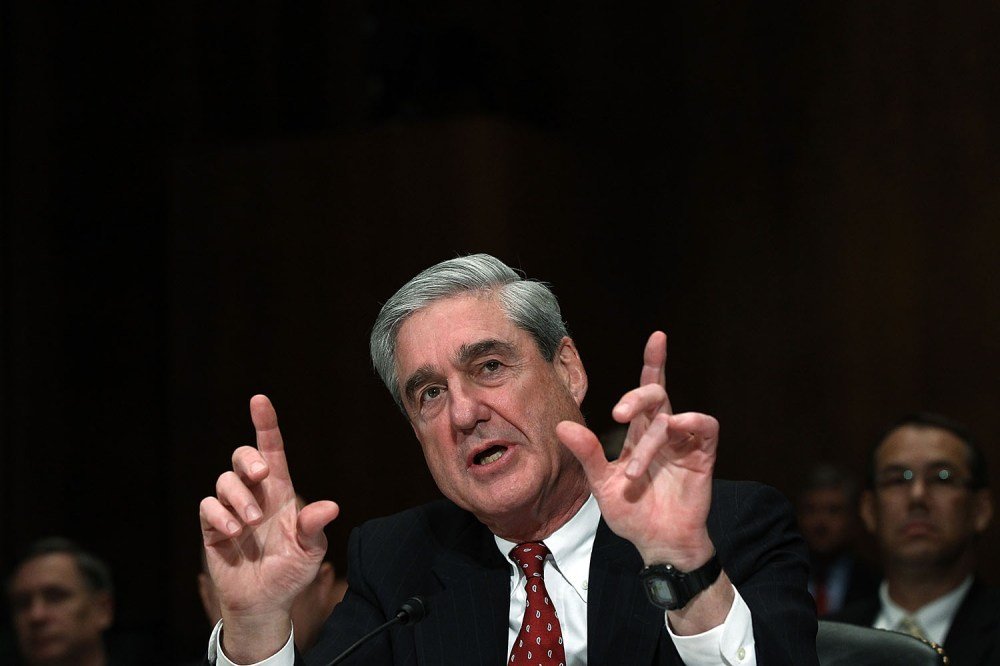
Mueller testifies before Congress in Washington on July 24, 2019, about about his report on Russian interference in the U.S. election. He told lawmakers that the report does not exonerate U.S. President Donald Trump. Saul Loeb/AFP via Getty Images
Nevertheless, the Russia investigation set Trump on his current course of vindictive prosecutions more than any other perceived affront.
Trump’s views toward Mueller have not mellowed with the passage of time. After news of Mueller’s death became public, Trump posted about it on Truth Social: “Robert Muller just died. Good. I’m glad he’s dead. He can no longer hurt innocent people.”
In 1962, Mueller graduated from the uber-preppy St. Paul’s School, where he was captain of the hockey, soccer, and lacrosse teams. It was there that he won the medal for best athlete before going on to attend Princeton University.
He enlisted in the U.S. Marine Corps in 1968 and soon headed to Vietnam, where he led a rifle platoon. A number of his fellow platoon members were killed in action.
Mueller rose to become aide-de-camp to the 3rd Marine Division’s commanding general and was awarded a Bronze Star, two commendation medals, a Purple Heart, and a Vietnamese Gallantry Cross. Mueller almost never talked about his service but when he did, it was never to tell stories about his own valor under fire, but rather of his love for the Marine Corps.
“Bob felt a profound connection to the organization,” recalled Aaron Zebley, who served as Mueller’s chief of staff at the FBI and later as member of the special counsel’s team. “One of the things that he was proudest of was that the Marines deemed him worthy of leading other Marines.”
Mueller got his law degree from the University of Virginia. After a stint in private practice, he joined the Justice Department as a prosecutor at the U.S. Attorney offices in San Francisco and Boston. In 1990, he became assistant attorney general in charge of the department’s criminal division.
At the Justice Department, Mueller was known as “Bobby Three Sticks,” a playful allusion to him being Robert Mueller III and, some say, to the three-finger Boy Scout salute. While there, he oversaw two of the era’s most high-profile prosecutions: the Pan Am 103 bombing and the case against Panamanian ruler Manuel Noriega. Mueller was known for cutting through the bureaucracy to get the resources and support he needed for his staff.
When U.S. President Bill Clinton took office, Mueller left the department and went to work for a law firm in Boston, focusing on white-collar crime. But he wanted to get back to prosecuting criminals, so he asked Eric Holder Jr., who was the U.S. attorney for D.C. at the time, for a job as a line prosecutor in that office’s homicide unit. Holder was astonished that a former criminal division chief would seek such a relatively low-level job. “It was one of the most extraordinary calls I’ve gotten,” he recalled, but he made the appointment.

Mueller speaks alongside U.S. Attorney General John Ashcroft at a news conference in Washington on Sept. 27, 2001. Behind them are photos of the men believed to be the hijackers in the 9/11 attacks. Joyce Naltchayan/AFP via Getty Images
Mueller was nominated to be FBI director by U.S. President George W. Bush on July 5, 2001. His confirmation hearing took place on July 30, just three days before he underwent a successful prostate surgery, and he began the job one week before 9/11.
At the FBI, he instituted major reforms, transforming the bureau into a full-fledged intelligence organization, modernizing its outdated technology, and bringing non-agents into senior positions. Mueller himself was not personally an early adopter of technology. A former FBI agent recalled giving the director a briefing on how to use social media. Mueller brusquely waived him off. “He wouldn’t even let me show him how to read the online edition of the New York Times,” the agent said.
Mueller could be starchy and buttoned-down. He expected agents to wear well-pressed white shirts. If someone came to the office in a pink or lavender shirt, he called them “pajamas.” He disliked small talk and bristled at those who tried to charm him.
He was also a creature of habit and somewhat ascetic. When he had friends over for dinner, he was known to flash the lights on and off at 9 p.m. in a not-so-subtle signal that it was time for his guests to go home. Most Friday evenings, he went to dinner with a group of friends at the same northern Virginia restaurant. He habitually ordered a Caesar salad with extra dressing and a single glass of red wine.

Mueller meets with Haji Gulalai, commander of the Kandahar region, at a U.S. military compound in Afghanistan on Jan. 23, 2002. Mario Tama/Getty Images
At the FBI, Mueller bucked some of the George W. Bush administration’s most aggressive and legally questionable counterterrorism tactics. When FBI agents present at “black sites” and other overseas detention facilities learned that CIA officers were planning to use waterboarding and other harsh interrogation methods on al Qaeda suspects, they asked headquarters what to do. Mueller ordered them not to take part in the interrogations. He believed rapport-based interrogation was a much more effective technique for eliciting information from detainees, and he didn’t want the FBI to be tainted by what the world would soon come to perceive as torture.
Mueller also played a key role in a stunning 2004 confrontation in the hospital room of U.S. Attorney General John Ashcroft. Needing a Justice Department sign-off on the Bush administration’s controversial program for wireless wiretapping, White House counsel Alberto Gonzales and White House Chief of Staff Andrew Card tried to talk Ashcroft, who was recovering from surgery and partially sedated, into giving his assent. Mueller and then-U.S. Deputy Attorney General James Comey intervened and helped persuade Ashcroft to hold off. “In every man’s life, there comes a time when the good lord tests him,” Mueller told Ashcroft, according to Angler, Barton Gellman’s account of U.S. Vice President Dick Cheney’s tenure. “You have passed your test tonight.”
Cheney, who badly wanted the surveillance program to go into effect, arranged for Gonzales to sign the authorization in place of Ashcroft. In a frantic series of late-night meetings, Mueller, Comey, and some half-dozen ranking Justice Department officials agreed to resign if the order wasn’t reversed—something that could have triggered a constitutional crisis and posed an embarrassment for Bush, who was running for reelection. The White House separately called Comey and Mueller into private meetings with the president, where the two men explained their objections. The administration backed down, modifying the program to meet the Justice Department’s demands.

Mueller reacts as he is applauded by U.S. Deputy Attorney General James Cole (center) and U.S. Attorney General Eric Holder Jr. (right) during his farewell ceremony at the U.S. Justice Department in Washington on Aug. 1, 2013. Win McNamee/Getty Images
As Mueller’s statutory 10-year term at the FBI was coming to an end in 2011, Holder stepped in and convinced the Obama White House to ask Congress for a two year extension. When Mueller left the bureau in 2013, he believed, according to a friend, that his days as a law enforcement officer were over.
In 2014, he returned to private practice but went back to the government just a few years later, this time for a job that would prove to be the most personally taxing of his career. When Rod Rosenstein, the U.S. deputy attorney general, asked him to serve as the Justice Department’s special counsel in the Russia investigation, Mueller wasn’t sure at first and consulted with friends and colleagues, some of whom advised against him taking the position. But ultimately, he agreed. “When you’re asked to perform service, you say yes,” he told Zebley.

Mueller arrives to testify before Congress in Washington on July 24, 2019. Chip Somodevilla/Getty Images
Mueller rarely showed emotion or complained, but one exception was after he submitted his report in the Russia probe to the Justice Department. Without releasing the report to the public, U.S. Attorney General William Barr issued his own executive summary of Mueller’s findings, emphasizing that he had found no collusion between Russia and the Trump campaign and leaving out that Mueller explicitly stated the investigation had not “exonerated” Trump. Mueller was angry and deeply disappointed in Barr, his longtime Justice Department colleague and friend. He gathered the lawyers on his team and said to them, “I know you’re pissed,” according to a participant. What he didn’t say—and didn’t have to—was how furious he was.



