
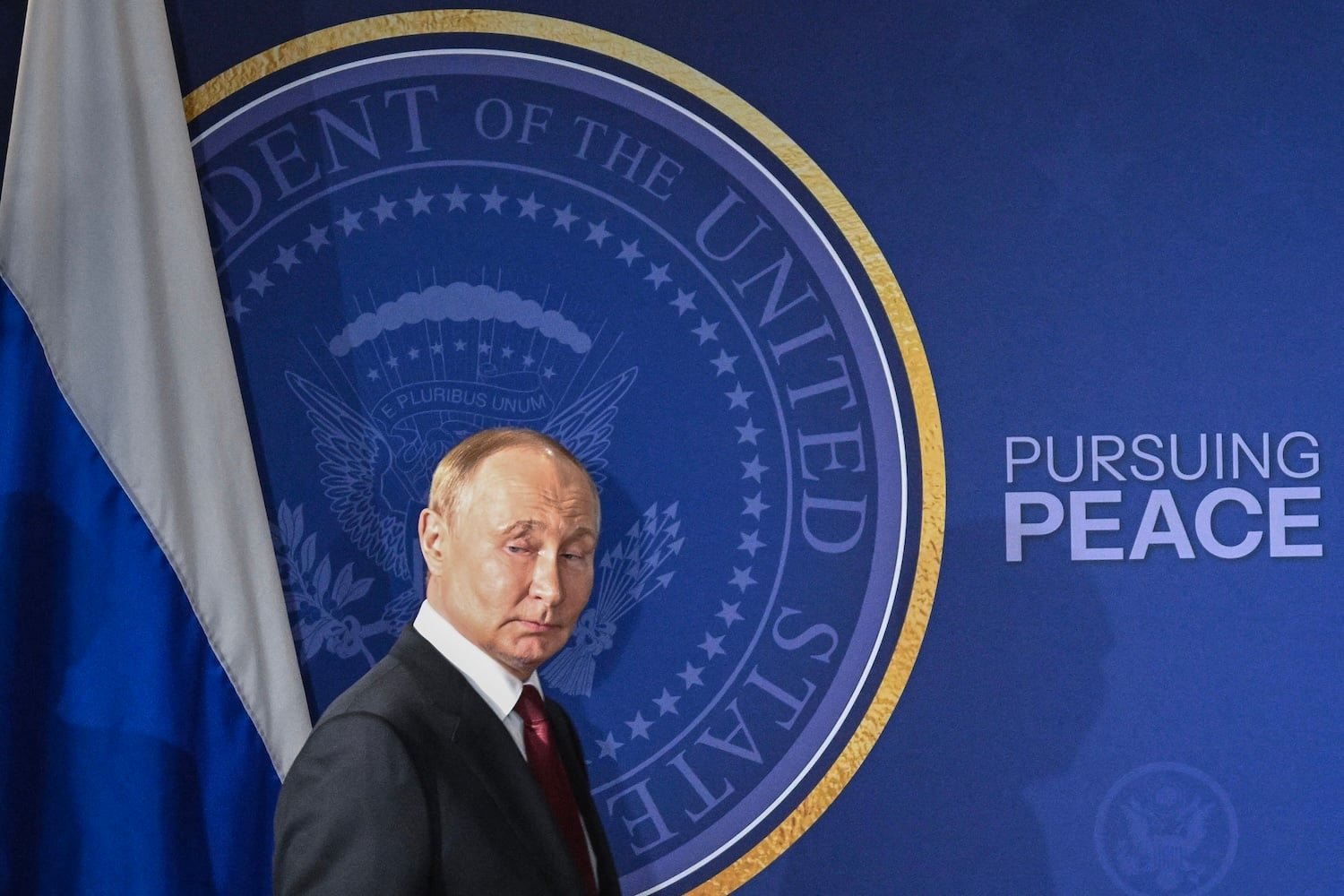
Last August, Russia triumphantly presented a summit with the United States in Alaska as a breakthrough in its war to conquer Ukraine, later waxing poetic about the “spirit of Anchorage.”
Almost a year later, that spirit is gone. On Wednesday, top Russian foreign-policy official Yuri Ushakov told Russian media: “I don’t know about the ‘spirit of Anchorage.’ I’ve never used that phrase.”
Last August, Russia triumphantly presented a summit with the United States in Alaska as a breakthrough in its war to conquer Ukraine, later waxing poetic about the “spirit of Anchorage.”
Almost a year later, that spirit is gone. On Wednesday, top Russian foreign-policy official Yuri Ushakov told Russian media: “I don’t know about the ‘spirit of Anchorage.’ I’ve never used that phrase.”
Ukraine, meanwhile, has been increasingly and publicly sour on U.S. mediation, even as its military efforts start to make gains against Russia—setting up the two sides for yet more protracted war.
On the U.S. side, negotiations have been led first by Steve Witkoff, a real estate developer and friend of U.S. President Donald Trump, and later jointly by Witkoff and Jared Kushner, Trump’s son-in-law.
The Kremlin initially appeared willing to woo the Witkoff team, with Witkoff traveling to Moscow to meet Russian President Vladimir Putin personally six times for marathon negotiations, as well as meeting with Russian Foreign Minister Sergey Lavrov. Russia also dispatched Kirill Dmitriev, a businessman, to represent the economic components of a U.S.-Russia deal on Ukraine.
But despite the full-court press, little progress has been made. Russia has been unwilling to cede its demand for full control of Ukraine’s Donbas region, and the U.S. side has proven unwilling or unable to pressure Ukraine into giving it up.
A senior European diplomat who was not authorized to speak on the record said they believed that the U.S. side had felt frustrated about Ukraine not giving up Donbas despite U.S. pressure—but that the United States believed Russia would eventually take the Donbas in time, which would then reopen the way for a negotiated peace deal.
Trump has repeatedly framed Russia as the stronger power in the war, telling Ukrainian President Volodymyr Zelensky in a February 2025 meeting that Ukraine didn’t “have the cards” and saying in December 2025 that Ukraine was “losing.” U.S. Vice President JD Vance previously argued that Ukraine would likely lose the Donbas.
Yet the Trump administration has in some ways pulled its punches when it comes to Kyiv: Although it has decreased the volume of aid it gives to Ukraine, it still sells weapons to the country via NATO, provides Kyiv with intelligence support, and sanctions Russian oil (though those sanctions have been partially lifted).
Russia’s apparent enthusiasm for U.S.-led negotiations has subsequently dimmed. In March, Lavrov said the spirit of Anchorage was evaporating; and in April, he said negotiations were not Moscow’s “top priority.”
“It’s pretty clear they’re down on [negotiations],” said John Herbst, senior director of the Atlantic Council’s Eurasia Center.
Nor is it clear that Russia will eventually take the Donbas, as Vance predicted. Russia has gained relatively little ground in the Donbas and recently even lost some ground in other regions.
Meanwhile, the pressure the White House put on Ukraine has decreased its leverage by pushing Kyiv to become less dependent on U.S. assistance. Following reductions in U.S. military and humanitarian aid to Ukraine, European nations largely replaced that funding, according to the Kiel Institute for the World Economy, a German think tank. And in April, the defeat of Hungarian Prime Minister Viktor Orban unlocked $104 billion in European Union funds for Ukraine.
Ukraine has also sharply increased its domestic production of weapons, including interceptor drones and ground robots. Kyiv continues to be dependent on the United States for deliveries (via European countries) of anti-ballistic missiles, but the relatively limited impact of Russian missile strikes on Ukraine’s ability to fight means that U.S. leverage there may be minimal.
And Ukraine’s own campaign against Russia is starting to bear fruit. Thanks to its use of drones and other technology, Ukraine is killing Russian troops faster than Russia can easily replace them. In turn, this is forcing the Kremlin to use pressure tactics on university students and businesses to get new recruits, potentially setting the stage for domestic turmoil.
Ukraine’s attacks on Russia’s oil production facilities are also chewing into the country’s energy-centric economy, contributing to a forecasted 0.4 percent growth for this year.
All that has seemingly made Ukraine more comfortable with openly critiquing the United States, with Zelensky saying in April that U.S. negotiators had “no time for Ukraine.”
Amid the apparent mutual disillusionment with the American-led process, both Ukraine and Russia have said they are open to Europe leading negotiations. On Sunday, Zelensky spoke with European Council President António Costa about getting Europe more directly involved, including by potentially appointing an envoy to represent Europe in negotiations. European leaders have discussed former German leader Angela Merkel as well as former European Central Bank chief Mario Draghi as possible options, the Financial Times reported.
Putin on May 11 proposed former German Chancellor Gerhard Schröder, who has close ties to Russia, as an interlocutor, a proposal that European leaders have dismissed.
Whether Europe can succeed where the United States has stumbled is unclear, though. At the very least, Europe won’t take the same tactics as Trump, Herbst said. “I don’t see the Europeans brow-beating Ukraine—because Russia is the aggressor.”
Individual EU member states themselves, however, have a diverse range of policy views on Russia, from the hawkish Baltics to more pro-Russian Bulgaria.
“The Europeans may have started the search for a messenger, but they’re still very far from settling on a message,” said Peter Slezkine, director of the Russia program at the Washington-based Stimson Center think tank. “Until they do, little progress is possible.”



