
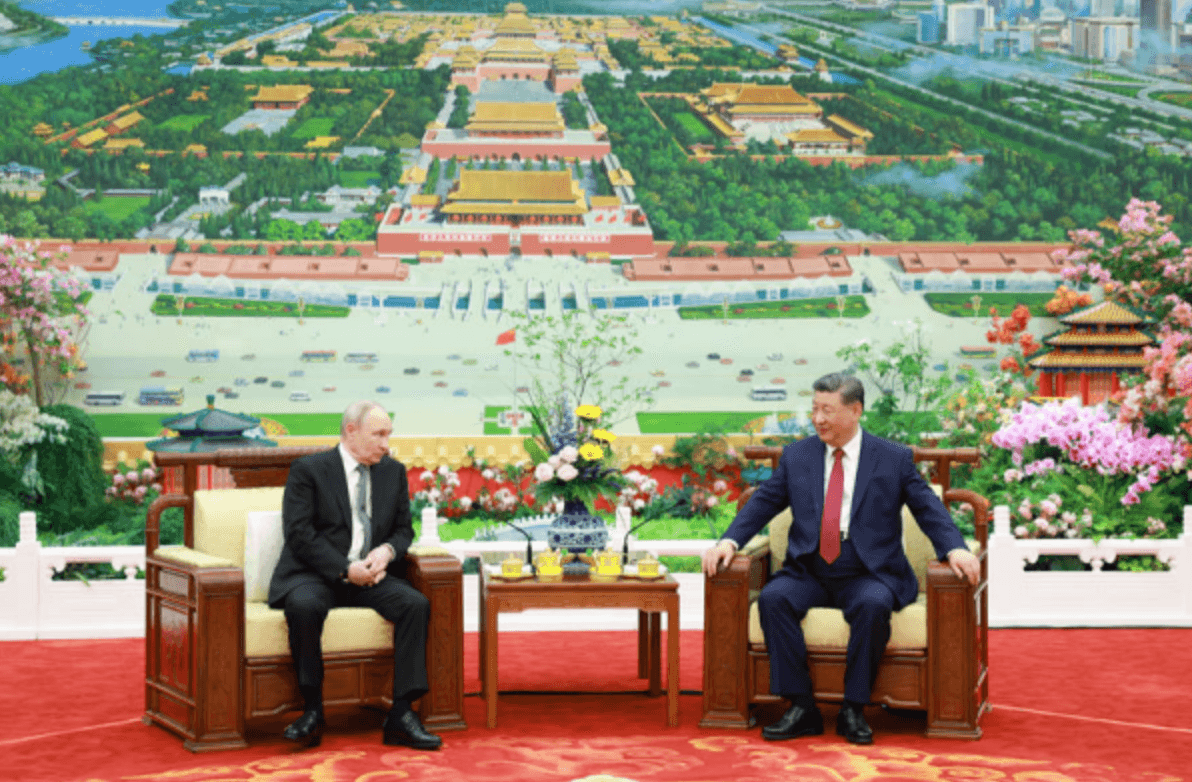
Chinese leader Xi Jinping and Russian President Vladimir Putin used a summit in Beijing on Wednesday to deepen their “good neighborliness and friendly cooperation,” which, among other initiatives, includes plans to expand collaboration on satellite internet, artificial intelligence, cybersecurity and internet governance.
In a lengthy joint statement, Moscow and Beijing pledged closer cooperation on satellite internet technologies and joint work on software development and open-source initiatives — part of a broader effort to reduce reliance on Western technology and build a more independent technological ecosystem capable of competing with countries both states consider “unfriendly.”
Moscow and Beijing said they would explore creating joint software development projects and expand cooperation on open-source technologies — a move that could help reduce their dependence on Western software as sanctions and export controls continue to limit access to technology, particularly for Russia.
The two countries also said they would move forward with a joint satellite navigation cooperation and improve interoperability between Russia’s GLONASS and China’s BeiDou systems. They also pledged closer coordination on radio frequencies, satellite orbits, satellite internet technologies and Internet of Things systems.
The statement also pointed to deeper cooperation on cyber policy and internet governance. Moscow and Beijing said they would strengthen high-level coordination on information security, work more closely on responding to cyber threats and share experience in internet regulation.
Both countries support the concept of so-called “internet sovereignty” — the idea that governments should retain broad authority over their domestic digital environments.
Russia has made several attempts in recent years to disconnect the country from the global internet and test its domestic “sovereign internet” infrastructure. The Kremlin has also sought to replicate aspects of China’s model in other areas, including the development of a government-backed messaging app called Max modeled on China’s WeChat.
Artificial intelligence emerged as another major area of cooperation during Wednesday’s summit.
Russia welcomed China’s proposal to establish a global organization dedicated to AI cooperation, while both sides said they opposed the use of AI “as a geopolitical tool” by individual countries seeking to preserve technological dominance.
Ukraine recently warned that Russia’s use of artificial intelligence in its cyberwar against Kyiv has expanded, with Moscow now embedding AI directly into malware capable of generating malicious commands on the fly.
Other countries have also raised concerns about China’s ambitions in cyberspace. According to leaked files reviewed by Recorded Future News, the Chinese government allegedly operates a secret cyber-training platform designed to replicate power grids, transportation systems and communications networks in countries Beijing considers potential adversaries, allowing Chinese hacking teams to rehearse attacks against digital replicas before conducting real-world operations.
Recorded Future
Intelligence Cloud.



