
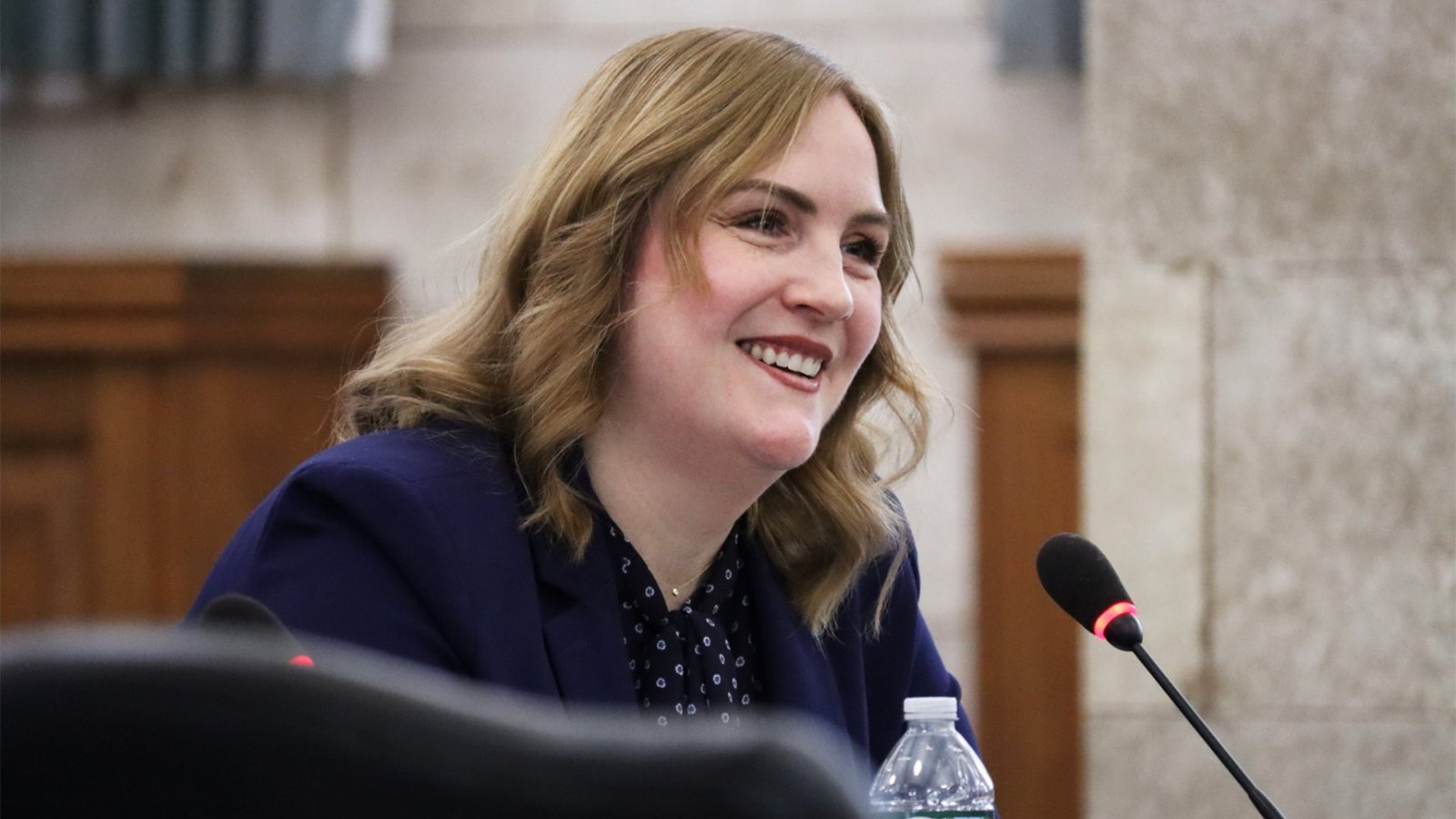
 New Jersey’s new education chief hails from Texas, where she led one of the nation’s largest efforts to get schools more in line with the latest science on reading.
For years, many had been using techniques that worsened outcomes for kids, experts say, relying too much on pictures and memorization, for instance, rather than teaching children how to decode words.
To nudge districts toward better programs, Lily Laux used funding as leverage when she was deputy education commissioner in Texas, while also overseeing the training of more than 150,000 teachers in the new techniques.
The question now: Will she bring this more forceful approach to New Jersey?
So far, New Jersey’s home rule culture has made reading reform difficult. The idea that districts should be able to manage themselves with minimal interference carries a cost for kids, critics say, in a state where as many as 60% of third graders can’t read on grade level.
Some districts may be confused about which programs work best. And experts say the new methods not only yield higher test scores, but also prompt more fluid reading, according to before-and-after brain scans. So how would Gov. Mikie Sherrill’s administration respond if districts still choose inferior programs?
To find out, NJ Spotlight News spoke to Laux about the overhaul that she led in Texas and whether she might take a similar approach here. This interview has been edited.
NJ Spotlight News: In practice, New Jersey does not currently require districts to use the reading methods shown be more effective. Instead, it describes the qualities a good program should have and then lets the locals decide. If some choose inferior programs, does that hurt kids? And what will you do about it?
Lily Laux: I’ve heard a lot about local control since I’ve gotten here. And I think there’s a piece about local control that gets conflated with what I think of as administrative burden – where we tell everyone they have to do everything on their own.
It’s really important that we come together to provide tools so districts can make great choices and use this comprehensive system that’s aligned to the science of reading. I’ve never met a teacher who doesn’t want their kids to read on grade level. But for a variety of reasons, they may not have access to some of this information.

I have found that having really detailed conversations about what the research says, how these things fit together and how we can support them really helps folks move forward. And so, I would hope that we are working with districts that have made a choice that we think is not ideal at the moment, to really get an understanding of why that has occurred, and what can we do to make sure they’re able to reap the benefits of this research.
NJSN: It’s hard to imagine that a handful of people at the state Department of Education have the capacity to do deep dives on how closely each of our nearly 600 districts aligns with the science on reading. Instead, why not create a pre-approved list of high-caliber programs that districts can choose from, like Texas did?
LL: I do feel very fortunate to have started at a time where the literacy screening legislation is giving us our first look at data across the state on foundational literacy skills, which gives us some real insight into what is happening across all of the districts in the state. That ability to look at data carefully to determine how we’re providing supports and resources and engaging is really important.
A list can be an important tool for giving people information. But a list, in and of itself, is not sufficient to lead to success. There still needs to be that support for selection, implementation and training. The list needs to be part of an ecosystem, one that makes sense for what we’re seeing in the data here in New Jersey.
NJSN: What do you mean by selection, implementation and training?
LL: Even when you have a list that districts have the opportunity to pick from, it’s really important that people know why they’re picking a set of materials. This goes back to people knowing the research and seeing why this will help their students. And so, teachers having a voice in material selection at the local level is really important.
The nuances of the day-to-day lessons with your students require support, coaching and ongoing work, even if you are someone who has been trained on the science of teaching reading. I have been in schools where they have bought materials that have never come out of the boxes, and that’s certainly not what we want to happen. And if we’re not implementing those materials with fidelity, the materials themselves become irrelevant.
NJSN: If districts don’t choose programs that are evidence-based, would you penalize them by withholding funding?
LL: I found, in general, that it’s most important to help people get there. Governor Sherrill has spoken about this: Everyone wants kids to be reading on grade level and to be successful. For us to make sure that they have those supports and have what they need is going to be really important. I have not found that penalizing is helpful.
We need to continue to have the conversation about what’s working. How do we make sure we’re collectively holding each other accountable for a shared goal, which is making sure all of our students can read on grade level and are successful? Just because you’ve selected good materials doesn’t mean that you’re using them well. And we need to make sure that people have support throughout that process.
NJSN: Some other states have required local districts to either adopt a proven strategy or show that their own method works just as well. Might you take that approach in New Jersey?
LL: Currently, I do not have that authority. And I would want to work with superintendents and the Legislature to figure out what we all think that shared expectation should be.
NJSN: When you say the DOE does not have the authority to require this of districts, what do you mean? Would it take some kind of legislation?
LL: I think there are some limitations to what the DOE currently can require of districts. Generally, in New Jersey, the authority to adopt curricula rests with local school boards. Figuring out what supports districts need that we don’t have to require is an important part of that system as well.
NJSN: Our state has invested a lot less in teacher coaching than Mississippi — $500,000 as compared to $17.5 million. So how are we going to train all the teachers in this new approach?
LL: We do have teachers who get support and feedback from their supervisors every day. I know the state is currently providing some resources in the form of grants for coaching. But continuing to figure out, how do we make this a core part of people’s job responsibilities, and not an add-on, is something foundational to making sure that we’re moving the needle.
NJSN: What do you mean, a core part of their jobs as opposed to an add-on?
LL: The literacy instruction is part of their day-to-day. It’s making sure that all the things that impact a teacher’s day-to-day, from their training to their support to their evaluation, are grounded in the science of teaching reading.
NJSN: In Texas, you presided over reading academies to train teachers, and they were required to take a science of teaching reading exam. Would you like to do the same here?
LL: I will share a personal anecdote here, which is relevant to how I came to this. I, myself, was a middle school reading teacher and ended up teaching sixth grade remedial reading, where I had more than 20 students who were on a kindergarten-reading level. And even though I had been through alternative certification and a traditional master’s in instructional and curriculum literacy, I did not know this research. I did not know this science. I absolutely wanted my kids to be great readers, but I didn’t know what that was going to take. And I had to do a lot of learning on my own to understand how to help my students grow. I was very lucky to be able to get some resources and do that, and I saw tremendous growth in many of my students.
But it still meant that even a student who made four years of reading growth in one year was heading to seventh grade reading on a fourth grade reading level. So, back to the teacher training piece: It’s really indicative of the need to make sure that teachers have this information. It’s also something teachers want.
This conversation about what our teacher preparation programs need to do, and what our certification requirements should look like, to make sure they are also grounded in this research, is important. And a very worthwhile conversation for us to have with our state Board of Education, and our educators and ed prep programs.
NJSN: How can our state ensure that our schools of higher ed are teaching new educators the right way to teach reading?
LL: Working with those programs, and the oversight that we have of those programs, to make sure that all teachers are getting this same science and how to implement it is really important.
NJSN: Of the reading reforms that you led in Texas, what worked well and what didn’t? How might we improve upon that in New Jersey?
LL: New Jersey has an incredible opportunity. You’ve heard Governor Sherrill talk about the imperative around literacy and I have also seen places where we already have great work happening around the science of teaching reading and some foundational legislation.
My lessons from Texas come back to what I’ve been sharing with you throughout our conversation. We know that teachers want students to be able to read. And we also know that they need to know and understand, and see and be able to do, the instructional moves that are related to that science.
Texas had to do multiple things over multiple years, because it’s about the ecosystem and not any one intervention. If you talk to other states that have been able to do great literacy growth, they speak about this as well.
My real lessons learned, and what I’m really hopeful to do here in New Jersey is to have a really robust conversation and to talk to as many people as we can and get the word out in as many ways and as many parts of our educational system as possible, about what is this research, and how do we do it, and how do we make it coherent.
If I’m going through teacher prep that’s telling me one thing, that’s different than the materials I have in my district, that’s different than the feedback I’m getting — none of that is going to make me successful as an educator and help students. In New Jersey, we have to look at all of these levers together. We have to make sure they are all grounded in the science.



