
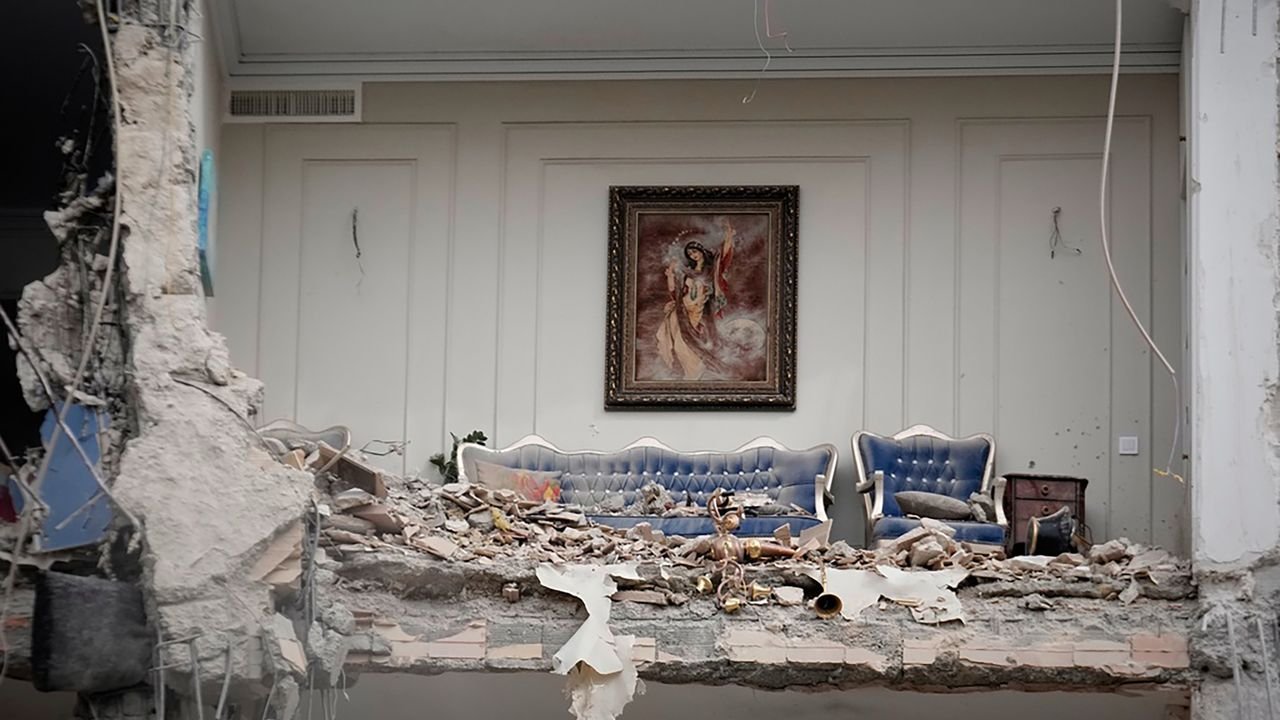
I sent him a message immediately to see if he was all right. “Hi cuz. I’m at home. I’m fine,” he wrote. “Stressful, though.” I pressed him with more questions, but I could tell by his vague responses that he was watching his words, aware of potential surveillance by the Islamic Revolutionary Guard Corps. Even the V.P.N.s that many people use to get online are controlled by the government.
My cousin said he would check in whenever he could. I have not seen a digital trace of him since. Such wartime silences are common; my wife has two elderly relatives we were particularly concerned about, but they went silent, and we feared the worst. Several days passed before the husband phoned us. “Don’t worry. We’re alive,” he told me.
The few calls that we receive are always brief, revealing little information or emotion, but we do learn things. For example, people now take care to wear shoes at home in case an explosion shatters glass, or there’s a need to evacuate immediately. Most of the neighborhood bread kiosks that are still standing remain open, but there are strict limits on the amount individuals can purchase. Many checkpoints once manned by Basij paramilitary forces have been destroyed or abandoned.
As far as we know, none of our family members have been killed. We have been lucky. Another former Tehran correspondent, now living in Washington, heard from a childhood friend still living in Iran. Her aunt had resisted leaving the capital for two weeks, but was finally convinced to evacuate. Realizing she’d forgotten her medications, she returned home to retrieve them. Her apartment building was bombed as soon as she went back inside. Her niece watched it happen from the car.
Once communications return to normal, stories like this will be frequent. Yet there remains a stream of messages that are undeniably optimistic. There is a sense of hope that grows whenever another high-level official is killed. The latest was Ali Larijani, a fixture of Iranian politics and repression, and one of the slain Supreme Leader Ali Khamenei’s most unflinching loyalists.
It’s impossible to say how much support the ongoing military campaign enjoys inside Iran, but it’s not insignificant. Even as civilian infrastructure is levelled, the fact that I’m still hearing this optimistic sentiment, almost four weeks into this operation, is a strong indication of how reviled the Islamic Republic has become inside Iran. That feeling could change if Trump follows through on threats he made over the weekend to “obliterate” Iran’s electrical power plants if the regime doesn’t fully reopen the Strait of Hormuz. (On Monday, Trump asserted that his Administration was engaged in “very strong talks” with Iran, and that he had instructed the U.S. military to postpone the strikes for five days.)
Some of those I hear from in Iran dream that the U.S. and Israel will somehow put an end to the Islamic Republic from the air. “I am staying because I truly hope this is the final battle and the regime gets the hell out of here,” a young software engineer from southern Tehran told me. “People are still in good spirits, even though the bombing is much worse than during the Twelve-Day War,” he said, referring to the conflict last June.
This kind of remark is not surprising. I’ve heard calls for foreign intervention from inside Iran since 2003, the year of the American invasion of Iraq. “When will it be our turn?” Iranians kept asking. “When are the American commandos coming to liberate us?”
Iranians’ desire for American intervention cooled as sectarian violence spread across Iraq—much of it fomented by Tehran’s regional proxies. After the fall of Saddam Hussein’s government, Iraq’s Shiite holy sites in Karbala and Najaf reopened to international pilgrims. Iranians were among the first wave to visit, but they were witnesses not to liberation and prosperity but to chaos, violence, and ruin from terrorist attacks.
In many ways, Iran would have been far more prepared for a transition toward democracy at that time than either Iraq or Afghanistan, and, frankly, more prepared than it is right now. It was a society yearning for more social liberties and integration with the rest of the world. Time and again, in tightly controlled elections, Iranians voted overwhelmingly for candidates seeking to take steps to liberalize the country.



