
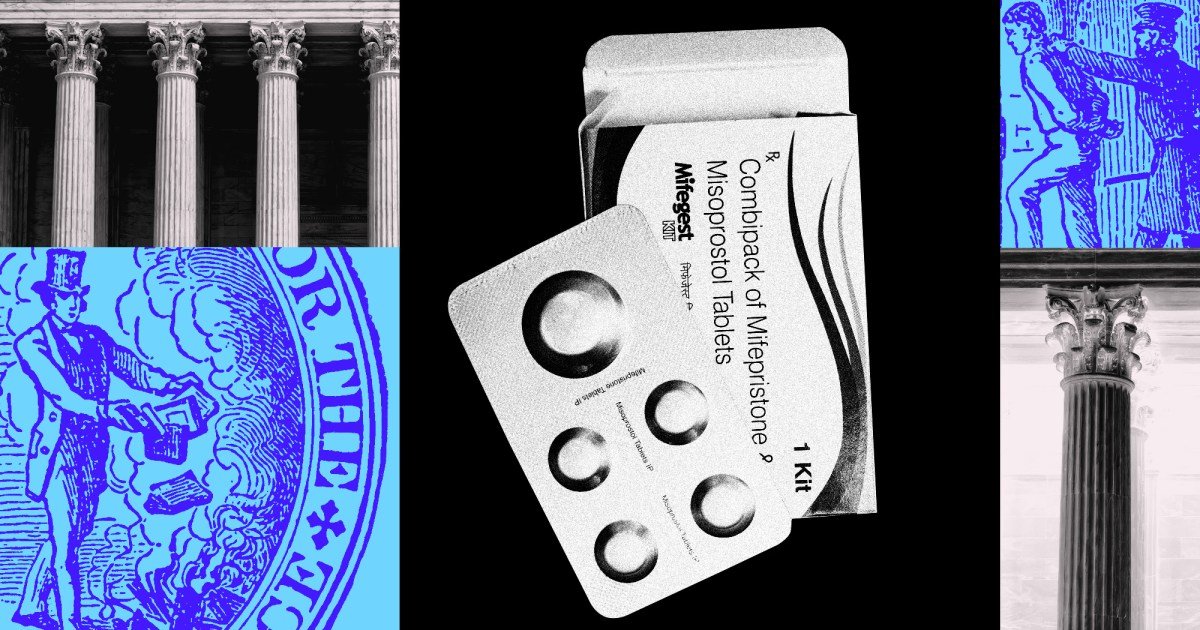
Mother Jones illustration; Unsplash
By all accounts, President Donald Trump really, really did not want abortion to become a major issue this election year. But here we are, six months before the midterms, and abortion pills are back at the Supreme Court, as the state of Louisiana and abortion drug manufacturers ask to fast-track oral arguments in what is shaping up to be a blockbuster case. Conservatives are invoking the Comstock Act. And Trump’s Food and Drug Administration has been AWOL, while its top official has been forced to resign.
The swift escalation of the showdown between Louisiana and the FDA over telemedicine abortion highlights just how little control Trump has over the abortion issue—both in terms of the timeline and the outcome. Meanwhile, the case is sparking confusion, uncertainty, and dread among patients, providers, and advocates across the US.
Just to recap how we got to this point. On May 1, the right-wing Fifth Circuit Court of Appeals, siding with Louisiana, issued a nationwide order suspending FDA rules that allow the abortion drug mifepristone to be prescribed via telehealth and dispensed through the mail. A few days later, Justice Samuel Alito temporarily paused the order, and on Monday, he extended his stay until May 14.
The decision to take a few more days suggests that the full court is struggling to figure out its next steps in a case that could upend abortion access throughout the US—and possibly much sooner than many SCOTUS-watchers had thought likely.
All last week, justices were blasted with amicus briefs from parties with keen and conflicting interests in the outcome. Former FDA officials warned about the dire consequences of allowing states to upend drug regulations put in place years or even decades ago. Doctors and reproductive health advocates pointed to the mass of research from around the world showing that abortion pills are safe and effective, including via telemedicine.
“There’s a really long list of briefs, but nothing from the federal government. And in a case challenging the FDA’s authority, that’s remarkable.”
Conservatives, meanwhile, repeatedly brought up the Comstock Act, a 150-year-old anti-obscenity statute that hasn’t been enforced for decades. Named for the 19th-century anti-vice crusader who championed it, Comstock made it a federal crime to mail or ship “any article or thing designed or intended for the prevention of conception or procuring an abortion.” Reviving the law could end legal access to most abortions nationwide and possibly threaten other reproductive health care, such as IUDs.
In its own brief to SCOTUS, Louisiana offered an audacious option: If justices don’t allow the Fifth Circuit suspension of mail-order mifepristone to take effect, they should put the case on the 2025-2026 docket and schedule oral arguments ASAP, so that a final decision could be made as soon as the end of June or the first days of July. Drug makers GenBioPro and Danco Laboratories also suggested the court should consider taking the full case on an expedited schedule. The current term already includes such hugely consequential issues such as birthright citizenship and Temporary Protected Status for asylum seekers.
The one interested party that did not weigh in was the federal drug agency Louisiana sued in the first place. Even though the Fifth Circuit’s order was directed at the FDA, GenBioPro and Danco filed the emergency appeals asking the Supreme Court to hit pause.
As of Tuesday, the FDA remained radio silent. “There’s a really long list of briefs, but nothing from the federal government on this,” says Naomi Cahn, a law professor at the University of Virginia. “And in a case that’s challenging the agency’s authority, that’s remarkable.”
Abortion historian Mary Ziegler, a law professor at the University of California, Davis, sees the FDA’s failure to speak up as yet more evidence that the Trump administration has backed itself into a very uncomfortable corner, caught between voters who overwhelmingly support reproductive rights and abortion opponents who are furious the president hasn’t worked harder on their behalf. “It’s clear,” she says, “that the Trump administration still doesn’t know what to do about this issue politically.”
The anti-abortion movement expected that when the Supreme Court overturned Roe v. Wade in 2022, abortions would plummet across much of the US. The opposite has happened: In the four years since the Dobbs decision, the number of abortions has risen nationwide, including in states where abortion is almost entirely banned.
As abortion opponents have strategized to stop the flow of pills, they have focused much of their energy on attacking Obama- and Biden-era FDA rule changes for mifepristone, one of two drugs that make up the gold-standard abortion-pill regimen. Approved by the FDA in 2000, mifepristone was subject to extremely strict rules and placed in a program—known as Risk Evaluation and Mitigation Strategy, or REMS—normally reserved for the most dangerous drugs. Starting in 2016, some of those rules were relaxed, including a requirement for in-person prescribing and dispensing that was finalized in 2023. Now, almost two-thirds of abortions in the US happen with abortion pills, and nearly 30 percent occur by telemedicine.
The first sweeping assault on the FDA rules, in a 2022 case that also originated in the Fifth Circuit, ended when the Supreme Court ultimately held that the plaintiffs—anti-abortion doctors and medical organizations—didn’t have standing to sue. But the justices made no determination on the underlying issue—the FDA’s regulation of mifepristone—and left the door open to other plaintiffs who might have standing.
Louisiana Attorney General Liz Murrill tried her luck with a narrower lawsuit last fall, arguing that the Biden administration’s decision to permanently ditch the in-person dispensing requirement was “arbitrary,” “capricious,” and “avowedly political.” It was not based on sound science, she argued, but on the Democrats’ determination to thwart the effects of the Dobbs decision that handed abortion policy to the states. Murrill claimed that the telemedicine rule interfered with Louisiana’s right to regulate abortion as it sees fit, while making it too easy for women to be tricked or coerced into having abortions they don’t want.
The FDA responded, not by defending the 2023 rules, but by pointing to its own ongoing review of mifepristone’s safety, which Health and Human Services Secretary Robert F. Kennedy Jr. and then-FDA commissioner Marty Makary announced last fall. At the time, Kennedy and Makary cited the Biden administration’s purported “lack of adequate consideration” before making the 2023 rules change; they also cited “recent safety concerns”—such as supposedly high rates of abortion pill complications—raised by the right-wing Ethics and Public Policy Center in a dubious study that has been widely debunked as junk science. In its court filings, the FDA argued that Louisiana’s lawsuit threatened to “short-circuit the agency’s orderly review” and should be put on hold. It also argued that Louisiana didn’t have standing to sue.
But the FDA study has been widely seen as a delaying tactic by a president reluctant to take a stand on abortion that might alienate voters. Trump has blamed many of his past political setbacks on abortion, and in his second term has avoided sweeping actions that would put the issue on the political front burner. For example, in defiance of the hopes of many conservatives, his Justice Department has declined to enforce the Comstock Act. His failure to take meaningful action to stop the flow of pills in the US has infuriated anti-abortion leaders. “Trump is the problem,” Marjorie Dannenfelser, the influential president of Susan B. Anthony Pro-Life America, told the Wall Street Journal last week. “The president is the problem.”
“They’ve been under a lot of pressure—threading this needle of defending the agency’s past actions [on mifepristone], while a lot of people within the Republican Party are upset about them.”
In the Louisiana case, the anti-abortion ideologues on the Fifth Circuit did what Trump officials have not. Using the FDA’s sham mifepristone review, and citing the statements by Kennedy and Makary about the Biden FDA’s “lack of adequate consideration,” they have set up the circumstances to potentially gut access to abortion pills. “You have the FDA conceding that there’s a question about whether they did this properly [on mifepristone],” says Sonia Suter, a law professor at George Washington University. “That only heightens the Fifth Circuit’s belief that the FDA had no authority to [get rid of the in-person dispensing rule] in the first place.”
The FDA’s silence at the Supreme Court may well be construed to further bolster Louisiana’s case, Ziegler says. The state is arguing that the FDA’s actions—or lack thereof—show that the agency agrees that the 2023 rules change was problematic. “The court could easily use the FDA’s silence the way Louisiana is using it.”
But Makary’s resignation, or perhaps firing, on Tuesday—which abortion opponents and others have been pushing for some time—also highlights the agency’s wider “disarray,” says Drexel University law professor David Cohen. “They’ve been under a lot of pressure—threading this needle of defending the agency’s past actions [on mifepristone], while a lot of people within the Republican Party are upset about them.” Given the politics and the chaos, he says, “I wasn’t surprised they didn’t file anything.”
The central question raised by Alito’s extension of his stay against the Fifth Circuit is, why? SCOTUS “seems to be really struggling,” Suter says, “not so much with the legal questions, but with how what they do is going to affect the integrity of the court.” Battered by reporting about the court’s shadow docket, she says, justices “may be worried about looking like they’re rushing too much” to resolve the kinds of hugely consequential issues that the FDA case raises—not just about abortion, but also about the rights of states to second-guess federal drug regulation.
Yet Louisiana and mifepristone manufacturers have all indicated they want SCOTUS to take the case on its merits, perhaps on an expedited schedule during the current term. “Basically, they’ve said, We know what the district court is going to ultimately rule,” Suter says. “We know what the Fifth Circuit is going to ultimately rule…Why wait?”
If the Supreme Court does take the case, conservative groups have made clear they plan to use the opportunity to push the justices on the Comstock Act. At least two archconservatives—Alito and Clarence Thomas—have signaled they think the long-defunct statute remains the law of the land.
In one amicus brief filed last week, more than 100 Republican members of Congress accused the Biden-era FDA of flouting Comstock when it ended the in-person dispensing requirement. “The FDA cannot purport to authorize conduct criminalized under federal law,” the brief contends. “[T]hat would exceed its constitutional authority.”
The far-right nonprofit Advancing American Freedom, writing for dozens of other groups, argues that by failing to comply with Comstock, “the FDA has directly harmed Louisiana and undermined the exercise of its authority to prohibit abortion drugs.”
Louisiana made similar arguments when it first sued the FDA last fall, but generally, Comstock has remained very much a background issue. The conservative briefs are aimed at “injecting” it back into the case—and further into mainstream discourse, says Amanda Barrow, senior staff attorney at the UCLA Law Center on Reproductive Health, Law, and Policy. “It’s just an extremely anti-democratic argument,” she says. “. . . They’re trying to transform [Comstock] into a no-exceptions nationwide abortion ban that they could never convince modern voters to enact.”



