
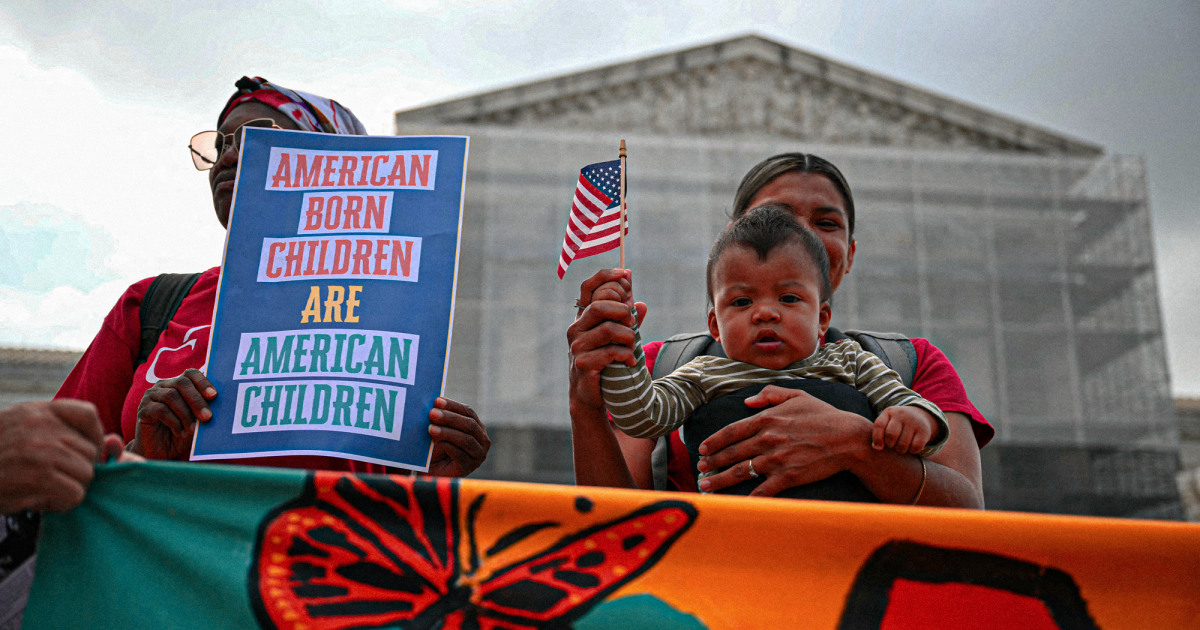
Last May, Olga Urbina stood outside the Supreme Court with her then 9-month-old son Ares Webster in protest over President Donald Trump’s move to end birthright citizenship.Drew Angerer/AFP/Getty
Next week, the Trump administration’s bid to deny birthright citizenship to the US-born children of undocumented immigrants and non-green card holders through an executive order will arrive at the Supreme Court—yet again. Last year, the justices didn’t address the constitutionality of the order directly; instead, they ruled on a procedural question to limit the power of federal judges to block the government’s actions nationwide. Now, in Trump v. Barbara, the Court is asked to determine whether the administration’s rewriting of the Constitution has merit.
With its executive order, the government is claiming to want to restore the original meaning of the 14th Amendment’s citizenship clause, which states that “all persons born or naturalized in the United States, and subject to the jurisdiction thereof” are citizens of the country. In a brief to the Supreme Court, the administration argues that the amendment—ratified in 1868 in repudiation of the Dred Scott decision that declared Black Americans couldn’t be citizens—specifically intended to extend citizenship to the children of former slaves and their descendants, but not of undocumented immigrants and temporary visitors.
Most constitutional law scholars and historians disagree, pointing to longstanding tradition, legislative history, and legal precedent that support a broad understanding of the citizenship clause. (An understanding that includes extremely narrow exceptions, such as for the children of foreign diplomats and enemy invaders.) The courts have also resoundingly rejected the Trump administration’s executive order, finding it unconstitutional in light of the plain 14th Amendment text.
The highest court has grappled with challenges to birthright citizenship before—and turned them down. In the late 19th century, at a time of rampant anti-Chinese bias, immigration restrictionists and the federal government argued that Wong Kim Ark, born in the United States to Chinese parents who couldn’t become naturalized due to exclusion laws, didn’t have a claim to citizenship. The dispute made its way to the Supreme Court and resulted in a landmark ruling reaffirming that the 14th Amendment applies to virtually everyone born on US soil, regardless of parentage.
Ahead of the oral arguments before the Supreme Court on April 1, I spoke with Cody Wofsy, deputy director of the ACLU Immigrants’ Rights Project and counsel of record in the Trump v. Barbara case. He talked about the government’s ahistorical reinterpretation of the 14th Amendment, and how it mirrors previous attacks on birthright citizenship.
The ACLU’s brief to the Supreme Court characterizes one of the government’s arguments in support of its executive order as “atextual, contradictory, and irrelevant,” adding that they relied on “authors engaged in a concerted effort to undermine the Citizenship Clause.” Can you explain what that effort to undermine the 14th Amendment has looked like?
In the late 19th century, there were two threads of legal and political activism that came together. One was ongoing opposition to Reconstruction and opposition to the Reconstruction amendments to the Constitution, including the 14th Amendment. These are the amendments that eliminated slavery and enshrined the principles of equal protection and due process as to States, as well as voting rights, into the Constitution. The other thread was rising anti-Chinese sentiment. There was huge bipartisan opposition to Chinese immigration, which culminated in a whole series of statutes at the federal level excluding Chinese immigrants and imposing extraordinary burdens on those communities. What we see is those two threads coming together in a set of authors that the government is now relying on, who spent years looking for ways to try to limit the text of the 14th Amendment to exclude the children of Chinese immigrants.
These authors essentially opposed what the framers of the 14th Amendment had put into the Constitution and were looking for ways to rewrite it. That argument came up to the Supreme Court in the context of anti-Chinese rhetoric in the Wong Kim Ark case, and the Supreme Court rejected it. It saw through the racist efforts to exclude Asian Americans from citizenship and essentially said, the Constitution means what it says. The fact that the Trump administration is recycling these same discredited ideas to try to exclude the children of immigrants today just goes to show that it is borrowing from the same playbook that the Supreme Court has already rebuffed.
“It’s remarkable that the Trump administration has taken aim at birthright citizenship. It’s a foundational American value that’s enshrined in the text of the Constitution.”
Much of the debate revolves around the meaning of the sentence “subject to the jurisdiction thereof.” Some scholars supporting Trump’s executive order argue that children of undocumented immigrants and temporary visitors fall outside the birthright citizenship rule because, under British common law, their parents wouldn’t have owed allegiance to—or been protected by—the king in a type of mutual contract. In the present context, the parents wouldn’t be “subject to the jurisdiction” of the United States and, therefore, their children should be excluded from automatic citizenship. What do you make of that legal theory?
The text of the 14th Amendment says “subject to the jurisdiction,” and that meant then what it means now: subject to American law. There are some people who are exempt from American law in full or in part, and ambassadors are the classic example of that. The government’s argument, echoed by its amici, uses a lot of different words and phrases that don’t carry a whole lot of meaning. At the end of the day, what they’re arguing is that the citizenship clause has this idea of a domicile requirement that a child’s parents need to not only be in the United States and subject to its laws but also be living here with an intention to remain indefinitely.
But the rule before the 14th Amendment was squarely to the contrary. The absolute leading common law case leading up to the framing of the 14th Amendment specifically held that a temporary visitor’s child born in the United States is a US citizen. That was the rule in the treatises. That was the rule across a variety of different sources. That’s what the framers understood, and that’s totally consistent with the language that they use, which is “subject to the jurisdiction” of the United States. What the government’s really trying to do here is muddy the waters enough so that we won’t notice that it is rewriting the clear text of the Constitution itself.
Looking at the Supreme Court case docket, I counted more than 40 briefs against the Trump administration’s executive order—from historians, constitutional law scholars, civil rights groups—and about 25 in support. Do you think these legal theories questioning birthright citizenship have gone mainstream among Republican and conservative circles?
The overwhelming consensus of historians and legal scholars is that we are right, and the government could not be more wrong. This isn’t the first time the principle of birthright citizenship has come under attack. If you think about this historically, the idea that people born in the United States are citizens goes all the way back to the founding of the country and before. At that time, there were racial limits because of the scourge of slavery. But what Dred Scott—that shameful decision that helped trigger the Civil War—said was that Black people were excluded from citizenship, whether they were enslaved or free. It was an attempt to imagine a kind of citizenship based on parentage that would exclude a whole caste of people. And that is exactly what the people who were putting together the 14th Amendment rejected. They wrote these words specifically to reject that idea.
Then you see the same idea coming up again in 1898, in an effort to twist the words of the clause to exclude the children of Chinese immigrants. And we’re seeing that same effort once again to come up with some way to exclude a politically disfavored part of the country from their birthright as citizens, using political rhetoric and concern about immigration. In some ways, there’s nothing new in that, but the rule that has stretched back to the beginning of the country has always been steadfast. The Supreme Court had no trouble turning aside the last effort to restrict birthright citizenship, even at a time of immense anti-Chinese political rhetoric and organizing.
I think that up until recently, most people would have considered the question of who gets to be an American citizen a settled matter. What is the significance of having the Supreme Court now consider an executive order that puts into question the history and meaning of the 14th Amendment?
It’s remarkable that the Trump administration has taken aim at birthright citizenship. It’s a foundational American value that’s enshrined in the text of the Constitution. But given the executive order that was issued last year, it’s not particularly surprising that the Supreme Court is taking up the issue. The Trump administration told the Supreme Court that this was a top priority for the administration, and that alone is often enough to get Supreme Court review of an issue. But we are extremely confident about the ultimate outcome of this case. The government is wrong on the text, the history, and the tradition, going all the way back to English common law, and we expect that’s exactly what the Supreme Court will say at the end of the day.
This conversation has been lightly edited for length and clarity.



