
Democrats and other opponents of President Donald Trump’s executive order clamping down on mail ballots prepared Wednesday to challenge the directive, signaling the start of another fight between states and the White House over elections.
The order, which would create a national list of voting-age American citizens and directs the U.S. Postal Service to place limits on mail-in ballots, constitutes an extraordinary and illegal attempt by Trump to intervene in the voting process, election experts said.
“The executive order is unconstitutional and I think it is very likely that it will be struck down,” Colorado Democratic Secretary of State Jena Griswold said in an interview. She said her state would join litigation against the order.
Several Democratic election officials issued similar statements. Arizona Secretary of State Adrian Fontes said he would meet the federal government in court, while Nevada Secretary of State Francisco Aguilar said “we look forward to our day in court challenging this illegal action.” Maine Secretary of State Shenna Bellows said her state was “not going to obey in advance” because the states, not Trump, are in charge of elections.
Advocacy groups also promised lawsuits. The Campaign Legal Center said it would challenge the order with its partners, the Democracy Defenders Fund, the League of United Latin American Citizens and other organizations.
“We are drafting the lawsuit right now,” Campaign Legal Center said on social media late Tuesday.
In Nebraska, Republican Secretary of State Bob Evnen downplayed the possibility of immediate changes to his state’s elections, while praising Trump for prioritizing election integrity. Nebraska will hold a primary on May 12.
“Over the coming months, we will continue to monitor and participate in how the implementation of the executive order might impact the November 3rd general election,” Evnen told Nebraska Examiner.
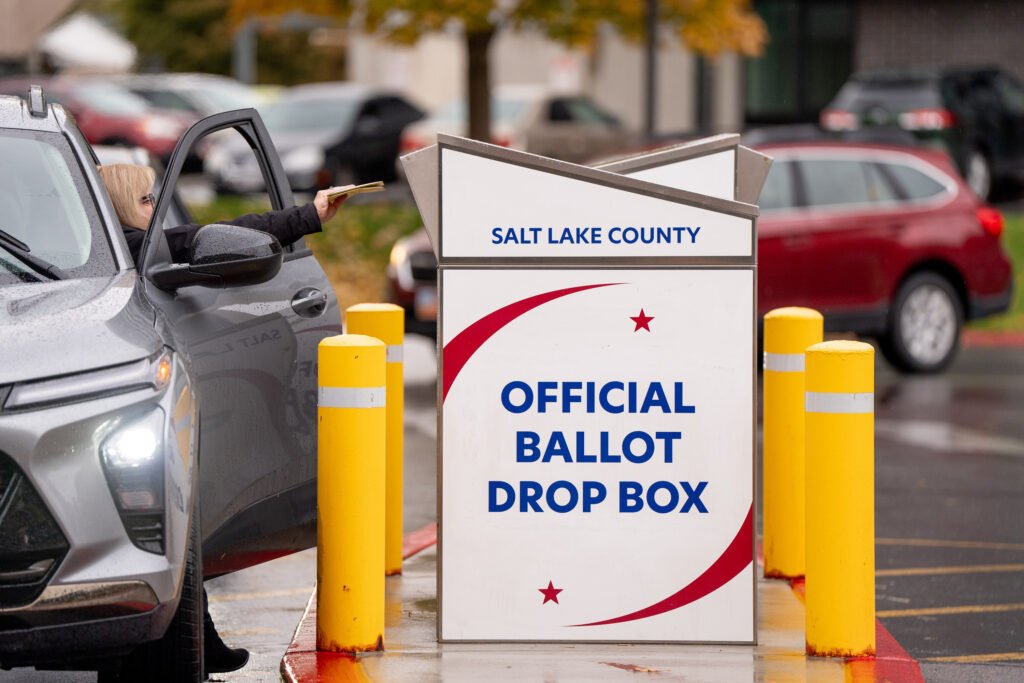
Tens of millions of Americans vote by mail in federal elections, underscoring the stakes of any major restrictions on voting by mail. About 30% of voters cast mail ballots in 2024, according to data gathered by the U.S. Election Assistance Commission.
Another elections challenge
Opponents of Trump’s election-related moves have a good track record in court.
Trump’s first order on elections, issued just over a year ago, attempted to require voters to prove their citizenship. While Congress is debating the SAVE America Act, which would implement similar requirements, federal courts found that the president had overstepped his authority when he attempted to impose changes unilaterally.
Nearly 30 states are also fighting U.S. Department of Justice lawsuits seeking to force them to turn over copies of voter lists containing sensitive personal information on voters. Three federal judges have so far ruled against the Trump administration.
State administration of elections is a fundamental feature of American democracy, spelled out in the U.S. Constitution. States run and regulate elections, but Congress — not the president alone — can override states and set national standards.
At a basic level, critics of Trump’s executive order argue it tramples on state authority and bypasses Congress.
“Once again, the President is attempting to act beyond his powers and seize control of our elections. Now he is attempting to weaponize the United States Postal Service against the voters. We will not stand for it,” U.S. Rep. Bennie Thompson of Mississippi, the ranking Democrat on the House Homeland Security Committee, said in a statement.
‘This will help a lot’
Trump cast the executive order as a necessary step in support of election integrity when he signed it during an Oval Office event on Tuesday. He acknowledged it would likely face legal challenges but called it “foolproof.”
Trump, who has long called the 2020 election stolen, falsely asserted that elections have been marked by significant fraud, saying the order was aimed at “stopping the massive cheating that’s gone on.” In fact, instances of noncitizen voting are extremely rare.
“I think this will help a lot with elections,” Trump said.
The order requires the Department of Homeland Security, with help from the Social Security Administration, to compile a list of voting-age U.S. citizens living in each state and then provide that information to state officials at least 60 days before each federal election. The order does not tell states how to use the data, but it instructs U.S. Attorney General Pam Bondi to prioritize investigations into state and local officials who issue federal ballots to ineligible voters.
The list of citizens will be drawn from naturalization and Social Security records, according to the order. It will also include data from SAVE, a powerful computer program maintained by Homeland Security that verifies citizenship by checking names against information in federal databases.
The Trump administration has been encouraging states to run their voter rolls through SAVE to identify potential noncitizens, but some election officials say it wrongly flags Americans as noncitizens. Several voting rights and civic groups have sued over Texas’ use of SAVE.
The Justice Department confirmed last week that it will share voter data it obtains with Homeland Security. At the same time, DOJ lawyers have been adamant in court that the Trump administration isn’t creating a national voter registration list.
“And yet here is an executive order that very overtly and expressly directs DHS to create that national voter database,” David Becker, executive director of the nonpartisan Center for Election Innovation & Research, told reporters on Wednesday.
Postal Service involvement questioned
The order directs Postmaster General David Steiner, who was named to the role by USPS’s Board of Governors last year, to require every outbound mail ballot be in an envelope that includes a tracking barcode.
At least 90 days before a federal election, states must notify the U.S. Postal Service whether they intend to allow ballots to be sent through the mail. States would then have to submit to USPS a list of voters planning to vote by mail at least 60 days before the election.
“What the president is doing today is he’s going to make sure mail-in ballots are safe, secure and accurate,” U.S. Commerce Secretary Howard Lutnick told reporters on Tuesday.
Trump’s effort to enlist USPS in election administration goes against the agency’s own policies. When the Postal Service updated its rules last year, it noted that it does not establish rules or deadlines for elections, or determine how the mail is utilized for elections.
USPS spokesperson Cathy Purcell said the agency was reviewing the executive order.
The order is a “structural inversion” of how mail voting works, said Pamela Smith, president and CEO of Verified Voting, an organization that promotes the responsible use of technology in elections. USPS delivers mail and isn’t involved in distributing ballots, she said.
“It is not up to the Postal Service to have this gatekeeping role over ballot delivery,” Smith said.
Under the order, the Justice Department and other federal agencies would be directed to withhold federal funds from states and localities that don’t comply with federal laws. It doesn’t specify what federal funds would potentially be targeted or whether states could lose election-related dollars.
States receive minimal federal election security grant funding each year from the Election Assistance Commission. During the 2025 fiscal year, the EAC distributed $15 million total, which can be used for upgrades to voting systems, cybersecurity, training and other needs.
“Even if it were to come to pass,” Smith said, “I don’t think it would carry much weight as a stick.”



