
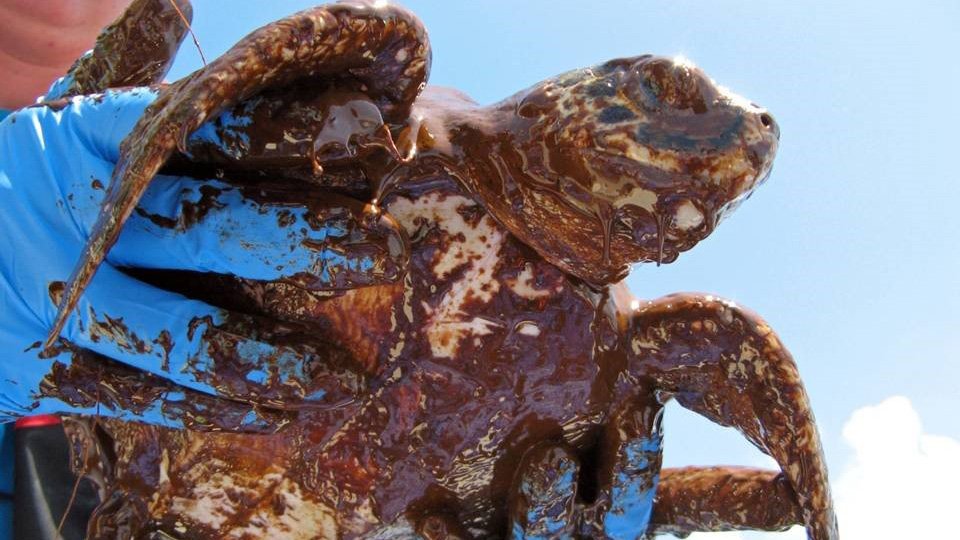
A rescue worker holds a juvenile endangered Kemps Ridley sea turtle covered in oil from BP’s Deepwater Horizon spill in 2010. (Photo via Florida Fish and Wildlife Conservation Commission)
The words “God Squad” do not appear anywhere in the Federal Register notice posted last week, but they sure were implied.

“The Endangered Species Committee will meet regarding an Endangered Species Act exemption for Gulf of America Oil and Gas Activities,” said the announcement from Interior Secretary Doug Burgum.
You may be familiar with “The Mod Squad,” the “Odd Squad,” and ‘The Suicide Squad,” yet you probably have never heard of the God Squad. It’s a seldom-seen entity. The last time it convened was in 1992.
The God Squad, officially known as the Endangered Species Committee, is a group of high-level federal officials who can, basically, play God. They can waive the requirements of the Endangered Species Act and choose to let one imperiled wildlife species go extinct to allow one particular project to proceed.
But that’s not what happened this time. This time, instead of condemning a single species to oblivion via one new dam or airport, the squad’s goal was much, much bigger.
The group that met Tuesday voted 6-0 to say it’s OK for the entire offshore oil industry to obliterate more than two dozen species that swim, float, or grow in the Gulf of Mexico. Sea turtles? Say ta-ta! Whales? Wave so long! Corals? Can’t save ya, despite your importance to the commercial fishing industry.
And their excuse for doing it is one that’s never been tried before: national security.

“I’ve been working on endangered species law for 40 years,” said J.B. Ruhl, a Vanderbilt University law professor who previously taught at Florida State. “I’ve never seen anything like this.”
I watched the entire meeting, which lasted a mere 16 minutes. In addition to national security, there was talk about burdensome regulations. There was even a brief mention of Iran’s blockade of the Strait of Hormuz, which has driven U.S. gas prices to more than $4 a gallon.
Not once did any of the God Squad members mention past oil spills and the damage those did to the seafood industry, tourism, and human health.
They didn’t even name any of the wildlife they’d condemned to a watery grave.
Watching them work, it seemed to me that the God Squad was auditioning for a job with the Devil.
The creation story
How did we get here? Let’s begin with the creation.
The creation of the God Squad, I mean.
The Endangered Species Act was written in 1973 by Republican government officials (including Florida man Nathaniel Reed) who were concerned that much of America’s iconic wildlife was disappearing. The list of endangered animals included eagles, alligators, manatees, and many more.
The measure passed Congress by a nearly unanimous vote. Nothing says “it was a different time” better than that, does it?
The bill was signed into law by then-President Richard Nixon, not the first name that leaps to mind when you think “tree-hugger.” Nixon could see how popular the growing environmental movement was.
Then a huge controversy erupted in Tennessee over the damage that a new dam would do to an endangered fish called the snail darter. Dam defenders were shocked to discover the darter had a leg up on them, legally speaking.
The U.S. Supreme Court ruled that the Endangered Species Act required the government to do everything in its power to protect even the tiniest imperiled species — no exceptions.
Congress found a sneaky way to exempt the dam. (Don’t worry, the darters survived and were taken off the endangered list in 2000). Then, in 1978, Congress amended the Endangered Species Act to create this committee with the power to override the law’s requirements in emergencies.
The panel had convened just three times before this week, according to the Associated Press. It issued only two exemptions.
The first was in 1979 to allow construction of a dam in whooping crane habitat in Wyoming, but it included a lot of requirements to lessen the harm. The other, in 1992, allowed some logging in northern spotted owl habitats in Oregon. That request was later withdrawn by the timber industry.
That means the God Squad issued one real exemption in 48 years — until the blanket one this week.

Keep the public out
The committee’s six permanent members are the secretaries of the Interior and Agriculture departments, administrators of the Environmental Protection Agency and the National Oceanic and Atmospheric Administration, the secretary of the Army, and the chair of the Council of Economic Advisers.
They all showed up for Tuesday’s meeting, which was held behind closed doors to keep out noisy enviro activists protesting outside. Instead, the Interior folks streamed the meeting live on YouTube.
In the past, there was a strict set of procedures to be followed to convene the God Squad, explained Jewel Tomasula of the Endangered Species Coalition.

“There were multiple meetings,” she explained. “Scientists would offer evidence on the impact, and other people offered testimony about why the exemption was necessary. The public was able to attend, and all the records were public records.”
But Burgum didn’t bother with all that folderol and fiddle-dee-dee. He and his colleagues on the God Squad were in too big a rush to help the oil companies. It’s a steel cage match, the God Squad versus Mother Nature, so get ready to rrrrrrrrrrrrrrrumble!
Burgum did not initially explain last week the reason for convening the God Squad. Then the Center for Biological Diversity filed suit. Facing a judge, the Interior Department at last identified who had requested Burgum take this step.
It was Defense Secretary Pete Hegseth, who has exhibited just as much skill in running the Pentagon as Tiger Woods has exhibited in driving his SUV.
Security risk
Hegseth, a former TV host who never rose above the rank of major, has made no secret of his disdain for the environment. One of his first actions was to cut funding for all the military installations coping with climate change.

Hegseth’s concern about a threat to national security was a real surprise. Last year he was so unconcerned about security that he was caught chatting about battle plans over the unsecured Signal app using his personal phone, a move that put American troops in Yemen in peril.
But now he’s changed! He’s all about security! He even showed up at the God Squad meeting to make his case in person.
Not everyone was persuaded by Hegseth’s argument against the Endangered Species Act.
“It seems pretty far-fetched that there’s any national security risk here,” said Brett Hartle of the Center for Biological Diversity.

After all, Hartl pointed out, the law hasn’t stopped any of the drilling that’s been going on in the Gulf for decades. Lawsuits have pushed the oil industry to be more careful but not once has any permit been blocked.
There are now some 3,500 oil and gas structures in the western and central Gulf of Mexico, according to Christian Wagley of the environmental group Healthy Gulf. About 3,200 are in use right now. Of that number, about 125 to 150 are active drilling rigs.
Those wells are pumping out beaucoup buckets of Texas tea. The United States is producing so much oil, we’re No. 1 in the world. We’re even exporting 30% of it to other countries.
As some smart aleck observed last year (OK, it was me), “During Biden’s four years in office, the oil companies set records for both oil production and oil and gas company profits. Their only emergency is finding new pockets in which they can stuff all that cash.”
But during Tuesday’s meeting, we finally found out what Hegseth meant. To him, the real security threat came from LAWYERS.
Kill the lawyers
Shakespeare, in one of his plays about King Henry VI, had one unsavory character say, “The first thing we do, let’s kill all the lawyers.” The character was making this sinister suggestion to “the head of an army of rabble and a demagogue pandering to the ignorant.”
Hegseth bears a similar resentment toward the legal profession, particularly attorneys representing environmental groups. Every time those greenie meanies sue to force the oil companies to obey the Endangered Species Act, he contended, they’re getting in the way of progress.
“These legal battles waste critical government resources and make it impossible for energy companies to plan and invest in new projects,” he told the God Squad. “When development in the Gulf is chilled, we are prevented from producing the energy we need as a country and as a department.”
Why, how dare these poorly paid attorneys try to force big, wealthy oil companies to obey the law that everyone else must follow! The nerve of those people!
“We cannot allow our own rules to weaken our standing and strengthen those who wish to harm us,” Hegseth continued, somehow keeping a straight face. “For these reasons, exemption from the Endangered Species Act in the Gulf is not just a good idea, it is a critical matter of national security.”
I hate to call the man a liar, but the last time I saw anything similar to that speech, it was piled up outside an Ocala thoroughbred stable. The truth about oil drilling in the Gulf is 180 degrees the other direction.
In fact, just last month, this administration awarded a new deep-water drilling permit to the last company you’d want to see drilling in the Gulf: British Petroleum, aka BP.

Spill it
The last time BP was turned loose in the Gulf, things didn’t go well.
On April 20, 2010, BP’s Deepwater Horizon rig exploded, killing 11 people and injuring 16 more, then quickly sank to the floor of the Gulf.
Two days later — on Earth Day, no less! — the damaged rig began spewing oil and no one could get down to the sea floor to stop it. The rig spat oil for months and its thick goo coated coastlines in Louisiana, Mississippi, Alabama, and the Florida Panhandle.
The spill damaged tourism, commercial fishing, and other industries that depend on clean beaches and uncontaminated water. BP wound up paying billions of dollars in damages.
The spill took a major toll on the Gulf’s wildlife. Red snapper and sheepshead developed lesions, fin rot, and parasitic infections. Sea turtles were slimed, oysters spoiled, dolphins died. An estimated 800,000 birds were killed.
The biggest casualties, in both senses of the word, were the Rice’s whales.
Did you know we have whales in the Gulf? I’ve lived on or near the Gulf most of my life but, until a few years ago, I didn’t know about these creatures the size of a city bus. They’re the only whales that spend their entire lives in the Gulf.
And the BP spill killed so many, there are now only 51.

Wild about whales
Many times in recent years, Donald J. Trump has expressed his concern about whales.
He’s not worried about them being killed by an oil spill, tangled in fishing nets, or clobbered by ships.
Instead, he’s contended that offshore windmills are somehow driving the whales bananas. At a rally in 2023, he even claimed dead whales were washing ashore “on a weekly basis.”
“The windmills are driving them crazy,” he told a crowd then. “They are driving the whales, I think, a little batty.”
Scientists said Trump was the one who was batty.
“There is no scientific evidence whatsoever that wind turbines … (are) causing any whale deaths at all,” a whale biologist from the U.S. Marine Mammal Commission told The Guardian.
If Trump is so wild about whales in danger, why can’t we get him concerned about endangered whales? I think the key here is showing him why he should care.
I think we should all log onto his social media platform, Truth Social, and convince him that we’ve started a petition to change the name of the Rice’s whale to the President Donald J. Trump Whale (TM).
“Sir,” we should tell him, “I have tears in my eyes as I tell you how much it would mean to everyone if you would lend your name to these important whales. Oh, and while you’re at it, please protect them from extinction.”
Then, to save all the other wildlife, we’ll tell him we’re lobbying to rename that body of water “The Gulf of Trump.”
If the God Squad exemption drives any wildlife to oblivion, the Rice’s whales are likely to be first in line. Hegseth would be OK with that — but I wonder whether his boss would feel the same way.



