
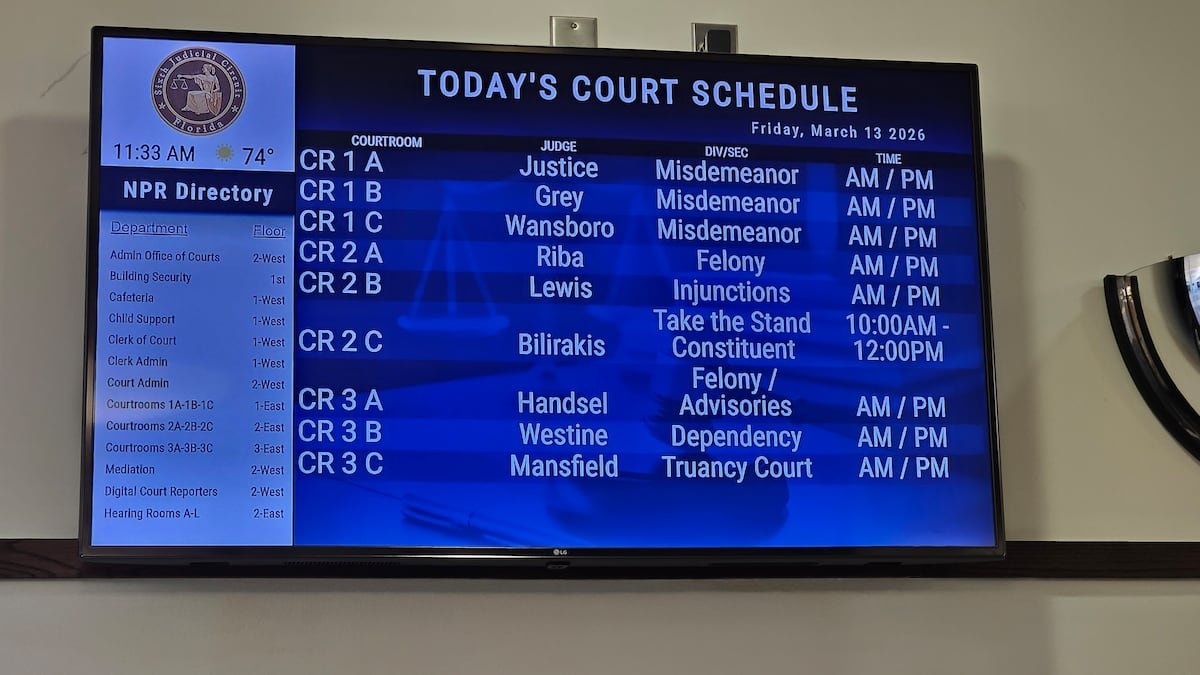
The children and their parents started arriving at the West Pasco Judicial Center before 9 a.m. on a recent March morning.
They should have been in school. But if they had been going to school regularly, they wouldn’t be required to appear here for truancy court instead.
Officials said they hoped the gravitas of the situation, from an armed deputy delivering a summons to a robed judge issuing formal orders, would drive home the message that school matters.

“It’s almost like ‘Scared Straight,’” Senior Judge Declan Mansfield said, referring to the 1978 film about convicts telling troubled youth stories about life in prison. “Maybe it will wake up kids.”
That’s the expectation of superintendent John Legg and the school board. The district has tried several campaigns to bolster attendance over the years, with limited effect.
About one in five Pasco students had missed 10% or more of classes by the end of February, according to district data. That’s down from a high two years ago, when more than a quarter of students were deemed chronically absent.
It’s also nearly double the level from before the COVID-19 pandemic. District records show 13.3% of students were chronically absent in 2019-20, before questions about the importance of in-person schooling began to surge. And historic trends show that as the second semester wears on, absenteeism tends to increase.
“We don’t want to inundate the court system. But we do need a process to officially address these students,” Legg said during a workshop on the subject, noting the district had not petitioned to have a truancy hearing since 2011. “These are chronic extensive absences, not a one off. We can’t wait any longer.”
‘We’re trying to help you’
The court held a practice run of three cases in February. The real test came a month later, with a dozen students scheduled to appear in the morning and another dozen in the afternoon.
It really wasn’t the best time of year to kick it off, Mansfield said, with spring break a few weeks off and summer vacation close behind. But the initiative had to start at some point.
“What I try to do is get their attention as to the importance of education,” said Mansfield, who once led the county truancy board. “I use different tactics with different families, depending on what they tell me.”
That approach was evident during the March morning session, in which Mansfield spent about 15 minutes with each student and their parents, all of whom arrived without a lawyer. The Tampa Bay Times was granted access to the proceedings on the condition that no photos or recordings would be made, and no minor children or their parents would be identified.
In the first case of the day, Mansfield dealt with a parent who spoke no English as he delved into why her fifth grader had missed 69 of 116 class days since August. After listening to the mom’s explanations, he told her through an interpreter that she had the responsibility of getting her child to school regardless of other family concerns.
“If he doesn’t go to school, there will be consequences,” Mansfield said.
Florida truancy law allows the court to enter an order requiring the student to attend school and the family to participate in services such as counseling about overcoming barriers to attendance. No fines or more severe punishments are contemplated.
Mansfield asked the boy if he understood the importance of getting an education, and urged him to tell his family to take him to school each morning. Lawyer Tom Neesham, one of a dozen district staff attending the hearing, advised the judge that when the boy did go to school, he regularly was picked up more than an hour before the final bell.
The mom said she goes to work before classes end, and she needed to get him home. Mansfield issued an order that the boy must attend school every day, all day.
“To get an education, you have to be there,” he told the youngster, who agreed to do better. He asked for a status report in May, and sent the family on its way.
Next, the judge chastised a mom after listening to her make what he considered too many excuses for her fifth grade daughter missing 49 days of classes, while the girl watched silently.
“This is her future, not yours,” Mansfield said. “You have to make sure she has the choice, and you’re not doing that right now. Your No. 1 priority is that she goes to school and learns. And that’s not what I’m hearing.”
As he dealt with older students, Mansfield put the onus more on their shoulders. He rejected their reasons for missing weeks of instruction — staying up until 2 a.m. playing video games and then oversleeping, for instance — and tried to find something that would inspire them to attend.
For one boy who blamed late school buses for his absenteeism, it was the prospect of playing football, and the need to improve his grades to be eligible. For another, who said he didn’t want to go to school, the judge reminded him that he wouldn’t be getting a driver’s permit until he turns 18 if he’s found truant.
He told one family to take away their child’s gaming devices until school becomes a priority. He suggested another remove their child from organized club sports until he straightens up. He encouraged one mom to get her child an alarm clock, which district officials said they’d provide free of charge.
Some cases left Mansfield almost as flustered as the parents. There was, for example, the seventh grade girl with 61 unexcused absences and 41 unexcused tardies who told Mansfield “I just don’t really like” school and had no interests.
“I don’t know what we’re going to do here. How can I motivate you to go to school?” he asked. “What do you want to be?”
The girl shrugged. He got her to acknowledge she needed an education for the future, whatever it might be, then ordered her to attend daily including summer school. She grudgingly agreed (as if she had a choice).
“Your future is coming up really fast,” he said. “We’re not punishing you. We’re trying to help you.”
Signs of success
After dispatching the current cases, finding each student truant under the law, Mansfield received updates from the three February test run cases. The information he received gave him hope.
The father of the first student reported that his child had a couple of tardies but hasn’t missed school since her court date.
“I’m getting her there,” the dad said. “She is working.”
He asked for permission to let her miss classes for an upcoming family reunion. The judge agreed, as long as the girl had perfect attendance leading to that date.
“It sounds like she is headed in the right direction,” Mansfield said. “Let’s continue.”
District officials reported that the other two students, who did not come to court, also had dramatically improved their attendance.
“It’s early, but we have seen some successes,” said district deputy superintendent Betsy Kuhn, who monitored the hearings from the back of the courtroom. “Having this here has students going to school. That’s our goal.”
Jeffrey S. Solochek is a reporter covering education as a member of the Tampa Bay Times Education Hub. You can contribute to the hub through our journalism fund by clicking here.



