
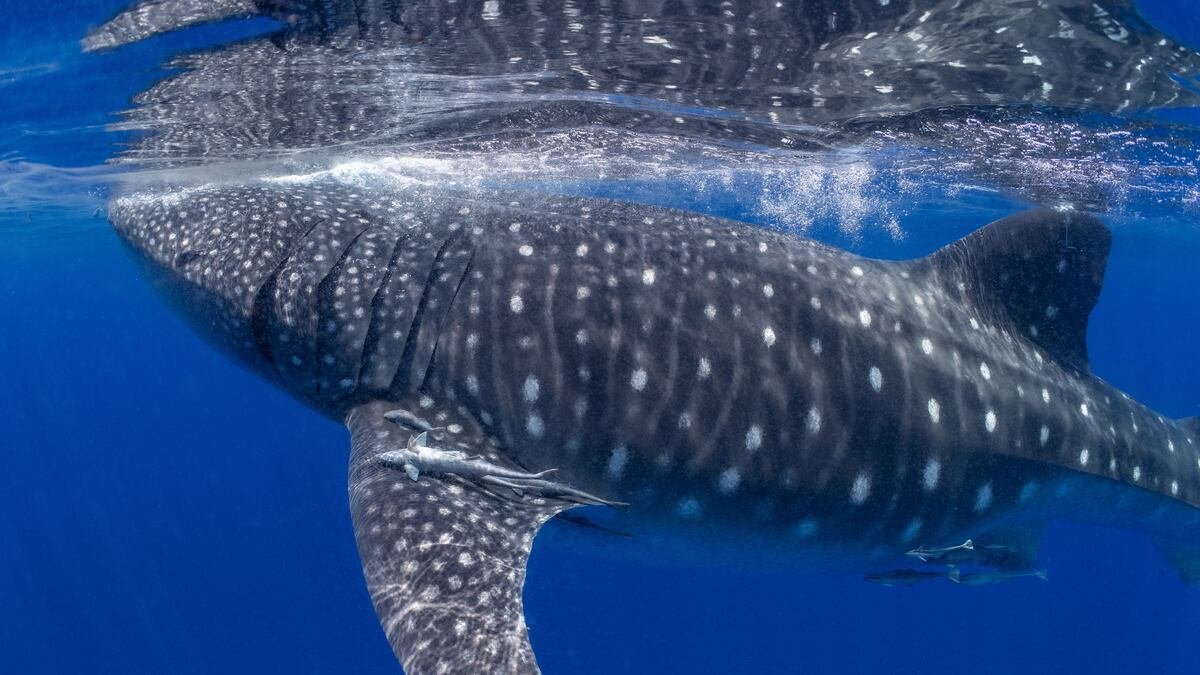
Researchers were more than 25 miles offshore Anna Maria Island last summer when they first met Larry.
The weather was fair, the seas calm, and the whale shark cruising toward them? The size of a delivery truck, measuring 26 feet long.
They hurriedly donned their masks and snorkels, grabbed a satellite tracker and jumped into the Gulf of Mexico. Nobody could know just how remarkable Larry’s story would soon become.
For years, scientists had been receiving reports of whale shark sightings offshore of Tampa Bay. But most of their research efforts had been focused on the Ewing Bank, a site off the coast of Louisiana where whale sharks historically gathered.
That changed last May, when a team of federal, state and university scientists tagged a series of whale sharks — and Larry in particular — that have since advanced their understanding of where the animals travel and why.
When experts sampled the waters offshore Tampa, they found it loaded with Spanish sardine eggs that whale sharks feast on. The waters may be prime feeding grounds for whale sharks, a species that gulps thousands of gallons of ocean water as they filter for food.
And there was no shortage of it last summer. The day Larry was tagged, whale sharks around his size were seen feeding for over 10 hours and could take in a whopping 330 pounds of food in just one day.

“Last year really opened our eyes to the importance of these areas,” said Eric Hoffmayer, a whale shark expert and research fishery biologist with the National Oceanic and Atmospheric Administration. “The animals were all at the surface, feeding on what seemed like an infinite amount of fish eggs.”
Researchers have deployed 15 tags on whale sharks in waters off Tampa Bay so far, Hoffmayer said.
But questions remain, and researchers are asking Tampa Bay locals to help answer them: If you’re offshore this summer — fishing, diving, sailing — and you spot a whale shark, report it to the University of Southern Mississippi, which is part of the ongoing collaboration to track the animals.
Experts are asking for some specifics: the general location of the whale shark, its estimated size, water depth and, crucially, any photos or videos.
“We’re just trying to get word out,” Hoffmayer said. “If people are out there on the water and see a whale shark, they can report that information that helps direct our research efforts.”
Larry the ‘Rockstar’
After scientists affix a temporary GPS tag to a whale shark’s dorsal fin, they’d usually be lucky to get a few months of data.
The animals like to rub on the bottom, and the antenna tracker can get damaged quickly.
But not Larry.
“Larry’s been a rockstar,” Hoffmayer said. In the first 350 days after researchers tagged Larry last May, his tag has reported locations for 320 days, offering up more than 6,000 unique data points. “It’s remarkable.”
Below: See a year of Larry’s movements throughout the Gulf in this data visualization created by the National Oceanic and Atmospheric Administration and shared with the Tampa Bay Times.
Design by Max Chesnes
Because Larry’s tracker has stayed on for so long, experts have been able to collect important data about where he spends his time over a longer period.
In the months after he was tagged, for instance, Larry traversed up and down the Florida coast. In the fall he left the Gulf for a quick stint, heading south toward Honduras. Then he made his Gulf return in November and was doing laps around the loop current this spring.
Paired with data from other animals like Larry, overall trends about whale shark movements could soon emerge, offering a clearer picture that could better inform conservation policy.
The whale shark population worldwide has declined by more than half over the past century, mainly from human causes like accidental catches in nets and strikes from ships. They are considered endangered by the International Union for Conservation of Nature and Natural Resources.
“Being that they are the largest fish in the ocean, that’s really saying something that these guys are depleting in their numbers and we could lose them,” said Jill Hendon, director of the Center for Fisheries Research and Development at University of Southern Mississippi.
Hendon oversees a Gulf whale shark sighting database the school has kept since 2003. Since then, there have been more than 600 reports of individual or groups of whale sharks, she said.
What’s exciting about Larry’s data in particular is that he left and then returned to the Gulf, implying that it’s an important part of his range, Hendon said.
Every piece of new information is a step toward better understanding the species in Gulf waters — and that’s why reports from citizen scientists are so key, Hendon said.
“They are majestic, and grand and beautiful. We are really privileged to have them in our waters, and we would really like to keep this population prevalent,” she said. But scientists can’t be everywhere at once.
“It’s only through (the public’s) participation that we can get a better handle on this,” she said.
‘Everybody has a role’
Larry (the whale shark) has Larry (a human) to thank for his name.
Researchers named the animal after local doctor Larry Spetka, a retired neurosurgeon who generously allowed experts aboard his private boat to track whale sharks last May.
“Nothing humbles a physician quite like standing beside real scientists on a whale shark tagging expedition — suddenly your white coat feels a lot less impressive next to people who can find, track and understand a forty-foot fish in the open ocean,” Spetka recently said in a social media post introducing both him — and the whale shark — to the world.
Spetka’s ongoing help shows how meaningful science can be accomplished through collaborations among private citizens and federal, state and nonprofit organizations, according to Jamison Smith, the executive director and chief scientist at Blue World Research Institute Inc.
“Things are changing out there in the Gulf, and the key is flexibility. These animals adapt, and I think it’s important for us researchers to adapt, as well,” Jamison said. His group is assisting with federal and university scientists in the ongoing research.
Jamison said an “orchestra of events” have to fall into place to successfully tag a wild whale shark: Fish are typically spawning around a new moon, and the weather and sea conditions need to be just right. Then comes actually finding the whale sharks.
“That’s why public sightings are so important,” he said. “Everybody has a role, including boaters out on the water.”
Even after all the stars align, it can be chaotic trying to track down, document and attach satellite tags to animals that can grow up to 60 feet long.
But Hoffmayer said when the day’s work is complete, he makes it a point to get in the water, slow down, and embrace the beauty of the animal in front of him.
“I look at it in the eye and wonder what it’s thinking,” Hoffmayer said.
He encourages his teammates to do the same.
“Our goal is to collect the data, but enjoy it,” he tells them. “You don’t get these opportunities very often.”
The ongoing whale shark research is supported by Wildpath, which combines science and storytelling to help shape conservation policy in Florida.
Wildpath tells stories of the importance of Florida’s wildlife corridor, an interconnected string of public and private lands meant to provide migration habitat for bears, panthers and other species. The group is now extending that concept of connectivity to offshore Florida waters:
“The whale sharks are showing us that there are wildlife corridors in the Gulf too,” said conservation photographer Carlton Ward Jr., who founded Wildpath and the Florida Wildlife Corridor project.
“From whale sharks to manatees and sea turtles, satellite tracking is showing us the marine wildlife corridors we need to protect.”
To report a whale shark sighting: Visit https://usmforms.formstack.com/forms/whale_shark_sighting_survey. You can also email fisheries@usm.edu or call 228-818-8815.
The Tampa Bay Times launched the Environment Hub in 2025 to focus on some of Florida’s most urgent and enduring challenges. You can contribute through our journalism fund by clicking here.



