
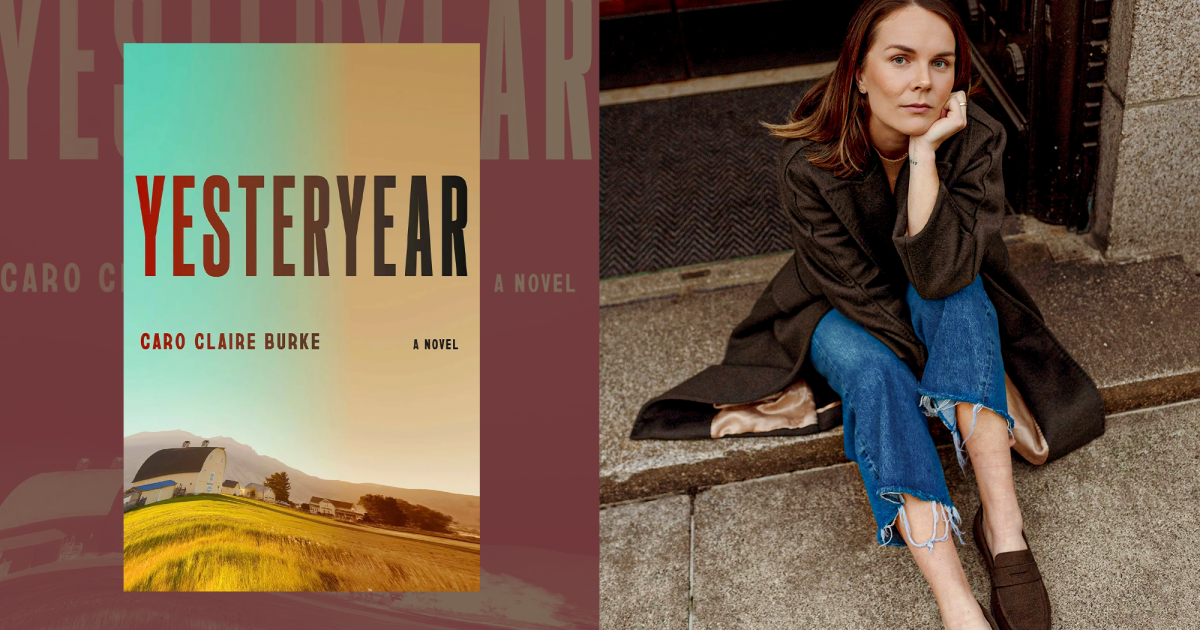
Mother Jones illustration; Penguin Random House; Aiste Saulyte
Trad wives have been baking, churning, scrubbing, and harvesting their ways through our social media feeds for several years now, praising homemaking and subservience to their husbands on countless dedicated TikTok channels. With her pristine makeup and prairie dresses and endless cheerful obedience, this internet persona—the trad as in “traditional” wife—seemed predestined to end up as a character in fiction or film.
But that in no way makes Caro Claire Burke’s new novel Yesteryear, starring a trad wife influencer, any less bracing. On the surface, Burke’s protagonist, Natalie Heller Mills, has everything she dreamed of: an internet following and sponsorships to match it, hard won by turning her life into an 1800s pioneer fantasy with her strapping farmer husband Caleb and their gaggle of children on a farm in the foothills of Idaho. She hasn’t even really had to give up modern luxuries; her children are tended to by (off-camera) nannies; there’s a refrigerator hiding in a pantry off the kitchen (a possible nod to the most famous real-life trad wife influencer, Hannah Neeleman, who goes by the handle Ballerina Farm). Sure, there are hordes of angry online commenters out to get her, and yeah, Caleb may be sleeping around, but life is mostly perfect.
One morning she woke up with the idea for the title of her book, Yesteryear, which felt “all-encompassing.”
Then one day Natalie wakes up to everything a little off-kilter, and pieces together that she has time-traveled to the actual 1800s, an era of little medical intervention, no electricity, and low patience for female opinions. Darkness sets in early, and the food sucks. But small observations soon have her questioning whether she has really time-traveled—or whether she’s caught up in some kind of dark West World-like reality show. The narrative unspools from there, with detours into Natalie’s origin story, and there are more than a few satisfying twists that kept me reading late into the night.
Burke came up with the premise after watching too many trad wife videos on TikTok in the winter of 2024, she told me on a phone call—the phenomenon was something she “became very obsessed with very quickly,” she said. She was working for Katie Couric Media at the time but had a fiction MFA and had been hoping to also write a novel. One morning she woke up with the idea for the title of her book, Yesteryear, which felt “all-encompassing.” She’d never written a thriller; all her fiction until that point had been, in her words, “small, quiet, family interiority drama.” Perhaps because of that, she “was really able to go for it,” unencumbered by her own expectations.
The resulting book is juicy, vindictive, and loads of fun—and has already been optioned by Amazon MGM Studios, with Anne Hathaway planning to co-produce and star in the film adaptation. While Burke’s tale serves as somewhat of an indictment of conservative gender roles, it’s not without its nuances. “It was very important to me to be just as honest and hard-eyed at liberal culture,” she says.
Burke also co-hosts, with Katie Gatti Tassin, the podcast Diabolical Lies, which lends a feminist lens to all manner of culture and politics topics, including young conservatives and the manosphere. I spoke with Caro about her own political awakening and her thoughts on trad wives’ agency.
I read that you grew up conservative. Anything resembling tradwife conservative?
I grew up in a Republican household, and I was Catholic, I got confirmed. But I also went to liberal schools, and so I was never cloistered away. I kind of grew up in the Bush-Romney era of conservatism. It wasn’t as hard of a pivot as the ones that you might see in the book.
You told an interviewer that your life changed after watching the movie Captain Fantastic, and then wondering who Noam Chomsky was. Is it true you and your husband then ditched your jobs to live in an Airstream?
It was a little less romantic than that. It was the pandemic era. We bought this, like shit kicker 1967 Airstream, and he renovated it, and then we lived on the road for two years, off and on. The Captain Fantastic of it all was pretty inspiring for us. The van life craze hadn’t super kicked off, but we were definitely a part of that as it was happening. So, yeah, I bet we probably were Chomskied a little bit.
So much was happening in America at the time—I don’t know if I would have radicalized honestly if our country hadn’t been radicalizing too.
It struck me that the off the grid life depicted in Captain Fantastic, and the supposedly off-the-grid life of your trad wife protagonist, Natalie, might actually have some overlaps, like back-to-the-land hippie or back-to-the-land Christian conservative? It’s kind of this place where the far left and far right start to converge.
We talk about this a lot on our podcast, there is a lot of overlap there. I mean, anytime you have anyone who is trying to behave in any sort of heterodox way. Something appealed to us so much about being quiet and reading and trying to hold on to those kinds of traits in a time period where it feels like the world is hellbent on wrestling that out of you. Arguably, you have that quiet in Yesteryear, but there are no books, so I think that’s kind of the inverse: You do have this quiet, you have opportunities for revelation, but I don’t know if you have people who are equipped to receive the revelation.
Yesteryear is kind of a thriller-slash-horror book. Obviously there’s trad wife content on TikTok, but did you draw on anything else as inspiration for the novel?
You mean, for like, the horror element of it? It’s funny that I had never written horror because I’m obsessed with it. I loved The Witch, and I rewatched it in the final days of editing Yesteryear. And I remember being like, Oh my god, darkness. I added a few lines about how dark it can be in a house when there’s no electricity. And then obviously, Hereditary is a classic. There’s a movie that came out this year called Bring Her Back that I thought was one of the more terrifying things I’ve ever seen. If you like horror, highly recommend.
I grew up loving Little House on the Prairie, and I have almost like a primal yearning for a simpler life that many trad wives seem to advertise. Did you feel drawn to that life at all when watching their content and imagining the life of an 1800s pioneer woman?
“The trad wife stuff and this vision of this aesthetic—I was obsessed with it.”
I think all of it is kind of intoxicating. There is something natural about seeing stars, as corny as that sounds, or being alone and not hearing anything else. That’s incredibly soothing. But yeah, I mean, with the trad wife stuff and this vision of this aesthetic—I was obsessed with it. I’m so aware of how attractive it is, because I find it attractive, and I think that’s also why it was easy for me to write about it for two years. It does seem so beautiful. And I think the way that America fetishizes the Wild West and cowboys and Indians and this whole fantasy, it’s so intoxicating, and we’re so educated to fantasize about it, that I think it’s kind of unavoidable in a certain way.
How did you do research for the book, aside from, I’m assuming, watching trad wife TikTok videos?
The thing that I researched much more were patterns of behavior with women in these fundamentalist communities. You can interview people, but also there are Reddit chats of people who have left the Mormon faith, or left the Jehovah’s Witness faith, or left an evangelical community. There are whole podcasts dedicated to women who have left those communities. I kind of went through a period of just like waterboarding myself with that, and then you start to see, it’s all the same consistent behaviors.
There’s a point in the novel when your protagonist, Natalie, has just woken up in 1805, or she’s not sure. And her husband smacks her for talking out of line. There’s this moment of shock that she no longer has the power she had in the modern era. To me, that actually highlights how much power she did have in the modern era—she was kind of running the show, calling the shots. To what extent do you think that is true for many trad wife influencers?
I think it’s a question that could be asked more often. I see a lot of people assume that if women are wealthy, then they have the ability to leave. And I think that anyone who looks into this is like, that’s not even remotely true. Something that was important to me was having certain elements of financial abuse, where it’s like, Natalie does have a lot of power, but also she doesn’t have control of their finances. I don’t really have an answer for how much power Natalie has. As I was writing her, it felt like, like a pendulum swing with each chapter, where it’s like, you have a moment where she is totally in charge, and has figured her way out of some bind, or come to a solution or gotten what she wanted, and then the next chapter is like, Well, be careful what you wish for, because now you’re stuck in a new way.
“I see a lot of people assume that if women are wealthy, then they have the ability to leave. And I think that anyone who looks into this is like, that’s not even remotely true.”
I think that a lot of women can think or hope that they’re reaching a level of power if they play along within these communities, but you never actually have it, because women are not allowed to have power. It’s all really an illusion at the end of the day.
With the women who seek to fulfill these traditional roles, what advantage do they gain by pretending to be powerless?
I mean, I think they are powerless. I’m sure there’s an exception to every example. But, I would say 99.9—virtually all—of the women that I spoke with or I listened to on podcasts or that I was reading from, they were all born into these communities. When you’re born into this community, you are taught from childhood that there is one way to go to heaven, and that way is to perform as a wife and a mother. When every woman behaves the same way, then you have to start to wonder if any of them are making choices to begin with, or if it’s all been kind of cultured into them.
“You are taught from childhood that there is one way to go to heaven, and that way is to perform as a wife and a mother.”
I know New York mag just did this big cover story: We never stop talking about Mormon women. But there’s a reason why they’re all over social media. It’s because they’re taught to be beautiful, to prioritize their looks and to evangelize and they’re also taught to work themselves to a bone and never complain about it. When it’s taught to you from birth, and when there are real punishments on the line of not doing it, like divorcing your husband is not an option in the same way that it is for me as like a totally secular person—these women usually don’t have access to their own finances. They often don’t even graduate from college. They usually have kids. If you have a child, I think it makes the idea of leaving pretty unattractive, let alone if you have, like, six kids.
I have a hard time with the idea of choice in these women, because I feel like when they’re all making the same decision and they all end up powerless—it’s hard for me to argue that they did really choose it.
There’s this internet idea that women are quitting the modern workforce to become trad wives, but it kind of sounds like what you’re saying is almost all trad wives were born into these communities.
I don’t think there’s any evidence that women who were not in these positions are now converting into these positions. There’s evidence that women are dropping out of the workforce, but that’s not because they’re about to bake bread. It’s because they can’t afford childcare. There’s this stat that this year, something like 400,000 women dropped out of the workforce, and it’s the biggest decline in modern history. It’s funnily timed, right? With the whole trad wife thing. But everything I can find from women who have reported leaving and who are willing to talk about it is caregiving responsibilities. It’s not them being like, I have chosen to reject feminism. I don’t think there’s any evidence whatsoever that women are choosing this en masse. I think there are women who are already born into it, and then I think there are women who make a lot of money by pretending that they’re doing it online.
Are there that many women doing that second option who are basically completely pretending, or are they still from these communities, they’re just kind of amping up the back-to-the-land lifestyle?
That’s kind of the question. I have my suspicions. I don’t know. Obviously the most famous one is Hannah Neeleman, Ballerina Farm. I have no fucking clue what that woman is thinking. There are people who could argue that she genuinely believes the whole lifestyle she’s selling. And then I think there are people who go, this woman went to Juilliard, she lived in New York City, she knows what she’s doing. I think we always learn more after the fact, and I think we usually learn more about what is taking place with these people from their children.
So we just need to wait like, 15 to 20 years, and then all will be revealed.
Yeah, exactly. It’s like the Duggars—we have to sustain maximum damage, and then we will get, like, a sliver of truth at the end of it.
The Trump administration is trying to redefine, even from a legal perspective, the sexes in a way that reinforces this Christian conservative idea of traditional gender roles and hierarchy and how women should submit to their husbands. I heard you suggest on your podcast Diabolical Lies that this could be considered a form of voter suppression. Can you say more about that?
I think it is voter suppression. There have been efforts all over the country to suppress the abilities of women to go about their daily lives in a number of ways. There are a bunch of Republicans in the Midwest who are actively trying to return us to our teenage birth rates that we worked so hard to decrease. They’re like, no, actually, we want a lot of teenagers giving birth again. You have a lot of people trying to reverse no-fault divorce laws. I think that there are a lot of Republicans who think like, well, make sure that the last name for the woman matches the last name of her marital license. And if that all matches up, then maybe they can vote. And if not, you’ve got a problem.
“When you are trying to encourage women to be at home…you are creating a scenario in which women will not have access any number of things outside the house, and one of those is basically behaving like democratic citizens.”
Also, economically disenfranchising—there’s also something they’ve done to the Black community forever, like when election day isn’t a federal holiday, you are intentionally ensuring that poorer people will have less of a chance to vote than wealthy people. The same is true for women. When you are trying to encourage women to be at home and to be a primary caretaker, and to not rely on anyone else, and to not use daycare, you are creating a scenario in which women will not have access any number of things outside the house, and one of those is basically behaving like democratic citizens.
Who is your imagined audience for the book?
It’s kind of hard for me to visualize. I think practically, it’ll be women, and I hope it’s women of a wide range of ages. If men read it, that’s awesome. The idea of a married couple, or any sort of couple reading it together really excites me. And having conversations with each other about gender and how it plays a role in their marriage or partnership, that’d be cool.
With your podcast Diabolical Lies, I’m curious—there are so many podcasts out there. When you and Katie Gatti Tassin were planning to start it, what hole were you trying to fill in the podcast universe?
We had a few instincts about things that we craved and we weren’t seeing, and so some of them were, longform. Joe Rogan does a three hour podcast every day. So Katie and I had both been told separately, ‘Oh, well, you can’t really have a podcast that’s more than an hour. People won’t listen.’ And we were like, there’s no way that’s true. We don’t need 10 million listeners, but there’s no way that you can’t have a viable product that’s also longform. We just kind of felt, it sounds really corny, but there just weren’t many podcasts where women were talking about issues in the kind of way that we wanted to, which is kind of irreverent, but taking itself pretty seriously, and caring about a range of issues that aren’t just pop culture. The fun thing about a podcast is that it’s very inexpensive to try.
What does the name refer to?
It refers to a [Kansas City Chiefs kicker] Harrison Butker commencement speech, and he was telling all the women that the greatest lie they had been told was that they should seek purpose outside of the home. He said, ‘You guys have been sold the most diabolical lies,’ essentially being the tenets of feminism: that you can have fulfillment beyond being a mother or a wife.
Something that kind of nagged at me a little bit while I was reading Yesteryear was the modern career woman is also pretty miserable seeming.
It was definitely intentional. I think first and foremost, it was important for me to really imagine the alternative through Natalie’s eyes. I had spent so much time in these trad wife worlds that it was very easy for me to regurgitate their perspective of what it meant to be modern. And I also think I started to realize like, well, there are elements of that that are true. Women aren’t supported in the workforce. Women don’t get the type of leave that they deserve. It is very hard, probably impossible, to “have it all.” And I think in a book that skewers so much of conservative culture, it was very important to me to be just as like honest and hard-eyed at liberal culture. The argument against feminism, is that feminism and all that it came from has led to miserable lives. And so I think in order to embody Natalie fully, it was important to go there and to kind of be like, yeah, no, it’s not just conservatism that is a little bit of a joke. It’s also the half-assed liberal feminism that we’ve gotten that really hasn’t given us what we need.
If modern liberal feminism is not giving us what we need, what do we need—what do we deserve?
What do we deserve? Oh, my God, that’s like the million dollar question. I mean, the first step, the bare minimum, is an adequate social safety net. If there were one thing that I would have Yesteryear do, it would be give women maternity leave, for fuck’s sake. There are certain things that America is so behind on that it’s laughable. Every woman should have access to a minimum of six months maternity leave, let alone support for breastfeeding, let alone access to child care. Having a serious conversation about where our taxes are not going and how pathetic that is, given that every other developed nation has figured it out to a better extent than us, would be my starting point. And then from there, we could have more waxing poetic conversations about, like, how many hours should a person work. But we’re at triage right now.



