
An A.I. video recently released by supporters of the Iranian government begins with a robed Shiite Muslim warrior approaching the White House on a stormy night, clutching an ornate split-bladed sword. In the next scene, the weapon slides across President Donald Trump’s cheek. Generated images depict present-day Iranian soldiers defending oil facilities under attack and capturing a U.S. aircraft carrier. Another group pays respects to the Grand Ayatollah Ali al-Sistani, the leading religious figure for millions of Shiites around the world, before launching what appears to be a suicide mission against enemies in Humvees. Then other soldiers attack oil tankers from speedboats as ballistic missiles launch out of a gold-domed mosque, and explosives-laden drones target Dubai. “You can’t kill people who are ready to die for their cause,” the narrator says in English, addressing the U.S. “The Shia are prepared to be martyrs in the cause of their faith. It is the Islamic Republic of Iran that they are defending—not just their land, not just their culture, not just their history, but their faith.”
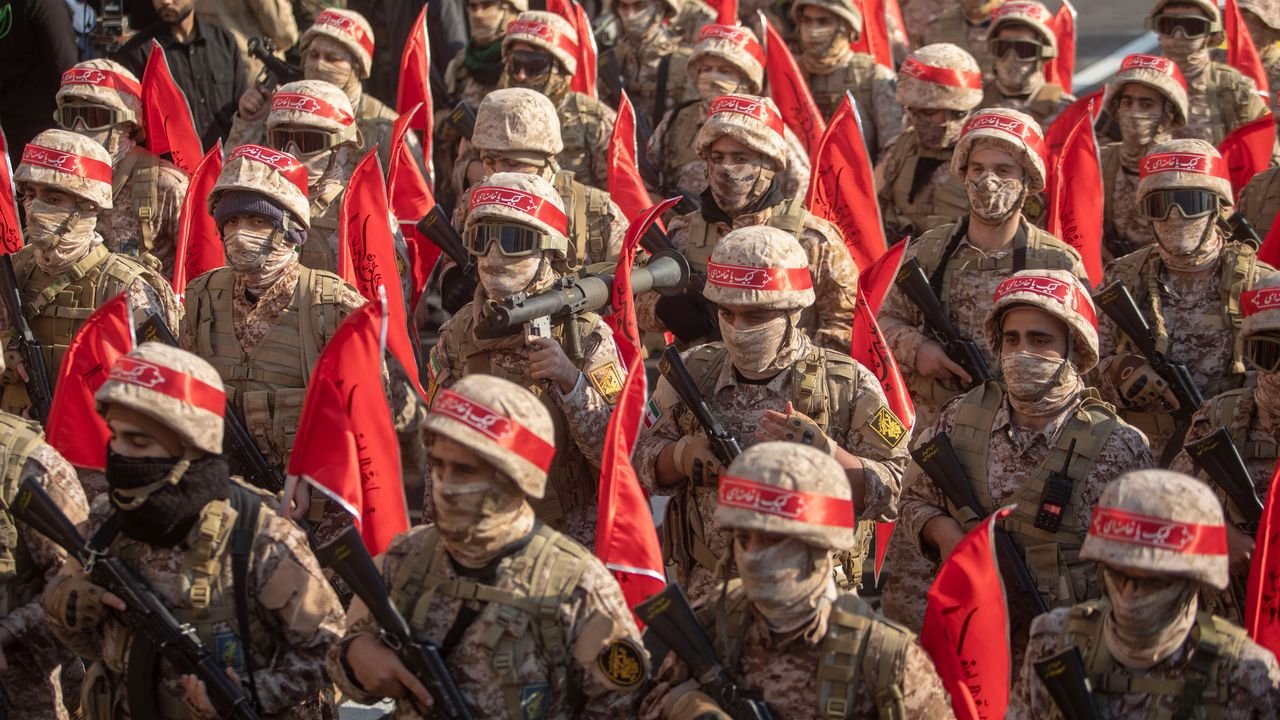
As the Trump Administration prepares for a possible ground invasion of Iran, the Iranian regime and its loyalists are waging a propaganda war, using motifs of religion, self-sacrifice, and glory, through dozens of videos like this one that are circulating on social media. Many troll Trump and are designed to motivate Shiite Muslims in Iran and around the world. Others are in English and attempt to influence global public opinion, including in the United States, where the war is increasingly unpopular among most Americans. While these A.I. memes are built for dissemination on the modern internet, the reliance on religious iconography and references to martyrdom originate from a different era: the last time Iran was invaded by a foreign power. In the nineteen-eighties, the country fought a brutal eight-year war against Iraq, whose government was backed by the U.S., the Soviet Union, and much of the Arab world. The lessons learned from that conflict still guide the regime and its powerful Islamic Revolutionary Guard Corps more than four decades later. The Iran-Iraq War “is a vast reservoir of resilience memory from which to draw on,” Hussein Banai, an Iran expert and professor of international studies at Indiana University Bloomington, told me. Iran saw “that it could stand up to the United States, but also to other countries that are backed by American power. The narrative of that war is really what’s driven a sense of purpose, especially for the Revolutionary Guard.”
On Sunday, Trump vowed to strike Iran’s power plants and bridges if by Tuesday night the regime doesn’t reopen the Strait of Hormuz. A defiant Iran replied that it would not open the strait, through which a fifth of the world’s oil and natural gas flows, unless the U.S. pays for war damages. And it warned that it would retaliate “much more crushingly and extensively.” The morning before the deadline, Trump posted on Truth Social that “a whole civilization will die tonight, never to be brought back again,” adding that “we will find out tonight, one of the most important moments in the long and complex history of the World.” Meanwhile, thousands of U.S. ground forces, including U.S. Special Operations Forces, seaborne marines and élite Army paratroopers, with experience in seizing strategic terrain during rapid-response combat missions, have arrived in the Middle East. Over the weekend, the risks of operating on the ground were laid bare when Iran shot down a U.S. F-15E fighter jet, and the two airmen in the plane ejected over the southwestern part of Iran. Later, a second, low-flying U.S. warplane, an A-10 Warthog that was part of a mission to rescue the F-15E pilot, was hit multiple times, but its pilot managed to fly out of Iran and eject safely over Kuwaiti airspace before it crashed. A U.S. HH-60W Jolly Green II combat helicopter also came under heavy fire; its crew sustained minor injuries but were able to leave Iranian airspace without mishap. While the pilot of the F-15E was rescued shortly after ejecting, the second airman, an Air Force weapons officer, fled into a mountainous region, where he climbed mountain ridges several thousand feet high, despite being injured, and successfully evaded Iranian forces for more than a day. He hid in a rock crevice and activated an emergency beacon to signal his location, setting off a sprawling mission deep inside Iran which involved commandos from SEAL Team Six, hundreds of other military personnel, and a hundred and fifty-five aircraft, including sixty-four fighters, forty-eight refuelling tankers, thirteen rescue aircraft, and four bombers. After the weapons officer was located, two U.S. transport planes that had landed at a remote forward operating base inside Iran to extract the team and the airman experienced mechanical problems, and three other planes had to be dispatched to extract them hours later. Before leaving, the team blew up the immobilized aircraft to prevent sophisticated technology from falling into Iranian hands. At a White House press conference on Monday, Trump acknowledged that the operation was “a risky decision, because we could have ended up with a hundred dead, as opposed to one or two. It’s a hard decision to make, but in the United States military we leave no American behind.”
While no U.S. service members died in the rescue, the chaos of operating inside Iran’s border is just a preview of what a full-scale ground invasion, or even limited incursions, would look like—and the Iran-Iraq War can offer a blueprint. U.S. troops could quickly find themselves fighting a guerrilla conflict against Iranian forces who deploy tactics and strategies developed during Iraq’s invasion and further honed in succeeding regional and internal conflicts. That war’s extreme death toll and the lingering memories of being occupied by a foreign force have established a mind-set that could galvanize more Iranians to support a war against an invading American force, including those who were opposed to the regime before the U.S.-Israel attack. “Those affiliated with the state know that the one thing that united everybody in post-revolutionary moments was the Iraqi invasion of Iran,” Amir Moosavi, a professor at Rutgers University-Newark who specializes in the cultural history of the Middle East, told me. The regime, Moosavi said, uses “this language of resistance to cultivate a culture of remembrance about that conflict,” which was “the first act of resistance that Iran had against the U.S. and its regional allies. It’s an evolving language that is now being used and updated for the current conflict.”



