
My generation—which is to say, the pillbox generation—came of age during the 1990s. The number of adults who were taking five or more prescription drugs doubled in that decade; the use of medications for depression and cholesterol more than tripled. If pills had once been used from time to time to curb a headache or stifle an infection, now they were a daily ritual for tens of millions of Americans. Popping meds, whether by catapult or tweezers, became the norm.
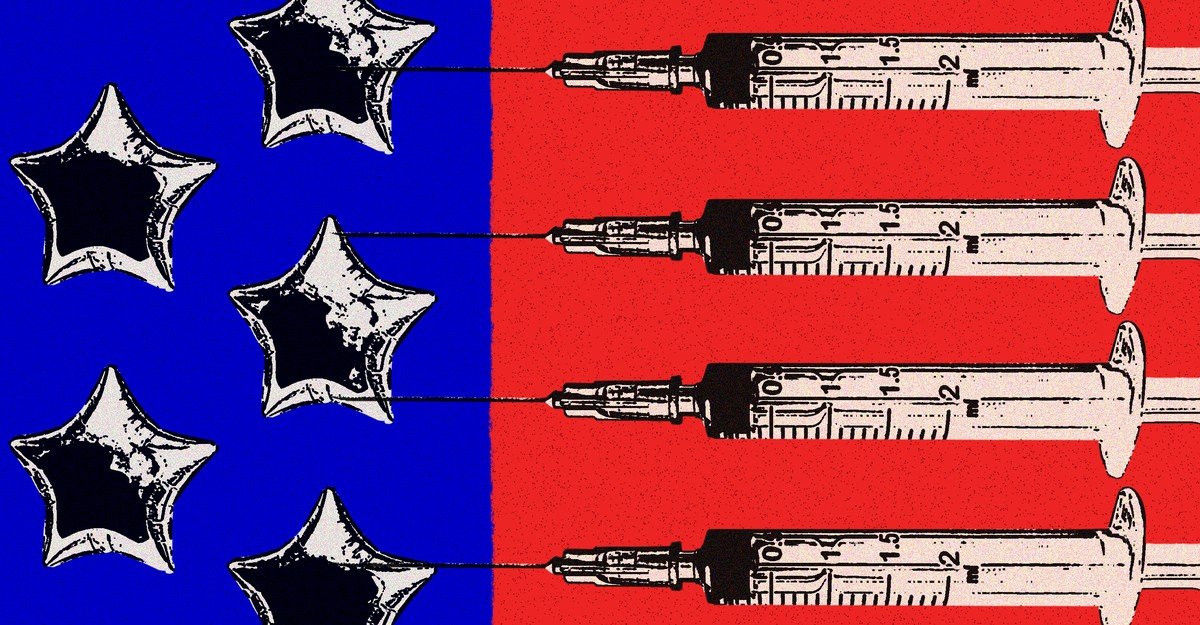
In the 2020s, we’re living through a second such transition: the dawning of the needle age.
For the past five years, the nation’s shots have multiplied to levels never seen before. Injected medications were once unusual, and mostly limited to diabetics who needed insulin. Now millions of diabetics use syringes of Ozempic, and millions of other people are on Mounjaro for weight loss. In 2025, some 12 percent of all U.S. adults partook of these injections or others in their class. GLP-1 shots were so commonplace last year that they accounted for about 7 percent of all prescriptions in America.
Even this is just the tip of the needle. Americans’ use of IVF has doubled in a decade, and now requires something on the order of 10 million to 20 million self-administered hormone shots a year. By 2024, 10 million rounds of Botox (or other wrinkle relaxants) were given out, along with 8 million filler treatments. Although some cosmetic shots are administered in doctors’ offices, many of the rest are received at the 10,000 “medical spas” that have lately come to dot the country. These are puncture parlors, more or less, and they offer a growing list of services: not just treatments for the skin but also vitamin injections, IV-dripped electrolytes, and minerals delivered through a tube. One needle-forward wellness chain, called JECT, has locations in Miami Beach, West Hollywood, the Hamptons, and, as it happens, right around the corner from my house in Brooklyn. If I were ever in the mood, I could head over for a “24K gold micro-dosing” process that will supposedly inject my face 2,400 times a minute.
These needle trend lines have been building for a while. Botox was approved for cosmetic use in 2002, and the first GLP-1-based drug for diabetes reached the market three years after that. But today’s rampant culture of injection did not have its breakthrough moment until early summer 2021, when the FDA signed off on semaglutide, the ingredient in Ozempic, as a treatment for obesity. That kicked off the weight-loss-medication craze. A month later, Joe Rogan told his millions of podcast listeners that injecting peptides—not insulin or Ozempic, but other, less established ones—can have miraculous results. Rogan said he’d tried one in particular called BPC-157, which cured his elbow tendinitis in two weeks. Peptide fever built from there, on glowing testimonials from tech bros, celebrities, and eventually officials at the highest levels of the U.S. government. “I’m a big fan of peptides; I’ve used them myself,” Health and Human Services Secretary Robert F. Kennedy Jr. told Rogan earlier this year. (RFK Jr. has also promised that regulators will soon be easing restrictions on the sale of peptides.)
The funny thing about our growing love for getting shots is how utterly at odds it is with human nature. Who, exactly, has any sort of love for getting shots? Needlephobia is natural and indeed appears to be widespread, even among grown-ups. Although formal research on the topic has been somewhat limited, a 2018 review of several dozen studies found that for adults under 40, the rate of needle fear may be as high as 30 percent. According to the same analysis, 16 percent may skip their flu shots simply to avoid the stress of an injection.
This last point in particular was worried over in summer 2021, just as our needle age was starting. New vaccines had been developed to reduce the risk of death from COVID-19, and experts worried that anxiety over needle sticks would hamper uptake. One paper out that June concluded that one-tenth of all COVID-vaccine hesitancy could be explained in just this way. Some people even called for a needle-fear exemption to be added to the mandates for vaccines.
And yet none of this posed a challenge to the rollout that ensued, which became without a doubt the largest mass injection effort in the nation’s history. By the end of 2021, more than half a billion doses of the COVID shots had been plunged into our deltoids. Let’s put that in “24K gold micro-dosing” terms: Americans received an average of 1,000 COVID shots a minute, every single minute of that year.
Yet a wariness about vaccines persists; perhaps it’s even grown, in certain quarters, since we started getting immunized against COVID. Jennifer Reich, a medical sociologist at the University of Colorado at Denver, has found that some people who refuse vaccines may indeed be hung up on the thought of a needle entering their body. But they aren’t simply squeamish; they’re worried by the fact that injections are unnatural, that a shot administers medicine in a way that isn’t right. “I would love it if they would put more research into edible vaccinations,” one mother told her, “so that it goes through the digestive system rather than directly—bang!—into the bloodstream.”
This framing of injection as a shortcut into people’s bodies conveys another meaning, too: It suggests that shots have greater potency and purity than other forms of medication. As a medical technology, the needle “plays in these contradictory ways,” Reich told me; what makes it scary also makes it strong. If you really want a given treatment, then you might prefer the needle version to a pill, so that it is delivered—bang!—into your bloodstream, where presumably it acts with greatest force. Inject that Botox straight into my wrinkles, please. Let me shoot this muscle-building peptide right into my butt.
In this way, America’s needlephilia and needlephobia are tightly coupled, both across the culture and among individuals. “There’s a huge overlap between people who sell the promise of wellness through alternative means and people who oppose vaccines,” Reich said. Indeed, this overlap has been a hallmark of the age of injections: The same person who might “stack” half a dozen experimental peptide injections into his weekly regimen may also end up saying no to a COVID booster; the same person who will pay $900 for microneedling with salmon sperm may refuse a hepatitis B shot for her newborn baby.
This isn’t quite a contradiction, though. People seem to draw a line between injections for the greater good and injections for their own well-being. When you’re given a vaccine, you’re participating in the work of public health, and hoping to stave off an illness that you may have never experienced and that may never pose a risk to you directly. When you take a dose of semaglutide, you’re engaged in private care, and expecting to optimize your own health, visibly and quickly. That difference is reflected in the hand that holds the needle: A vaccine gets put into your arm by someone else; most GLP-1 drugs are self-injected. (Oral formulations of GLP-1s for weight loss have become available in recent months.) “I think that sense of control over the mode of administration might be really important,” Reich said. The line between public health and private wellness also changes how the drugs are regulated: In the past two years the government has taken steps to raise the bar for demonstrating the safety of vaccines, while lowering it for peptides.
Reich told me that she thinks the needle is an emblem of a broader shift toward asking individuals to solve their own health problems. For some parents, even vaccines have been “recast as kind of an optimization technology,” she said; they tell her how they pick and choose among the recommended shots, asking whether and how each one might personally benefit their children. In this worldview, the vaccine schedule may not look that different from the menu of services at JECT.
Maybe this is where we’re headed next: injections as a vector for autonomy in medicine, vaccinations à la carte, home recipes for peptide shots, glucose sensors poking through your skin. This is health care in 2026. Welcome to the needle age.



