
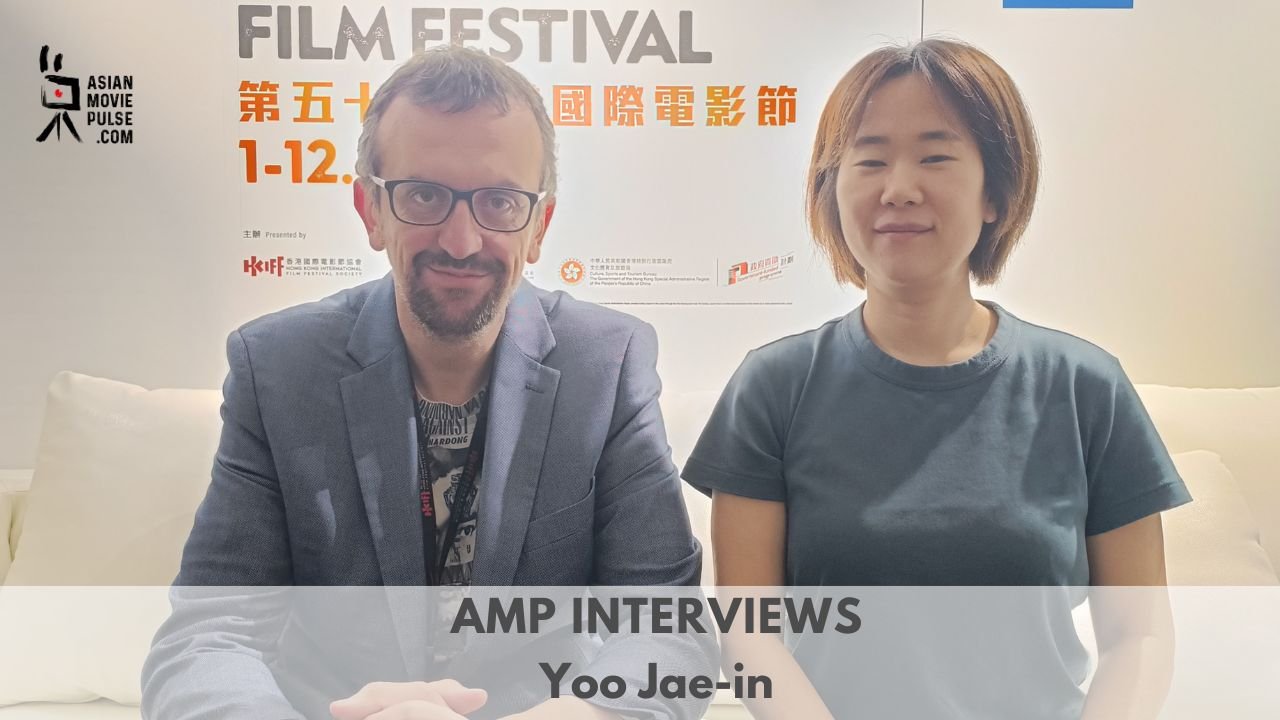
At this year’s Hong Kong International Film Festival, Korean director Yoo Jae-in presented her feature “En Route To,” a quiet yet emotionally charged story about two teenage girls whose bond is tested by pregnancy, abortion, and the lingering shadow of an inappropriate relationship with a teacher. Speaking after the screening, Yoo reflected on how the project grew from a graduation assignment into a fully realized work that is already traveling to international audiences.
Yoo developed “En Route To” at KFA Academy as her graduation project. Together with classmates and through a series of workshops, she spent about a year refining the story before moving into production. Once the script reached its final form, the team shot the movie over the course of a month, followed by six months of editing. The completed work premiered at the Busan International Film Festival, marking both her first major festival appearance and the start of the movie’s journey abroad.
The story opens with the absence of a teacher, a narrative choice that immediately creates unease in the classroom and among the teenagers. Yoo explains that she was less interested in spelling out the teacher’s psychology and more focused on the emotional impact of his disappearance. What matters to her is how the protagonist, Yun-ji, copes with the collapse of her first love and the consequences that follow. The teacher’s presence is felt in what he has left behind rather than through direct scenes or a fully mapped backstory.
“En Route To” engages directly with abortion, but Yoo is careful to resist easy judgments. She was developing the script at a time when debates around the Korean abortion law were highly visible, while the MeToo movement and sexual abuse scandals involving celebrities were dominating social media. These overlapping discussions made her think about the vulnerability of teenagers and the responsibility adults should bear. For Yoo, abortion is fundamentally a matter of choice that must be respected, whether a woman decides to terminate a pregnancy or to give birth. She emphasizes that what some observers dismiss as irresponsible choices should be seen instead as the outcome of a social environment in which responsibility is shared by the wider community, not carried by one individual girl.
The friendship between Yun-ji and Kyung-sun stands at the heart of the story. Yoo notes that both girls come from similar, imperfectly nurturing backgrounds, yet they respond to their circumstances in opposite ways. Yun-ji tends to protect herself by withdrawing and hiding her real feelings, erecting an emotional wall even when she most wants connection. Kyung-sun by contrast has learned how to move people in order to get what she wants, outwardly confident and assertive, often manipulating situations to her advantage. Despite this contrast, they understand each other deeply. Yun-ji knows how adept Kyung-sun is at steering others, while Kyung-sun can see through Yun-ji’s silence and read the emotions she never verbalizes. For Yoo, these two girls represent different strategies for surviving the same wounds.
As the story progresses, the dynamic between them becomes a journey of mutual transformation. Kyung sun begins to see Yun-ji’s struggle as if it were her own, especially as she confronts unresolved anger about her own birth and her mother’s decision to have her. Through Yun-ji’s choice and the way she faces it, Kyung-sun slowly opens herself to the world and softens her stance toward society and her own existence. Yoo views this progression as an essential part of adolescence, a painful yet necessary metamorphosis in which young people move from pure resentment or self-defense toward a more complex understanding of themselves and others.
Check the review of the film
One of the striking aspects of “En Route To” is the relative absence of men as central figures, even though their influence shapes the narrative. Yoo is frank that she did not want to devote much screen time to the teacher or to male perspectives. Part of this was a question of running time, but above all she wanted to keep the focus on a woman’s story: the dilemma of whether to become a mother, and the emotional interiority of the girls who must navigate that decision. The teacher’s feelings or motives are left largely off screen because, in her view, the core of the story is Yun-ji’s way of overcoming her first love and living with the consequences, not an inquiry into whether the teacher truly loved her or simply used her.
Casting was crucial in making the contrast between Yun-ji and Kyung-sun clear. Yoo first secured Lee Ji-won for the role of Kyung-sun. Having watched her work since she began acting as a child, Yoo admired her range and presence and was thrilled when the collaboration became possible. With Kyung-sun cast, she then needed a Yun-ji who would stand apart visually and energetically. Because the girls share the same school uniform, hair color, and ethnicity, there was a real risk that audiences might confuse them. Yoo wanted someone whose appearance and aura would signal a very different personality from Kyung-sun. Through the company representing the actress who plays the teacher’s wife, Jang San, she was introduced to Sim Su-bin, an inexperienced young performer for whom this was a first leading role in a long work. What convinced Yoo was how close Sim felt to her idea of Yun-ji and how instinctively the actress seemed to understand the character’s emotional world. Jang San, who plays the teacher’s wife, was an actress Yoo already admired from previous projects, making her an ideal fit to round out the adult side of the cast.
“En Route To” has so far screened on the festival circuit, including Busan and now Hong Kong, but has not yet opened in Korean cinemas. Yoo hopes for a domestic theatrical release later this year or next, though she is candid about the difficulties facing the national industry. In her view, large scale productions still struggle to secure investment and to fully recover, even as theaters attempt to return to pre-pandemic patterns. Paradoxically, this environment may create opportunities for smaller, independent projects, which can sometimes move more flexibly and find space in the market despite the pessimistic mood.
Looking ahead, Yoo does not yet have a fully formed new project but has a clear sense of the direction she wants to explore. Rather than staying centered on Seoul, she is drawn to smaller scale works set in other regions and even other countries, with an emphasis on emotional resonance rather than pure entertainment spectacle. She speaks of travel based stories that use changing landscapes and cityscapes to mirror inner transformation, an approach that also explains her affection for Hong Kong cinema. Among the titles she mentions is “Comrades Almost a Love Story,” a classic that embodies the mixture of romance, migration, and urban atmosphere she finds inspiring. In the wake of her debut, Yoo Jae-in seems poised to pursue stories that keep teenagers and women at the center, tracing how they come of age within societies still learning how to support their choices.



