
This article first appeared in South Jersey Climate News, a content-sharing partner of NJ Spotlight News.
Climate change is rooted in scientific data, not religious belief.
However, at a recent event, Dr. Elizabeth Cerceo, a professor of medicine at Cooper Medical School who researches health and environmental issues, made the case that science and faith can coexist.
Using a faith-based approach to tackling climate change, Cerceo emphasized the disproportionate impact that environmental hazards have on vulnerable populations. Cerceo said that the phrase “Everything is connected, and no one is saved alone” is her guiding principle.
“That’s what religion tells us as well, that we are all one body,” said Cerceo. “So in harming the world around us, we are quite literally harming ourselves. Whether we’re talking about extreme heat or air pollution or extreme weather events, extreme climate events, or plastics that are polluting the environment.”
In Catholicism, environmental care is a core imperative.
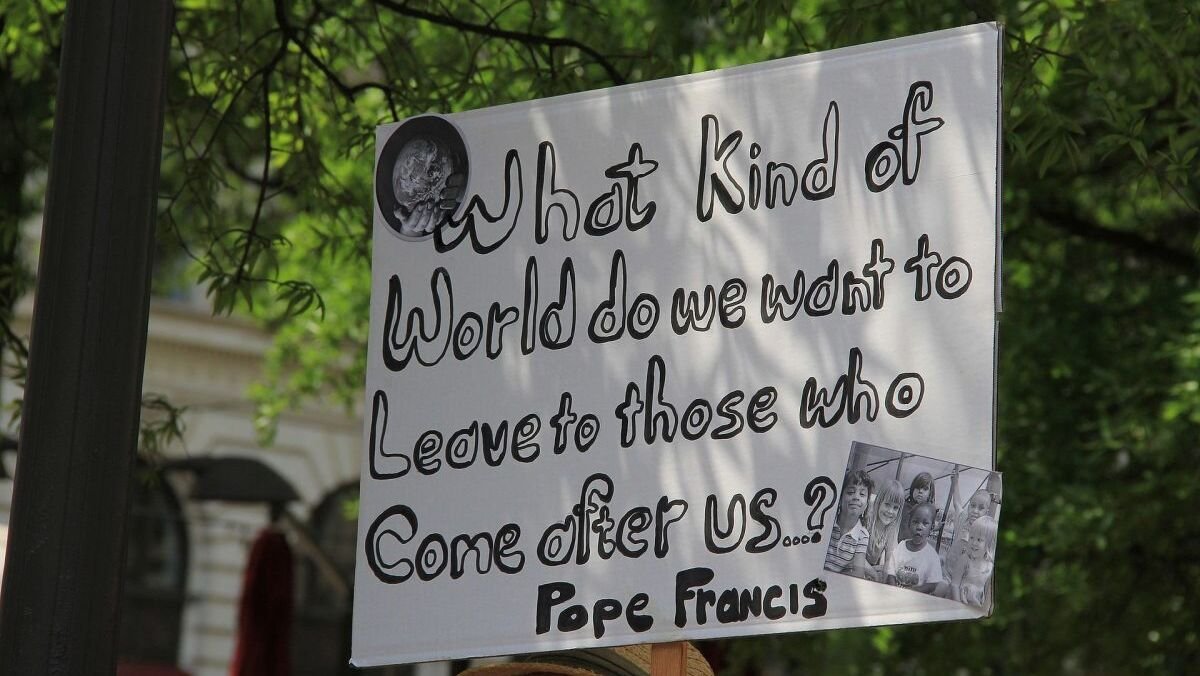
Pope Francis’ 2015 encyclical Laudato Si’ calls for urgent action, criticizing consumerism and promoting sustainable development to protect “our common home.” He criticized human’s harm to the environment.
“The Earth, our home, is beginning to look more and more like an immense pile of filth. In many parts of the planet, the elderly lament that once beautiful landscapes are now covered with rubbish,” Pope Francis said. “Never have we so hurt and mistreated our common home as we have in the last 200 years.”
In her presentation, Cerceo cited air pollution as a major threat to global health and prosperity. Air pollution, in all forms, is responsible for about eight to 14 million deaths annually. It’s also the cause of one in five premature deaths.
Polluted air contains particulate matter, which is a combination of a mix of tiny solid and liquid particles that are in the air people breathe. It can also contain harmful chemicals, gases, and smoke from nearby factories and power plants.
Exposure can cause cardiovascular and respiratory diseases. Risks increase for pregnant women, as air pollution can cause problems in utero or lead to stillbirth.
Polluted air is increasingly common in urban areas, especially in Central Asia, but it isn’t limited to just the Eastern nations. Cerceo cited a case of a 27-year-old woman dying from asthma in London.
Overwhelmingly, however, low-quality air affects impoverished areas. The World Health Organization reports 90% of these deaths are reported in these areas.
“Disease studies show that particulate matter air pollution is now the leading contributor to global disease burden, and that means it outstrips hypertension and diabetes and obesity and all of these other things that we know are bad for people,” Cerceo said.
Another key topic was extreme heat, which causes problems like dehydration and heat stroke, which has a high fatality rate. High temperatures can cause problems for people with chronic conditions and increase the spread of infectious diseases.
A study by the WHO 2000–2019 shows approximately 489,000 heat-related deaths occur each year, with 45% of these in Asia and 36% in Europe. As temperatures rise, so do costs. The Federation of American Scientists found that the combined effects of extreme heat cost the United States $162 million in 2024, equating to about 1% of our GDP.
The last topic Cerceo touched on was microplastics.
Humans ingest an estimated 39,000 to 100,000 microplastic particles annually — the equivalent of eating an entire credit card.
Particles can be found in food, air, and water. Health impacts include impaired cognitive function and respiratory and cardio issues.
“Microplastics are a huge environmental issue, and certainly only getting worse,” Cerceo said.
During her practice in New Jersey, she notices that all three of these issues affect lower classes disproportionately
“Where I treat patients in Camden is very different from where I live in a rather privileged Cherry Hill,” she said. “Where your zip code is can essentially determine your life expectancy.”
Through faith, Cerceo says people should look out for the poor.
 Credit: (Sarah Shockey/South Jersey Climate News)
She mentioned the Buddhist circles of compassion, which is a meditative and ethical practice aimed at expanding one’s empathy from oneself to loved ones, neutral people, enemies, and eventually all sentient beings. It reduces the “delusion” of separation, fostering connection, unity, and the alleviation of suffering.
This also appears in Christianity, in the teachings of Pope Francis. Cerceo said that there’s always a “way out,” relating that principle to climate change.
“Certainly, you know there’s a lot in the news everywhere about the impacts of climate change, but I don’t want to say that this is a story of doom and gloom,” she said. “Because I think it’s actually more than helpful because optimism tends to look at the world through rose colored glasses, and hope acknowledges the brokenness of the world. To see a path forward.”
“We can always redirect our steps, and we can always do something to solve our problems, and so that is how we, many of my colleagues, in climate health, approach this huge issue that we have.”
Pope Francis, in that same encyclical that criticized human destruction on Earth, echoed that same optimism.
“Yet all is not lost,” the pope declared. “Human beings, while capable of the worst, are also capable of rising above themselves, choosing again what is good, and making a new start.”



