
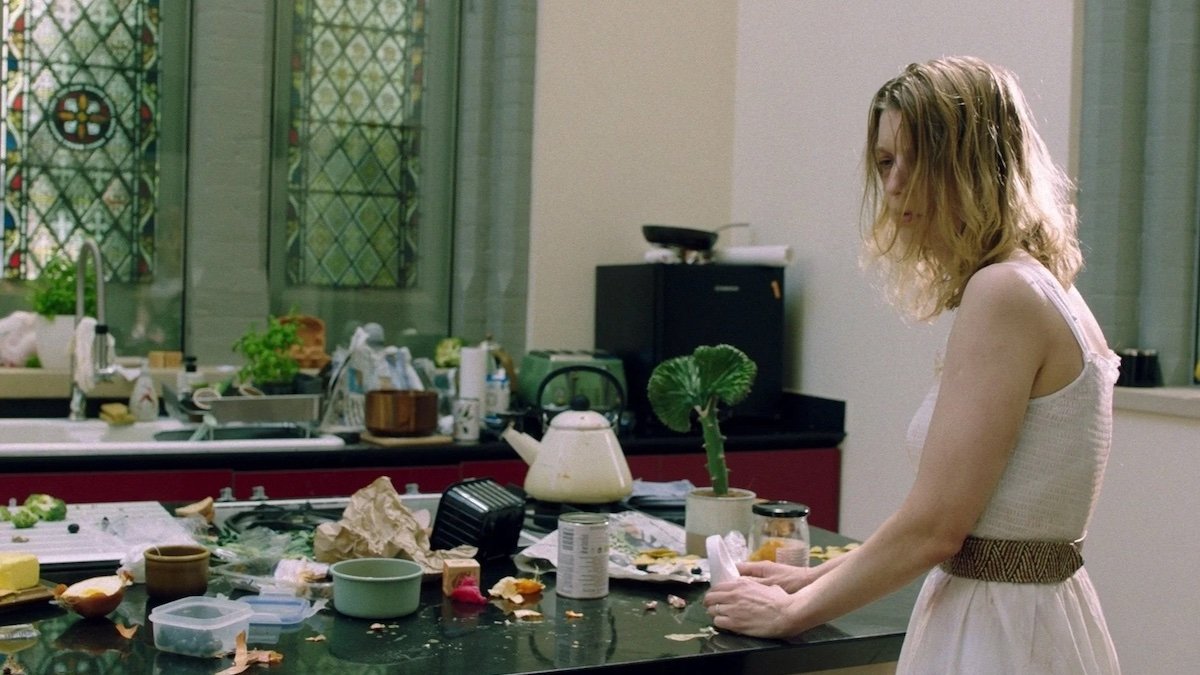
“Sleepeater” director Amrita Acharia notes that women are often assigned caregiver roles, whether they want them or not — they’re asked not just to care for children, but also for spouses, and aging parents.
The lead characters of “Sleepeater,” Ahri and Matilda (played by Jordan Alexandra and Amelia Clay), have no interest in caring for Ahri’s aging father (Emilio Doorgasingh). When he shows the slightest signs of fading, they have him committed and take over his modernist house, the house they’ve been working on together, and commit to raising their new child there.
Then guilt creeps in. And also a lot of slugs. Their idyllic existence is disrupted by a sleeplessness they never could have predicted.
The film plays today at the Poppy Jasper International Film Festival as part of LGBTQ Day. We talked with Acharia and her co-writer on the film, Max Krupski, about sleep, not worrying about whether your characters are likable, and finding a suitable substitute for slugs.
Amrita Acharia and Max Krupski on Making ‘Sleepeater’
MovieMaker: I love the title and did a little Googling — I see that sleep eating is a sleep disorder, similar to sleepwalking, where a person eats in their sleep, often without remembering it. But that isn’t the subject of the film — except perhaps metaphorically. Can you talk about how you arrived at the title?
Amrita Acharia: Both Max and I have had experience with insomnia and how it can affect your physical and mental state of mind. The title came before the story was fully developed, with the concept that Max came up with about two women in an endless cycle of sleeplessness. The story ties into the guilt eating away at the women alongside the paranoia that ensues and becomes more and more heightened throughout the film.
Max Krupski: Yeah, Amrita and I have lists and lists of isolated moments or images some of which we turn into fleshed out stories. For “Sleepeater” we kept coming back to the theme of guilt. Our character’s lack of sleep eats into their mental state and relationship uncontrollably. And so the title became both literal and metaphorical in this sense.
MovieMaker: Amitra, this is your second short film that deals with people who are contending with aging parents. In the first short, “Carer,” a daughter is overwhelmed by caring for her mother. In this film, a daughter (and her partner) reject that responsibility. Can you talk about why this subject intrigues you?
Amrita Acharia: Society generally places women in care-giving roles and takes that as a given, often regardless of circumstance. Taking “the best” choice can come with judgement, guilt and a sense of abandonment. With “Sleepeater,” the choice sets into motion sleeplessness — through a curse, guilt or however else the viewer may perceive it. Ultimately it’s less about specifically this subject matter and more about seeing women in “unpalatable” circumstances that can strike discomfort in the viewer.
MovieMaker: We’ve been trained, by watching past stories, to root for your leads, because they’re the kinds of characters we traditionally root for: They’re a couple who appear to be in love, and they’re mothers of a very young child. But almost as soon as we meet them, they do what seems like a callous thing when they send the elder father away and take over the house they’ve been working on with him, even though he doesn’t seem, at least on first impression, to need professional help. As things go dark for the women, we sympathize with their suffering — but also keep thinking about the poor man they’ve sent away. Can you talk about how you balanced making them sympathetic and unsympathetic, and how it helps the story?
Amrita Acharia: Max and I generally look for the most honest and human sides to our characters, and specifically choose not to shy away from showing the darker and less commercially “acceptable” parts of them, especially women. Rather than focusing on whether they are likeable or whether we can sympathise with them, our approach is make their actions and behaviors both relatable and questionable.
I don’t feel we need to root for them in order to relate or for the story to strike a chord or invoke a reaction from the viewer in some way. If there is a balance in how they are perceived as sympathetic or not, I think this would really come down to the viewer and how they personally relate to the characters and their situation — I believe this balance is found by rooting them in reality without fear of them being disliked.
Max Krupski: Sometimes people do bad things, that’s human nature. It’s what you do after you messed up which counts. We always said that if the couple could just find a moment of clarity in which they could communicate honestly, they would have been OK. But the guilt, manifesting in sleeplessness, isolates and ultimately dooms them.
MovieMaker: Amitra, you have a thriving acting career in addition to directing. But you haven’t, so far, acted in your films. Why do you prefer to keep them separated?
Amrita Acharia: Never say never, but at the stage I am at with exploring directing, I like to keep my focus on one job and be able to put my energy into that and do it as well as I possibly can without splitting my attention. That may change in the future, but for now I love keeping the creative output either in front or behind the camera!
MovieMaker: Finally, I’m very curious about the slugs in the film, which are extemely effective. Real? VFX? Who was in charge of slugs?
Amrita Acharia: The slugs were real but we used burnt liver for the smashed lightbulb shot! One of our art department, Naomi Battrick, was in charge of the live slugs, though we did have one that escaped whom she named Dora the Explorer.
The slugs are also a symbol of guilt/curse/paranoia, or in plain terms, the consequences of the choice eating away at life. They bridge the space between reality and nightmare. The film depicts a worm farm in the kitchen, a space of regeneration, which is infiltrated and invaded by slugs, that destroy worms and eat away at the remains of the farm.
“Sleepeater” plays today at the Poppy Jasper International Film Festival. You can read more of our festival coverage here.



