
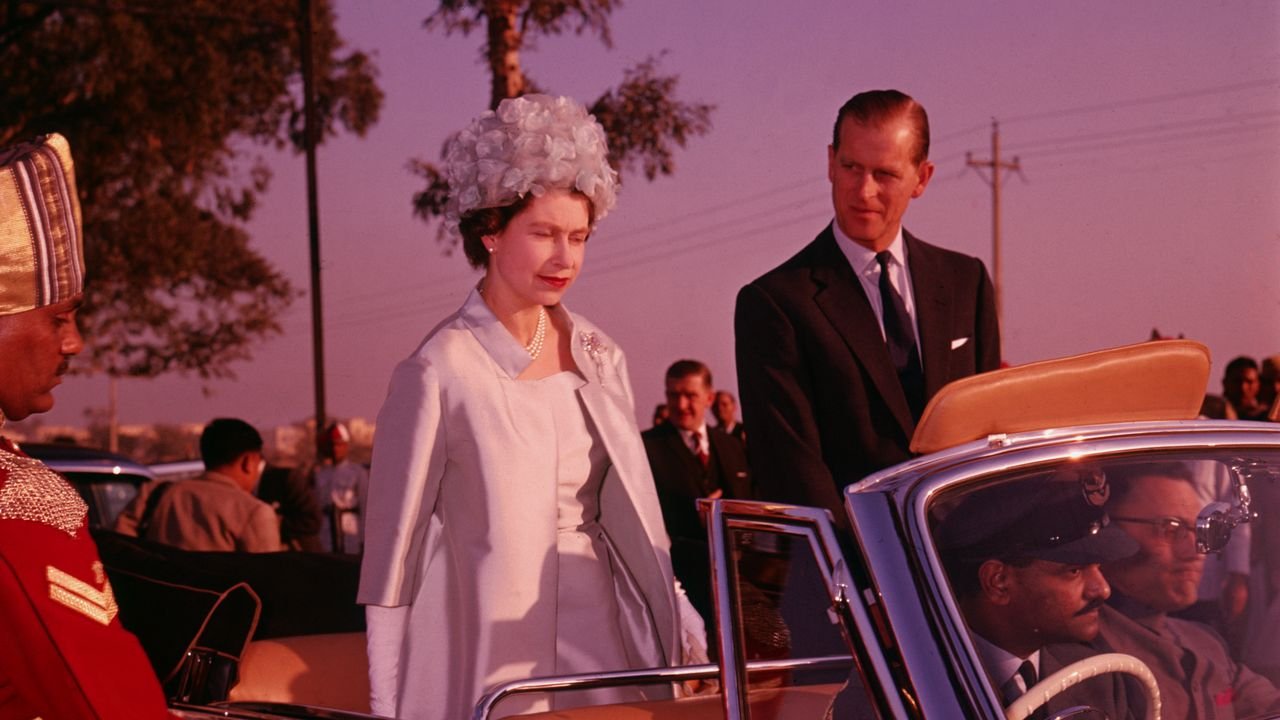
In early 1961, nine years after ascending to the throne of the United Kingdom, Queen Elizabeth II made her first visit as monarch to India and Pakistan, among other destinations. The trip had momentous political significance. Both populous nations had formerly been under British colonial rule and were now independent; the British government, led by Prime Minister Harold Macmillan, had an interest in maintaining good relations. In India, the Queen showed her appreciation for the country by touring the Taj Mahal and riding an elephant. In Pakistan, she was greeted by President Mohammad Ayub Khan, laid a wreath at the tomb of Mohammed Ali Jinnah, the nation’s founder, and attended a state dinner in Islamabad, the nation’s capital. For that event, the Queen’s dressmaker, Norman Hartnell, had fashioned a duchesse-satin evening gown which, seen from the front, was unadorned and almost entirely white but for its wide-set, kingfisher-green shoulder straps. Seen from behind, the gown descended into a waterfall drapery with overlapping layers of white and green satin—a tribute to the colors of the Pakistani flag. The design was an unspoken but unmistakable gesture of recognition and esteem: diplomacy in dress form.
There is only so much diplomacy a dress can be asked to do, of course: Queen Elizabeth II did not go to Islamabad with the goal, for example, of concluding a war that her government had ill-advisedly launched against a foe who was inconveniently failing to crumble. (Vice-President J. D. Vance, for his arrival in Islamabad on just such a mission this past weekend, wore the colors of his own flag: a blue suit, a white shirt, and a red tie, the unofficial uniform of the MAGA movement.) But the royal gown that the Queen wore in Pakistan is a vivid example of the kind of soft power that can be exerted by a head of state who is otherwise without executive or legislative potency, especially one who takes a keen interest in international affairs, as Elizabeth II clearly did. The year before her royal tour of South Asia, Charles de Gaulle, the French President, made his own state visit to London, and was impressed by the young Queen’s mind, coming to believe, as he wrote in his memoirs, “that she was well-informed about everything, that her judgments, on people and events, were as clear cut as they were thoughtful, that no one was more preoccupied by the cares and problems of our storm-tossed age.” Even Donald Trump, a democratically elected head of state who continually proves himself erratic and unaccountable on the diplomatic front, seems to be dazzled into docility by his encounters with the British Crown, in the person both of Queen Elizabeth II and of her heir, King Charles III, who will be making his own state visit to the U.S. later this month. The President’s attacks this week on the Pope notwithstanding, it seems safe to say that Charles is the international figure least at risk of being subject to a public berating or humiliation by the President, and is perhaps the one most likely to bring out the limited best in his volatile American counterpart. (No Kings, sure. But on the other hand, maybe Kings?)
Charles’s opportunities for sartorial diplomacy on his forthcoming American visit will be limited by his gender: white tie offers little opportunity for message-bearing customization. His mother, however, had command of a wide-ranging language of clothes. Roughly two hundred items from her wardrobe, many never before publicly displayed, are now on view in “The Queen’s Style,” a blockbuster exhibition that has just opened at the King’s Gallery in Buckingham Palace, in London. Her childhood is represented by a handful of garments, including the royal christening gown, first worn in 1841 for the christening of Queen Victoria’s eldest daughter. (It continued to be used for every royal baby until 2004.) Other important ceremonial garments are also on display, including the Queen’s wedding dress, from 1947, another Hartnell creation that incorporated not just the white rose of the House of York but also featured orange blossoms, a symbol of fertility. Her coronation gown, from 1953, once again designed by the indefatigable Hartnell, bore embroidered emblems of the four nations of the United Kingdom—the English rose, the Scottish thistle, the Welsh leek, and the shamrock of Northern Ireland—as well as of representative plants from various Commonwealth nations, including a lotus flower for India and a jute plant for Pakistan.



